
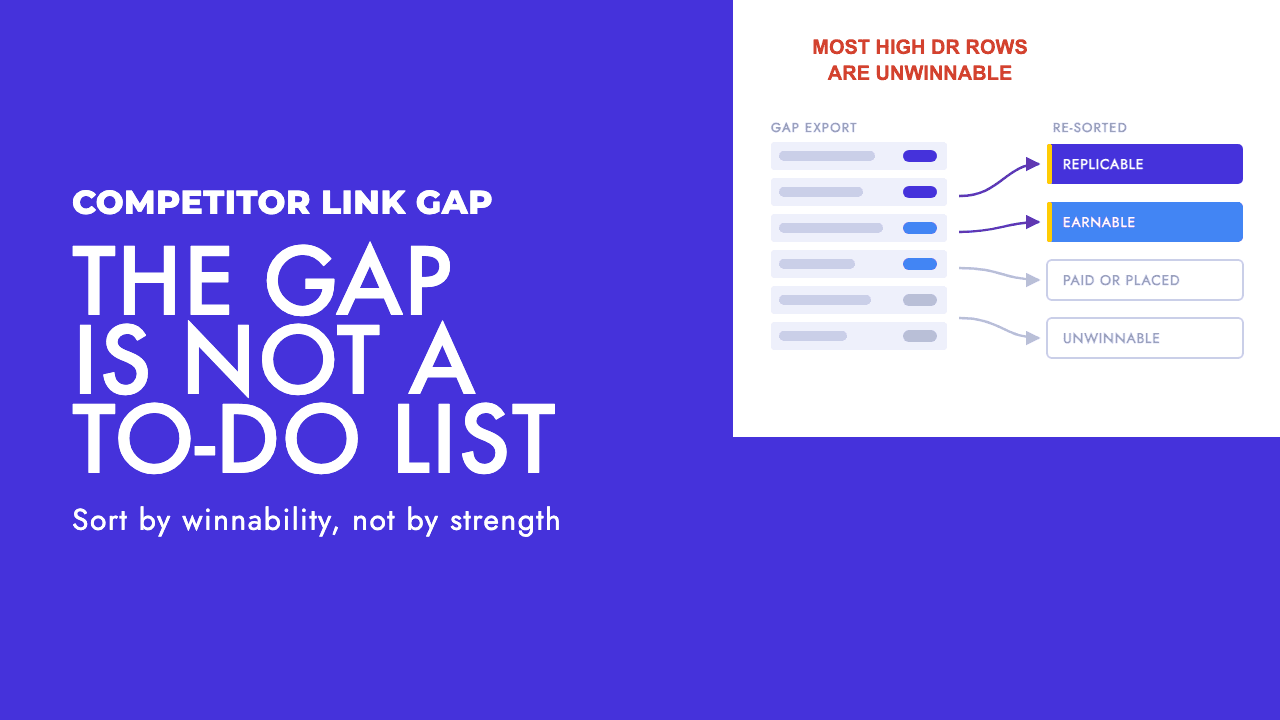
The gap report takes about four minutes to run. The export it hands back is a few hundred rows sorted by Domain Rating, and most of the top of that list is links you will never get.
That is not a failure of the tool. It is what happens when you sort by how strong a link is rather than by whether a business your size could earn it, and it is why so many gap analyses end as a spreadsheet nobody opens twice.
What the report actually does
Strip away the interface and a backlink gap analysis is a set difference. Take the referring domains pointing at competitors A, B and C, subtract the ones pointing at you, and what remains is the gap. There is no scoring model underneath, no judgement about relevance, no sense of how the link got there.
Ahrefs' version is Link Intersect, which shows the domains and pages that link to competitors but not to you, lets you enter up to 10 competitors, and runs at either referring domain or referring page level (Ahrefs help). Semrush's Backlink Gap compares the backlink profiles of up to five competing websites at once and returns referring domains rather than individual backlinks (Semrush knowledge base).
Neither tool claims the output is a prospect list. It is raw material. The interesting decisions happen before you press run and after you export.
Choosing the comparison set decides most of the value
This is where the exercise is won or lost, and it is the step almost everyone gets wrong by default.
The natural move is to type in the market leader. If you are a twelve-person accountancy firm in Limassol, you gap yourself against the biggest name on the island. The report comes back full of national press, a partnership announcement with a bank, a mention in a government consultation and a handful of university pages. Every one of those links is real. Not one of them is available to you.
Now run the same report against the firms one rung above you, the ones that were roughly where you are eighteen months ago. Their referring domains look different: a chamber of commerce member page, a sector association directory, a supplier's "clients we work with" page, a local awards shortlist, a resource page on a regional news site. These are links a business your size has provably earned, because a business your size earned them.
Same tool, same four minutes, completely different output. The first list tells you what dominance looks like. The second tells you what the next step looks like, which is the only thing you can act on.
The small-market version of this is sharper. A Cyprus business that gaps itself against UK or US competitors gets a list of American and British domains with no reason to link to a company in Limassol or Nicosia. The genuinely useful rows, the Cyprus business directories, the chambers, the local professional bodies, sit near the bottom because their authority scores are low. In a market this size the gap list is short, and that is fine. You work it by hand, which is how we approach it for the Cyprus businesses we work with.
Pick three to five comparison sites slightly ahead of you and accept a shorter list. You are trying to see what is reachable, not everything.
Running it, with or without a subscription
If you have Ahrefs, open Link Intersect, enter your domain as the site without the links and your comparison set as the sites with them. It is available on every subscription plan, so this is not a feature you need to upgrade for (Ahrefs help). Run it at referring domain level first. Page level is useful later, when you want to see exactly which article linked out.
If you have Semrush, the tabs matter. Best shows domains that point to all your competitors but not you, and Weak shows domains that link to you less than to them (Semrush knowledge base). Most people start on Best. Weak is often the better tab, because a domain that already links to you once has shown it will.
Without a subscription, you can do half the job. Google Search Console's Links report shows your top linking sites grouped by root domain, and although the on-screen tables are limited to 1,000 rows, you can export up to 100,000 (Google Search Console help). Google calls it a sample rather than a comprehensive list, so treat it as roughly right. Ahrefs Webmaster Tools gives you backlink data for sites you have verified, up to 1,000 backlinks at once (Ahrefs Webmaster Tools).
Both cover your own side only. Neither shows a competitor's unverified site, which is where the free route ends: pay for a month and cancel, or ask an agency that already pays.
The filters people apply, and the one they get wrong
Ahrefs' own guide to the exercise recommends sensible defaults: dofollow domains only, a minimum Domain Rating of 50 and a minimum domain traffic of 1,000, and priority for domains that link to more than one competitor (Ahrefs blog). The same guide says that even after filtering there will always be links your competitors get that are not relevant to your brand or industry, and that you need to open each domain and check it manually.
The dofollow filter and the multiple-competitor filter are fine. The manual review advice is correct and under-followed. The DR 50 floor is where I part company with them, at least for the readers of this post.
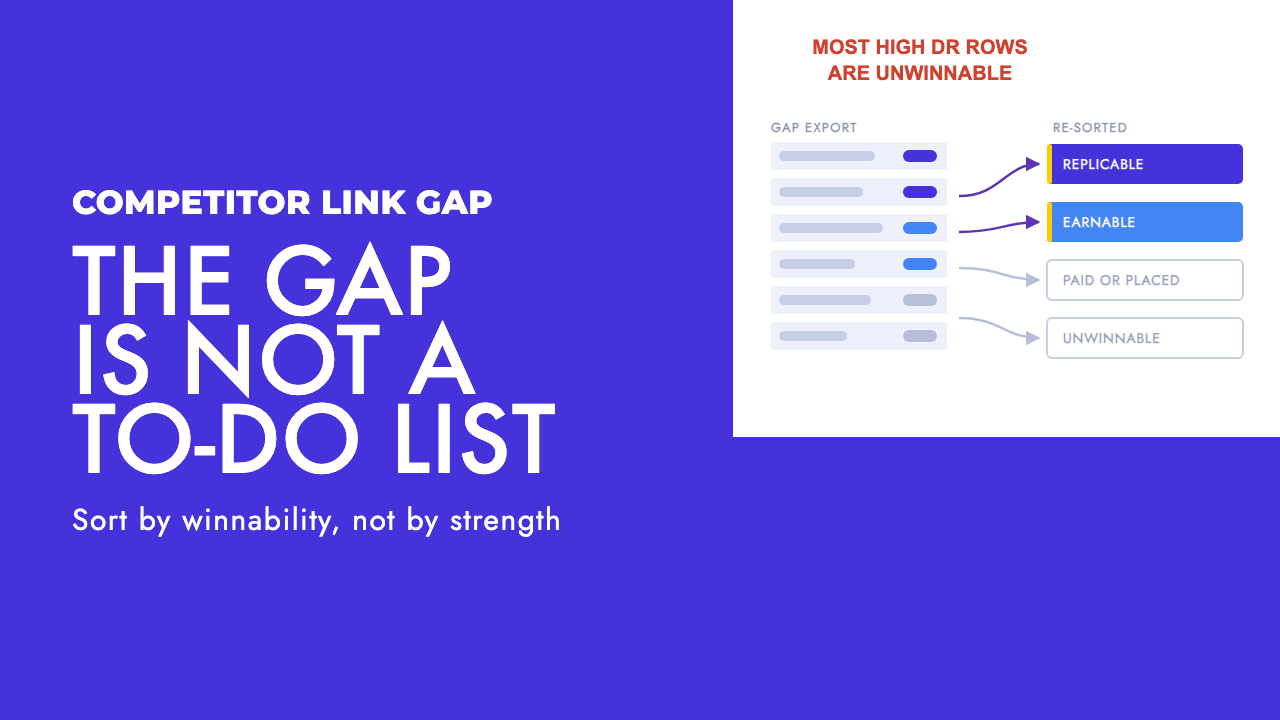
A DR threshold sorts the list by strength, not by winnability, and for a small business in a small market those two orderings are close to opposites. The strongest rows are almost always the least replicable: national coverage, a funding announcement, a university that mentioned a competitor in a research summary. The rows a twelve-person firm can actually convert, the chamber, the sector association, the regional directory, the supplier's client page, usually sit well below DR 50. That floor deletes every one of them and leaves you with a list of things to admire.
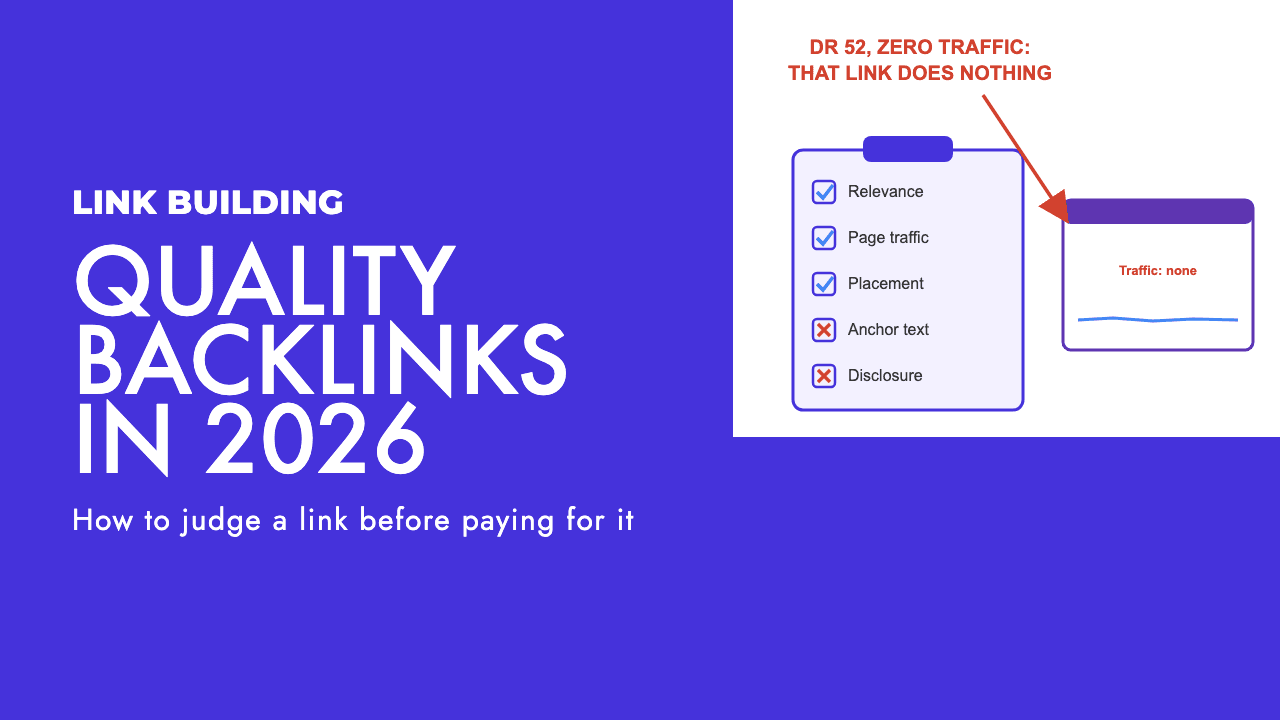
For a large brand with a PR function, Ahrefs' thresholds are reasonable. For the accountancy firm in Limassol, the dental clinic in Leeds or the SaaS company with eight employees, the useful filter is the reverse: hide the top and look hard at the middle. We wrote up what separates a link worth having from one that merely looks strong in what makes a good backlink. Use DR as a tiebreaker between two links you could plausibly get, not as a gate on which links you are allowed to look at.
Sorting the gap into buckets
Once the report is exported, the job is classification. Open each domain, look at the page that actually carries the competitor's link, and put it in one of four buckets. It is slow. It is also the whole point.
| Bucket | What the row looks like | What it is worth doing about it |
|---|---|---|
| Replicable listings | Business directories, chamber and association member pages, supplier or partner "who we work with" pages, awards shortlists, event sponsor lists | Apply, join or ask. These are the only rows where the answer is almost always yes if you qualify. Do them first and do them all. |
| Earnable with work | Resource pages, roundups, data or tool mentions, expert commentary in articles, links to a guide or calculator the competitor published | Work out what the competitor gave the linking site (a stat, a tool, a quote) and produce something at least as useful. Then pitch the specific page, not the domain. |
| Paid or placed | Advertorials, sponsored posts, guest posts on sites that publish anything, link inserts in old articles on unrelated topics | Leave them. Note the pattern as intelligence about what the competitor is spending, and move on. |
| Unwinnable | News coverage tied to an event, funding or acquisition announcements, a founder's personal connection, one-off mentions in national press | Accept them. They tell you how the competitor got where they are, not how you will. |
Two things surprise people the first time. The paid bucket is large: a meaningful chunk of almost any gap list is bought, and you learn the shape quickly (a lifestyle blog with a "business" category, a post nobody wanted to write, a commercial anchor pointing at a service page). And the first two buckets are small. In a small market you might end up with twenty or thirty rows across replicable and earnable. That is not a disappointing result. That is a list you can finish.
What not to do with the list
The gap report is also a map of what your competitors paid for, and the temptation is to buy the same placements. It is a bad trade under Google's current policies, and worth being specific about why.
Google's spam policies define link spam as creating links to or from a site primarily to manipulate search rankings, with listed examples including buying or selling links for ranking purposes, advertorials or native advertising where payment is received for articles that include links, and low-quality directory links (Google Search Central). Read that against your paid bucket and most of it is covered.
The rel guidance cuts the other way as well. In its July 2021 update on link tagging, Google said it still strongly recommends applying the appropriate rel values to sponsored and guest post links, and that when it detects sites engaging in either publishing or acquiring links with excessive sponsored and guest posting without proper link tags, algorithmic and manual actions may be applied (Google Search Central Blog). The exposure runs in both directions. The publisher who sold the link and the business that bought it are both named.
That leaves a trap. If the seller tags the link rel=sponsored as Google asks, you have paid for a placement that does not pass the value you were buying. If the seller does not tag it, you have bought something Google says it may act on. Neither version is the deal it looks like, which is the longer argument in should you buy backlinks.
One more thing to leave alone. Seeing a competitor's junk sends some people looking for their own, then reaching for the disavow tool. Google says in most cases it can work out which links to trust without guidance, calls disavow an advanced feature to be used with caution, and warns that used incorrectly it can harm your site's performance (Google Search Console help). Unless you have a manual action or bought links in bulk in a previous life, put it down.
Turning the shortlist into outreach a human answers
The first bucket barely needs outreach. Join the chamber, apply to the association, ask your suppliers whether their client page is current. The link is a by-product of a relationship that should exist anyway.
The second bucket is where outreach happens, and the gap report gives you an advantage most cold emails lack: you can see the exact page where the site linked to your competitor, so you know why.
Open that page. If it is a resource list, your email is short: here is a thing that belongs on this list, and here is why it is at least as useful as what you already have. If it is an article that quoted your competitor, offer a quote or a number nobody else has next time they cover the topic. If they linked to a competitor's calculator or dataset, build your own first, and make it better in a way you can describe in one sentence.
Write to a named person and reference the specific page. Ask for one thing. Mention the competitor's link only if it helps, never as a complaint. Follow up once, a week later, and stop.
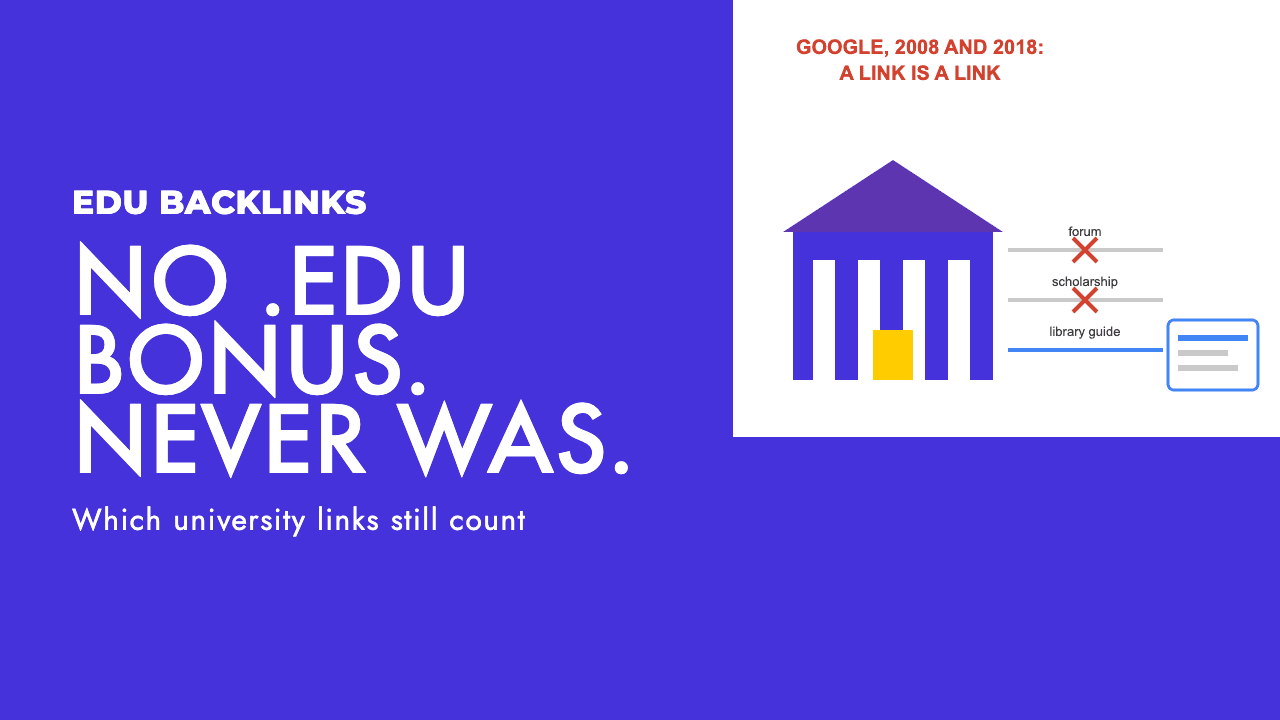
Universities, sector bodies and professional institutes have a higher bar, which we covered in how to get .edu backlinks. The short version applies everywhere: the link goes to the thing they wanted to reference, not to your service page.
And make sure the page you are pointing people at can hold the weight. There is no sense earning a resource page link to a guide that is orphaned inside your own site, which is one of the things an internal linking audit catches early.
What the gap report cannot tell you
A few honest limits, because the interface implies a precision it does not have.
It cannot tell you whether the link caused the ranking. A competitor with a hundred more referring domains may be ahead for reasons that have nothing to do with links. The report shows that they have more and that they are ahead, and leaves you to draw the line between the two.
It cannot tell you whether a domain is relevant to a business in Cyprus or the UK. An American marketing blog linking to a US competitor sits in the gap with a healthy DR, looking like an opportunity. It is not one. The tool does not know where your customers are.
It cannot tell you whether the link is still live, whether the page still exists, or whether the site has quietly become something else since the link was indexed. Every shortlisted row needs opening in a browser before it goes near an outreach list. Keep the list short and you will not want to skip that step.
Run the report against the right comparison set, sort it by winnability rather than strength, work the two buckets that are actually yours, and leave the rest. If you would rather have someone hand you a list that has already been opened, checked and classified, that is the shape of our backlink building service, and a free SEO review is the easiest way to find out whether links are your bottleneck in the first place.
Frequently asked questions
What is a backlink gap analysis?
It is a comparison of referring domains. You give a tool your site and a handful of competitors, and it returns the domains that link to them but not to you. Ahrefs calls it Link Intersect, Semrush calls it Backlink Gap. The mechanics are a set difference, nothing cleverer. The value comes from which competitors you pick and how you sort the output afterwards, not from the report itself.
Which competitors should I gap myself against?
The sites one rung above you, not the market leader. A small firm gapped against the dominant brand gets a list of news mentions, acquisition announcements and national placements it cannot replicate. Gapped against businesses that were where you are a year or two ago, the same tool returns directories, associations, supplier pages and resource lists that a business your size has provably earned. Same four minutes, different output.
Can I run a backlink gap analysis for free?
Half of it. Google Search Console's Links report and Ahrefs Webmaster Tools both give you your own referring domains at no cost, but neither shows a competitor's unverified site. The competitor side needs a paid Ahrefs or Semrush plan, or a one-month subscription you cancel after exporting. For a small market the gap list is short enough that a single month covers the whole exercise.
Should I copy the paid links my competitors have?
No. Google's spam policies list buying links for ranking purposes and advertorials that include links as link spam, and its 2021 guidance says algorithmic and manual actions may apply to sites acquiring links through excessive sponsored or guest posting without proper rel tags. If a placement is openly paid, it should carry rel=sponsored, which means it does not pass the value you were paying for. Spend the budget on the earnable rows instead.