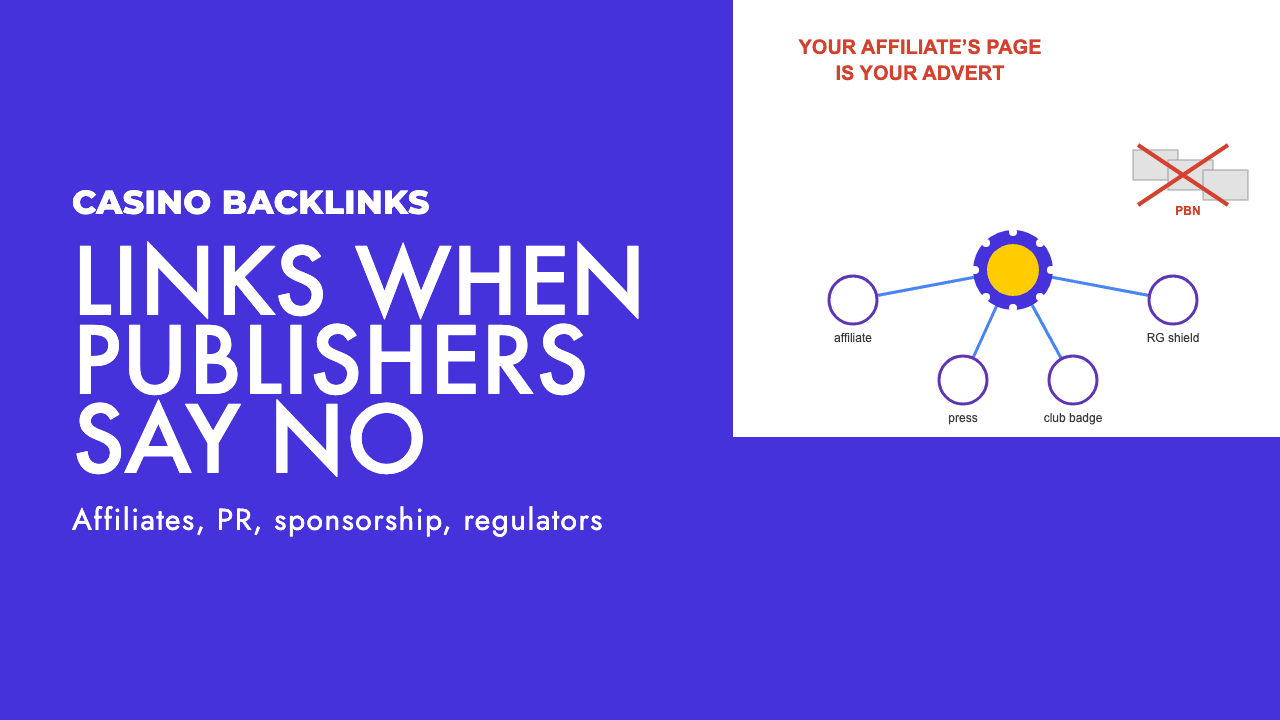
Most editors will not link to an online casino at any price. Not because they dislike you, but because their commercial policy, their ad network or their own legal team says no. That single fact shapes everything about casino backlinks: the good sources are scarce, so an entire grey economy of PBNs and "casino guest post" marketplaces exists to sell you the bad ones.
The operators that rank anyway are not the ones with the biggest link budget. They are the ones whose profiles look like a licensed business that people write about, and that is a buildable thing.
The market you are actually buying into
Search for casino link building and the results are mostly vendors: guest post lists sorted by DR, "niche edits" on sites you have never heard of, and PBN packages with prices per link.
Google's spam policies define link spam as links created "primarily for the purpose of manipulating search rankings" and list buying or selling links, excessive link exchanges, and text links that do not block ranking credit as examples. Paid links are fine when marked nofollow or sponsored, which is precisely what the marketplace links are not.
The thing people in this vertical misread in 2026 is the spam updates. The August 2026 spam update ran from 18 to 21 August and Google confirmed it did not target link spam (Search Engine Roundtable). That does not mean bought links are safe. It means link spam is handled continuously and separately, so surviving a named update tells you nothing about your link profile. In our experience the named updates land on the content side of this vertical: programmatic affiliate sites, scaled AI reviews, thin comparison pages. If those are the sites linking to you, your link graph is thinning whether or not Google touched you directly.
Then on 28 August Google changed its site reputation abuse enforcement. From 30 August, a manual action for hosting third-party content still hits the affected section for users outside the EEA, but inside the EEA there is no ranking penalty; instead Google may separate the section so it ranks on its own merits, and its own example was that "casino content ranks against other casino content" (Search Engine Journal). Read that as a description of the casino subfolder on a European news site: it will not be penalised, and it will not borrow the newspaper's authority either.
Four regulators, one principle: you own your affiliates' marketing
Before you place a single link, know who is liable for what the page says. In every major jurisdiction, the answer is the operator.
| Regulator | What it says about third-party and affiliate marketing | What that means for links |
|---|---|---|
| UK Gambling Commission | LCCP condition 1.1.2: "Licensees are responsible for the actions of third parties with whom they contract", contracts must bind them to the same codes, and licensees must be able to terminate them promptly (UKGC) | Every page that links to you with a promotional claim is an ad you are answerable for |
| Malta Gaming Authority | Adverts must comply with the Gaming Commercial Communications Regulations (S.L. 583.09), showing licensee name, licence number, minimum age and responsible gaming information, and the same applies on social media (MGA) | An affiliate review missing your licence number is a non-compliant advert |
| Curaçao Gaming Authority | The LOK, approved by parliament on 17 December 2024, ended the master and sub-licence system; operators need a direct licence and have had to reapply (iGB) | "Curaçao licensed" now means something specific. Affiliates showing a sub-licence seal are showing an expired credential |
| Cyprus National Betting Authority | Only sports betting is licensable online; online casino games are prohibited (CMS). The advertising code applies to licensees and to anyone contracted for "any aspect related to the licence", requires a link to responsiblegaming.gov.cy in all advertising, and bans youth-team sponsorship and venue renaming (NBA draft code, February 2025) | A Cyprus-facing casino page is illegal marketing regardless of where the link came from. Betting brands here need affiliates who carry the responsible gaming link |
We build link plans for iGaming clients around that table, because the fastest way to lose a licence is a stack of affiliate pages promising "guaranteed wins" that nobody on your side ever read.
What a real casino link profile looks like
Pull the referring domains of any operator that has held top-three rankings in a regulated market for more than a year and the composition is predictable. Not in numbers, which vary wildly by market, but in kind.
| Link source | Share of the profile | How it got there |
|---|---|---|
| Affiliate and comparison sites | The majority of referring domains | Commercial deals, listings, reviews |
| National and trade press | A small number of high-authority domains | Company news, data stories, regulatory coverage |
| Sponsorship pages | Clubs, leagues, esports teams, events | Partnership announcements, partner pages |
| Regulator and licence listings | A handful, but the most trusted | Licence registers, approved-operator lists |
| Responsible gambling and treatment organisations | Few, but topically strong | Support pages, tool listings, funding acknowledgements |
| Game studios and platform providers | Dozens of industry domains | "Now live at" announcements, partner pages |
| Forums, Reddit, review platforms | Mostly nofollow | Community presence, which matters more for AI search visibility than for PageRank |
What is missing from that list is the guest post on a lifestyle blog whose only casino content is your article. Real profiles contain almost none of those. Manufactured profiles are mostly those.
Affiliates: the main source, and how placement is actually earned
Affiliate sites are where the volume is, and they are also the most relevant links a casino can get. They rank for the exact queries you want, they link to operators by design, and their referrals convert.
Most operators treat affiliate acquisition as a pure commercial negotiation: revenue share, CPA, hybrid. That gets you listed. It does not get you the top slot, the editorial mention, or the link on the pages that actually rank, because an affiliate's placement decision is increasingly a compliance decision as much as a revenue one.
Think about what a UK or Malta-facing affiliate needs to defend. The operator is liable for the affiliate's page, and the affiliate knows operators are being told to drop partners who create risk. So the operators that get preferential placement are the ones that make the affiliate's page easy to keep compliant.
What we ask clients to have ready before any affiliate outreach:
- A partner page with licence numbers per market, current logos, and the responsible gaming lines each regulator requires, so the affiliate can copy rather than improvise.
- Bonus terms that survive a comparison with the affiliate's own summary. Mismatched terms are the most common thing enforcement notices cite.
- A named compliance contact who answers within a day. Affiliates rank operators on this informally, and it shows up in placement.
- A reason to be reviewed: a market launch, a new licence, an exclusive game, a payments feature. "Please add us to your list" gets you added to the bottom of the list.
Do not confuse this with buying "casino guest posts". A review on an affiliate site that discloses its commercial relationship and is maintained by a team that will lose its own operator deals if it misleads users is a different asset from a spun article on a site that exists to sell links.
Data-led digital PR that non-gambling publishers will cover
Here is the workaround for publishers who refuse gambling links: give them a story that is not about gambling.
Operators sit on data that sports desks, business desks and consumer journalists want and cannot get elsewhere. Which fixtures drive the most betting interest by region. What a season ticket costs against a betting slip over a season. How odds moved around a managerial sacking. The story is about football, or money, or behaviour. The operator is the source.
The rules of the game in this vertical:
- The angle cannot be a promotion. A journalist covering your data is not advertising your bonus, and the moment the release reads like one it is dead. It also drags the coverage into advertising rules it was never meant to be under.
- Keep youth appeal out of it. Building a story around a teenage footballer's popularity is the fastest way to turn a data piece into a regulatory complaint.
- Pick the desk, not the publication. Sports and business editors will run a betting-data story about the market. Gambling editors will run it about you. Only the first gets you a link from a domain that is not already in your profile.
- Expect the link to go to the study page, and build a study page that deserves it. The same asset does a second job in AI search, where a named, citable source is what gets an operator mentioned at all.
This is the same play we run for crypto exchanges, another category most publishers will not link to on request: the data earns the coverage, and the brand rides along.
Sponsorships: still a link source, with new limits
Sponsorship links are editorial by nature. A club's partner page, a league's announcement, a team's roster of backers. The catch is that the space available is shrinking and the disclosure rules are tightening.
In the Premier League, clubs agreed to withdraw gambling sponsors from the front of matchday shirts from the 2026/27 season, with sleeves and pitchside hoardings still permitted (Sky Sports).
Esports opened at the same time football closed. In June 2025 Riot Games allowed betting sponsors for Tier 1 League of Legends and VALORANT teams in the Americas and EMEA, with partners vetted by Riot, required to use its GRID data feed, and kept off Riot's own broadcasts and team jerseys (Riot Games). That gives you a partner page and a press cycle, but not a logo on the stream.
In Cyprus, the NBA's draft code bans sponsoring any team or championship where most participants are under 18, bans renaming clubs or venues to include a betting brand, and requires licensees to publish a quarterly statement of sponsorship and advertising spend.
On the Google side, a sponsorship link is a paid relationship. Ask for rel="sponsored" on the partner page and stop worrying about it. The value of a club sponsorship was never the followed link; it is the coverage, the branded search and the entity association, and none of that needs a link attribute.
Responsible gambling content as a linkable asset
Every regulator in the table above requires responsible gambling messaging, and most operators treat it as a compliance page nobody reads. That wastes the one topic where universities, treatment charities, journalists and public bodies will link to a gambling company without hesitation.
The difference between the compliance page and the asset is whether it does something. A properly built deposit and session limit explainer, a self-assessment tool, an honest write-up of how your affordability checks work, a published record of what you fund, and clear links to national services. Researchers cite that. Local press covers a treatment charity partnership. Regulators list operators that go beyond the minimum.
Nobody should do this for links, and it will not work if that is the only reason. But if you are going to spend on responsible gambling anyway, spend it in a way that is publishable.
What to avoid, and what the 2026 updates actually hit
| Tactic | Why it fails |
|---|---|
| PBNs sold as "casino networks" | Public networks are mapped. Buying links to manipulate rankings is link spam under Google's policy, and enforcement is continuous, not tied to named updates |
| Hacked or injected links | Hacked content is a spam policy violation. Links on compromised .edu and .gov pages are ignored at best and evidence at worst |
| Spun or AI-scaled casino blogs | Scaled content abuse is a named spam policy and the kind of site the 2026 updates keep hitting. If a vendor's sample site reads like a template, it is one; our AI text detector is a quick sanity check before you pay |
| Casino subfolders on news sites | Site reputation abuse. Manual actions outside the EEA; separated ranking inside it from 30 August 2026, so the host's authority no longer transfers |
| Link exchanges between operators | "Excessive link exchanges" is named in Google's link spam examples. Also a bad look to a regulator reviewing your affiliates |
| Expired-domain 301s | Redirecting a dead sports site into a casino is the pattern Google's systems were built to catch |
| Affiliates promising outcomes | "Guaranteed wins", "risk-free": your licence, your fine |
Notice the shape of the 2026 damage. The named updates went after content and explicitly left link spam alone. For a casino that means two things: the cheap affiliate sites linking to you are losing their own visibility, so your link graph is decaying, and any link spam consequences will arrive without a status-dashboard announcement to blame them on.
Where to start
If you inherit a casino site with an unknown link history, the order is: audit the profile for the tactics in the last table, check every linking affiliate page against the rules of the markets you hold licences in, and only then start building. Multilingual operators should also fix the hreflang setup on their casino sites before earning links to pages Google is serving to the wrong country. Crypto casinos carry a second layer of platform rules on top, which we cover under crypto SEO.
That is the work our backlink building and iGaming SEO teams do together, and a free SEO review will tell you which of the three steps you are actually at.
Frequently asked questions
Are casino backlinks legal?
Links themselves are not regulated, but the marketing around them is. The UK Gambling Commission holds the licensed operator responsible for contracted third parties, the Malta Gaming Authority applies its advertising regulations wherever an advert runs, and Cyprus's National Betting Authority applies its advertising code to anyone contracted by a licensee. A paid placement that breaks advertising rules is the operator's problem, not just the publisher's.
Do PBN links still work for casino sites?
They can move rankings for a while, which is why the trade persists, but buying links to manipulate rankings is link spam under Google's policies and the networks sold openly as casino PBNs are the easiest ones for Google to map. Google's August 2026 spam update did not target link spam, so a site that survived it has not been cleared. Link spam enforcement runs continuously.
What is the best source of casino backlinks?
Affiliate and comparison sites, by volume and by relevance. They exist to link to operators, they already rank for the queries you care about, and their referrals convert. Earning placement means giving them a licence, terms and payouts they can defend to their own regulator, not paying for a review. Data-led PR and sponsorships fill in the non-gambling domains.