
Search for local link building and most of what comes back is a list of directories to submit your business to. Google's spam policy names "low-quality directory or bookmark site links" as an example of link spam. That is the whole genre summarised in two sentences.
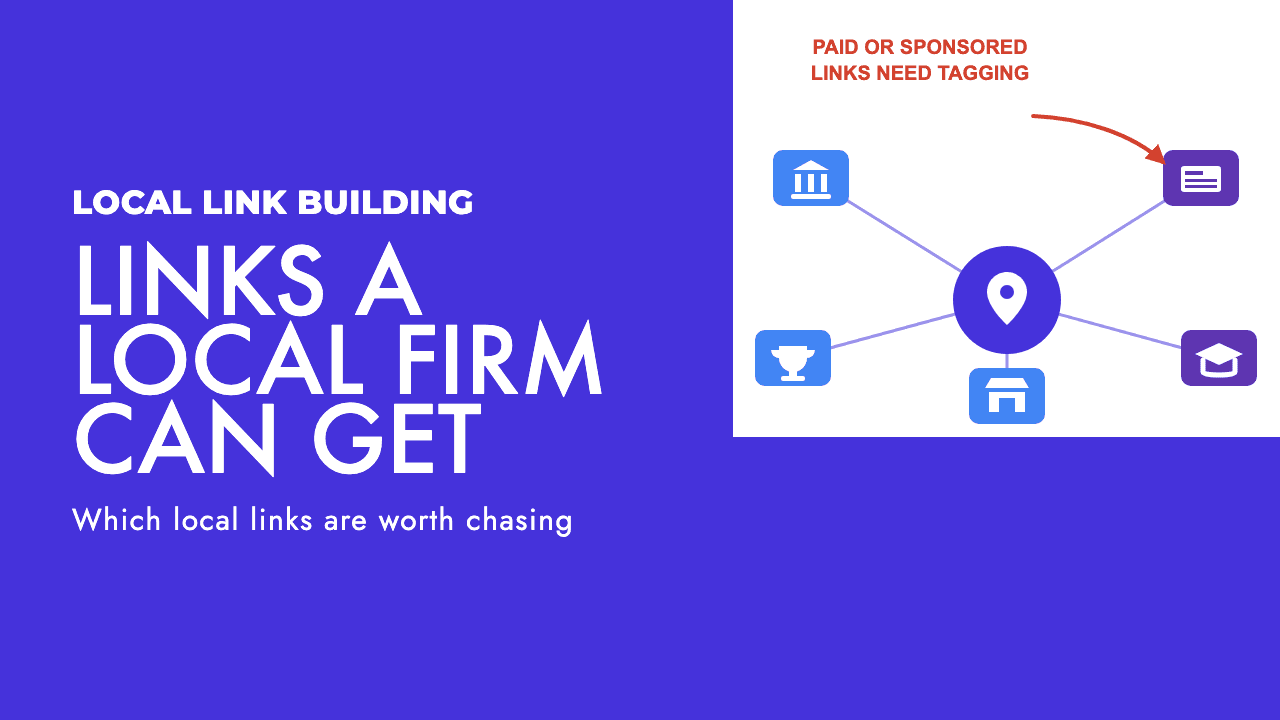
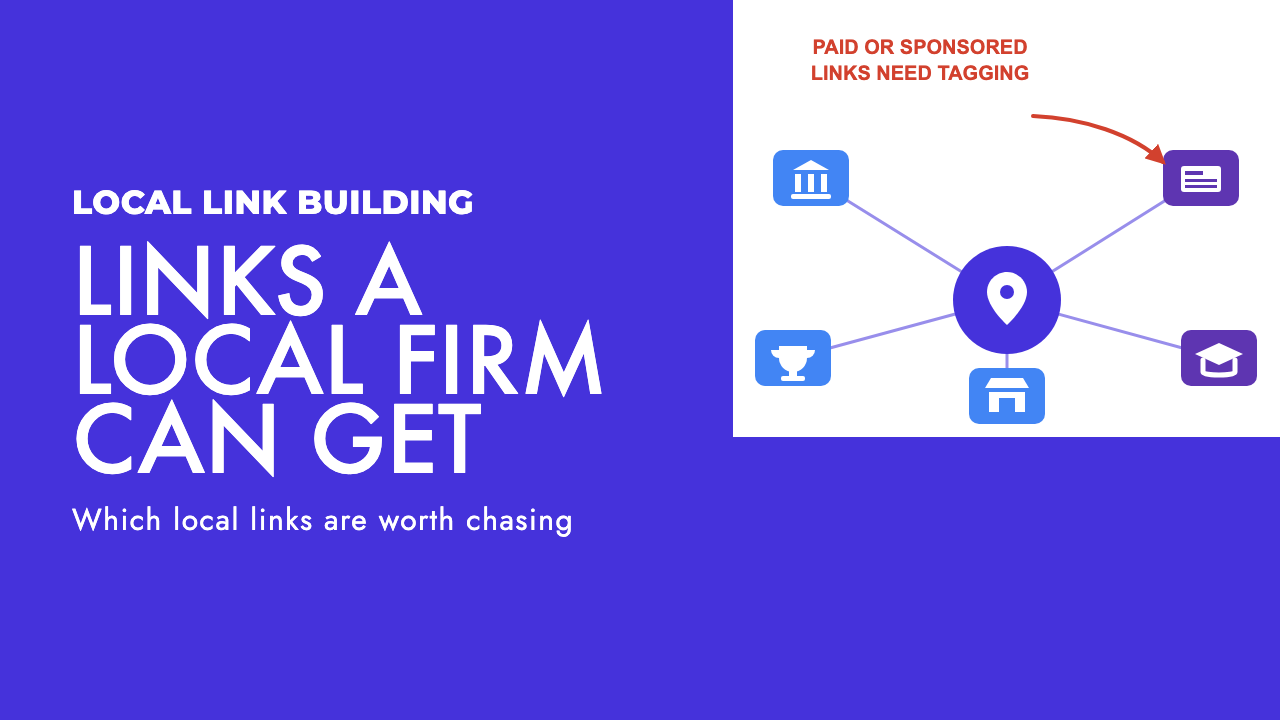
The useful version of this topic is narrower and more boring. A local link is worth chasing only if the page it sits on exists for a reason other than linking out, and if a real person might plausibly arrive on that page. Apply that test and the source list collapses to a handful: memberships, sponsorships, local press with an actual story, suppliers and partners, local institutions, and events you are genuinely part of.
What Google actually says a local link does
Google's explanation of local ranking lists three factors: relevance, distance and prominence. Prominence is the one that links touch. Google describes it as "how well-known a business is" and says the factor is "also based on info like how many websites link to your business and how many reviews you have" (Google Business Profile Help).
The older phrasing still quoted in agency decks, about "links, articles and directories", is not what the page says today; the word directories does not appear on it. And the sentence is about websites linking to your business, the entity, in the same breath as review count.
Hold that against what Google's Gary Illyes said at SERP Conf in Bulgaria in April 2024: "We need very few links to rank pages" and "Over the years we've made links less important" (Search Engine Journal). He later said on X that he should not have said it.
Take both at face value. Links still count, they count less than they did, and a dentist competing in one city is not in an arms race with anyone. Ten links a human would click beat two hundred nobody will.
The test to apply before you chase any local link
Two questions, asked about the page the link would sit on. Would a human plausibly land on this page for a reason other than the link? And does the page exist to serve someone?
A chamber's member register passes: members use it to find a supplier. A football club's sponsors page passes: fans see it. A "Top 50 plumbers in Limassol" page on a site that also has top 50 plumbers in every other town fails, and so does a directory whose only visitors are other businesses submitting themselves.
The test also answers the question everyone asks first, whether the link is followed. If a person lands on the page and clicks, you have a referral and a citation regardless of the rel attribute. If nobody lands on it, a followed link is a weak signal from a page Google has little reason to trust. The broader argument is in what makes a backlink good.
Where local links actually come from
Here is the honest list. Read the effort column first.
| Source | How you actually get it | Typically followed or nofollow | Effort |
|---|---|---|---|
| Chamber of commerce or trade association membership | Pay the fee, complete the member profile properly, turn up to something | Varies by platform, often nofollow | Low once paid, but the fee recurs |
| Local sponsorship (sports club, festival, charity event) | Pay or supply goods, ask for a link on the sponsors page, ask for rel="sponsored" | Should be sponsored or nofollow. Often untagged in practice | Medium: money, plus a markup conversation nobody at the club wants |
| Local press with a story | Have something newsworthy, pitch the named journalist, accept the link may not appear | Varies by publisher | High. You need a story, and a press release is not one |
| Suppliers and partners | Ask to be listed as a stockist, installer, approved partner or case study | Usually followed | Low to medium. One email, if the relationship is real |
| Local institutions (schools, colleges, councils, charities) | Give them something to publish about: placements, a talk, a donated service | Varies, often followed | Medium to high, and slow |
| Event listings and speaking | Speak at or host a local event so the organiser's page lists you | Varies | Medium. You have to show up |
| Industry bodies and accreditation schemes | Earn the accreditation and appear in the find-a-member register | Varies, often nofollow | Medium. Real criteria, real fees, real value beyond the link |
Every row is a page that would exist whether or not you were on it. That is the point.
Memberships and chambers: worth it, for the wrong reason
The British Chambers of Commerce describes "over 51 accredited UK Chambers" operating in "over 75 international markets worldwide", and runs a postcode-based finder so you can locate yours (British Chambers of Commerce). If you run a UK business there is a chamber with a member register for your area. Cyprus has the equivalent layer: chambers of commerce by district, plus sector associations for hoteliers, contractors, dental and legal professionals, most of which publish a member list.
Most of those member pages are nofollow, and people who paid expecting a ranking signal feel cheated when they look at the source code.
Our position is that the nofollow is fine. You are not buying a ranking signal. You are getting a citation of your business, with its correct name, address and website, on a page that real people in your town use to find a supplier, and one Google can use to corroborate what your Business Profile says. If the membership is worth having for the networking and the register alone, join. If it is only worth having for the link, it is not worth having.
Multi-location businesses: join the chamber where each branch actually is and point each listing at that branch's page, which is the structure set out in local SEO for multiple locations.
Sponsorship is a paid link, so tag it
This is where most small businesses quietly break a rule without knowing there is one.
Google defines link spam as "the practice of creating links to or from a site primarily for the purpose of manipulating search rankings", and its first example is "Buying or selling links for ranking purposes" (Google Search Central). Buying includes exchanging goods or services. A shirt sponsorship with a link on the club's site, a charity gala sponsors page, a "local partner" page you paid for: each is a link in exchange for money or goods.
Google also says this is allowed when the link is qualified: "It's not a violation of our policies to have such links as long as they are qualified" with a rel="nofollow" or rel="sponsored" attribute. The outbound links documentation uses sponsored for advertisements or paid placements and nofollow "when other values don't apply", and says links carrying either "will generally not be followed" (Google Search Central).
If you have been buying "local guest posts", read Google's 2021 link tagging post, which said that for guest posts "we still strongly recommend that site owners apply the appropriate rel values to these links", and that excessive sponsored or guest posting without proper tags may lead to "algorithmic and manual actions" (Google Search Central Blog).
You cannot control the other site's markup; the club's webmaster is a volunteer with a day job. So the honest position is: you sponsor the under-12s because the parents on the touchline are your customers, and you ask for rel="sponsored" when the link goes up. If they do not add it, you asked, and the value was always the audience rather than the equity.
Buying "sponsorship" from sites whose only product is the followed link is buying backlinks with a charity logo on top, and it carries the same risk.
What local press will actually cover
Regional newsrooms are small and need stories that fit their patch. A press release announcing your new website is not one.
Small businesses have more genuine stories than they think:
- You opened, moved or expanded: a new premises, a second branch, taking over a shop people already know.
- You are hiring in numbers that mean something in your town.
- You hold a local data point nobody else has. A dental practice knows where its new patients travel from. A hotel knows how the season's bookings compare with last year.
- A seasonal problem you can comment on with authority: a plumber in a cold snap, a Cyprus hotelier on how the season is shaping up.
- A sponsorship of something people care about, which gives the paper a photograph.
Pitch it to the named journalist who covers business or your area. Two short paragraphs, a usable photo, a phone number, and no mention of links at all. If the piece runs with your name and your town and no link, you still reached the readers it was for, and the next link from that paper gets easier.
Citations are a separate job from links
A citation is your business name, address and phone number appearing on another website, with or without a link. It gets lumped in with link building because both happen on other people's sites. They are different jobs with different budgets.
Google's Business Profile guidelines are the reference. Your name "should reflect your business's real-world name, as used consistently on your storefront". "Including unnecessary information in your business name isn't permitted" and it can lead to suspension. On location: "Use a precise, accurate address and/or service area to describe your business location", and "P.O. boxes or mailboxes located at remote locations aren't acceptable". The summary line is to "Represent your business as it's consistently represented and recognized in the real world" (Google Business Profile Help).
Consistency is the whole job. If the profile says one name, the chamber listing adds a town and a keyword, and your footer uses the limited company name, you have three entities where you wanted one.
On your own site, the markup should agree with the profile. Google's LocalBusiness structured data, a subtype of Organization, requires name and address. Recommended properties include url, telephone, geo, openingHoursSpecification and priceRange, and the url "must be a working link" (Google Search Central).
This matters for the link work because Google's prominence wording counts websites linking to your business, the entity. If the entity is fuzzy, you are earning links into a confused record. Do the citation clean-up first: it is cheaper, mostly one-off, and it makes every link you earn afterwards count towards the right thing. Our local SEO work treats citations and links as two line items for exactly that reason.
Anchor text and where the link should point
Google can generally crawl a link only if it is an <a> element with an href attribute, and it describes good anchor text as "descriptive, reasonably concise, and relevant" to both pages. Generic text like "click here" or "read more" is discouraged (Google Search Central).
You rarely control a local link's anchor text, and your business name is a fine anchor anyway. What you do control is the URL you give people.
Stop sending every local link to the homepage. If you have a location page for Larnaca, or a service page for emergency callouts, and the page linking to you is about Larnaca or emergency callouts, hand over that URL. Your homepage already has every internal link on your site pointing at it. The location page is the one that is starved.
What to stop doing
Google's spam policy examples cover most of what passes for local link building. Alongside the directory example, it names "Excessive link exchanges ("Link to me and I'll link to you") or partner pages exclusively for the sake of cross-linking" (Google Search Central).
- Bulk directory submissions. Beyond the few registers your customers actually use, stop.
- Reciprocal swaps with every business in town. A "local partners" page that exists to cross-link is named in the policy almost word for word.
- Paid "local guest post" packages. A post about your town on a site nobody in your town reads, with an untagged followed link, is the case the 2021 post warns about.
- A monthly link target. If Google needs very few links to rank a page, a number on a spreadsheet pushes you towards whatever is easiest to acquire.
If you have already done some of this, do not plan a disavow clean-up. Google calls the tool "an advanced feature" to be "used with caution", says it "can assess which links to trust without additional guidance", and tells you to disavow only when you have "a considerable number of spammy, artificial, or low-quality links" that have caused, or are likely to cause, a manual action (Google Search Console Help). Stop acquiring the problem rather than budgeting to tidy it up later.
What is left is a short list of unglamorous pages your customers already use, a few tagged sponsorships you would have done anyway, and the occasional story a local paper wants. For a business competing in one place, that is enough. If you want someone to map which of those are open to you and do the asking, that is what our backlink building service covers, and a free SEO review is the fastest way to see where your citations and links currently stand.
Frequently asked questions
Are directory submissions still worth doing for local link building?
A handful, yes. The directories your customers genuinely open, such as a chamber member register or an accreditation body's find-a-member page, are real citations on pages people use. Bulk submission to general directories is a different activity. Google's spam policy names low-quality directory and bookmark site links as an example of link spam, so the test is whether a human would plausibly land on the page, not how many you can submit to.
Does a nofollow link from a chamber of commerce or trade association help local SEO?
Treat it as a citation rather than a ranking signal. Google says links with nofollow or sponsored attributes will generally not be followed, so you are not buying equity. You are getting your correct business name, address and website on a page that real people in your area use to find suppliers, and that page can corroborate what your Business Profile says. If the membership is only worth having for the link, skip it.
Is a local sponsorship link against Google's rules?
Only if it is untagged. Google defines buying or selling links for ranking purposes as link spam, and a sponsorship that produces a link is money or goods exchanged for a link. Google says such links are fine as long as they carry a rel=sponsored or rel=nofollow attribute. Ask the club or charity to add it, and treat the sponsorship as audience and brand spend rather than a link equity purchase, because you often cannot control their markup.
What is the difference between local citations and local link building?
A citation is your business name, address and phone number appearing on another site, with or without a link. Link building is earning hyperlinks that point to your pages. They support each other, since Google's prominence factor counts how many websites link to your business, but they are different jobs. Citation clean-up is a one-off audit with light maintenance. Link acquisition is slow and continuous. Budget them as separate line items.