
On 22 July 2026 Alphabet raised its capital spending guidance for the year to as much as $205 billion, and its shares fell on the news. A week later Meta, Microsoft and Amazon reported, and between them the four now plan something in the region of $720 to $745 billion of capex in 2026.
That money is not abstract if you sell anything that people find through search. It is buying the servers that generate the AI answer above your listing, the ad units that will sit inside that answer, and the agents that will soon book the hotel room without visiting the hotel's website. This post puts the 2026 figures in one table and then works through what each of them does to a business that depends on being found.
The money, in one table
| Who | What | Amount | Date | Source |
|---|---|---|---|---|
| Alphabet | 2026 capex guidance, raised from $180 to 190bn; Q2 capex $44.9bn | $195 to 205bn | 22 July 2026 | Investing.com on the Q2 release |
| Microsoft | Calendar 2026 capex, restated from $190bn after a change to asset useful-life accounting; Q4 FY26 capex $41bn | about $175bn | 29 July 2026 | Investing.com on the Q4 FY26 release |
| Amazon | 2026 capex indicated on the Q2 call, up from about $200bn, citing memory costs | about $220bn | 30 July 2026 | UncoverAlpha earnings summary |
| Meta | 2026 capex guidance, narrowed from $125 to 145bn; Q2 capex $31.1bn | $130 to 145bn | 29 July 2026 | Meta investor relations |
| OpenAI | Funding round announced at $110bn, $730bn pre-money, Amazon $50bn, Nvidia and SoftBank $30bn each | $110bn | 27 February 2026 | TechCrunch |
| OpenAI | Round closed at $122bn and $852bn post-money; confidential IPO filing followed on 8 June 2026 | $852bn valuation | 31 March 2026 | Sacra |
| Anthropic | Series H, $965bn post-money, run-rate revenue past $47bn | $65bn | 28 May 2026 | Anthropic |
| Perplexity | Last priced round, $200m at $20bn | $20bn valuation | 11 September 2025 | Yahoo Finance |
| Perplexity | Reported talks with Nvidia at a valuation above $30bn, unconfirmed by either company | $30bn+ (reported) | 23 August 2026 | PYMNTS citing The Information |
| Worldwide AI spending, all categories | Gartner forecast, up 47% on 2025, with AI infrastructure over 45% of the total | $2.59 trillion | 19 May 2026 | CIO Dive on the Gartner forecast |
Two caveats on the table. Amazon does not issue formal full-year capex guidance the way Alphabet and Meta do, so its figure is the number management pointed to on the call rather than a published range. And the Gartner number is a forecast of everything from chips to consulting, built from vendor revenue projections, so treat it as a scale marker, not a measurement.
Google has not put a separate price on AI Overviews or AI Mode. The closest it comes is the capex line, which management said is mostly servers and data centres, and the comment on the Q2 call that AI Mode has passed a billion monthly users while the cost to generate each response keeps falling. Read those together and the strategy is obvious: spend to make the answer cheap enough to give away at Google's scale.
What the capex actually buys
Most of this money is inference capacity: serving billions of AI answers a day is where the servers go, which is why capex keeps rising even as models get cheaper per token.
For search, that changes the economics of the results page. A blue link costs Google almost nothing to serve. An AI answer costs real compute, so Google has to make the answer pay, through ads or by keeping you in the session long enough to show ads later.
Alphabet's Q2 numbers suggest the promise is being kept so far. Search and other revenue grew 17% to $63.3 billion, and Cloud grew 82%, according to the same release. That is not a company being disrupted by AI answers. It is a company charging for them twice, once to advertisers and once to the businesses renting the same chips.
Subsidised answers with no clicks
Here is the uncomfortable part for anyone whose funnel starts with a click.
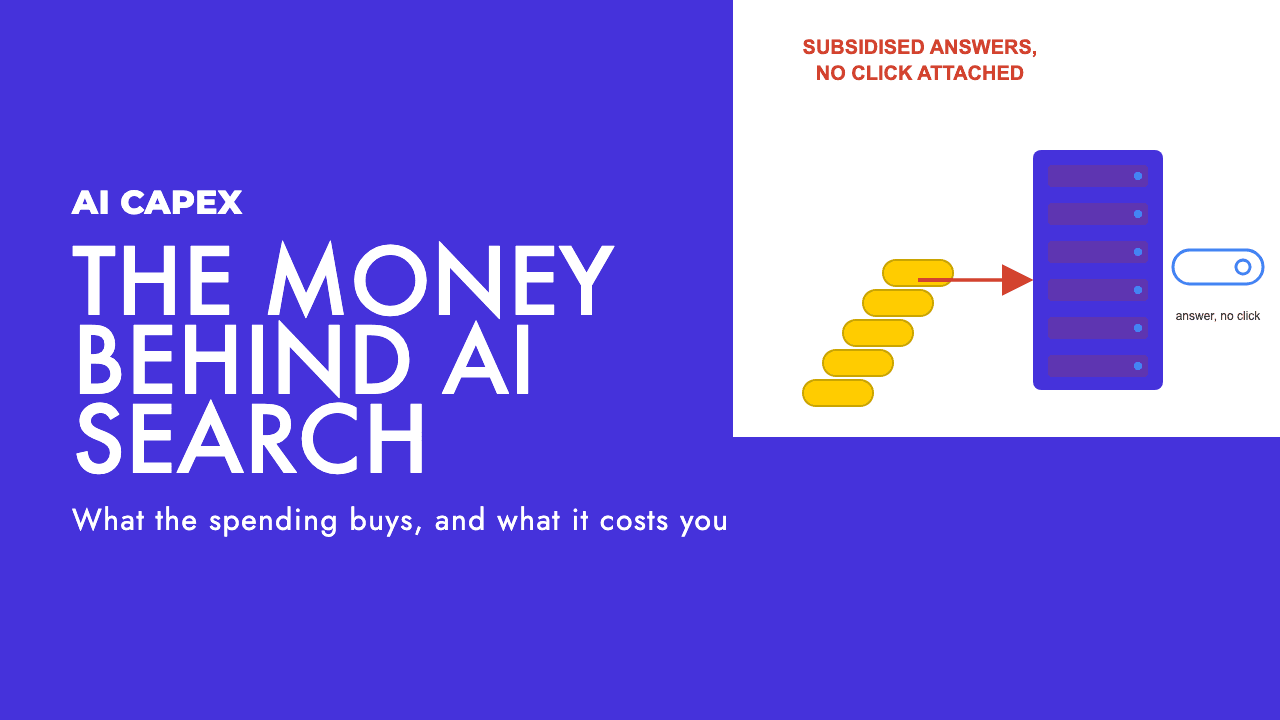
A subsidised answer is one where the platform absorbs the cost of answering so the user does not have to leave. Every dollar of that $725 billion lowers the marginal cost of doing that, and the platforms have every incentive to do more of it. The behaviour is already visible in the data: more Google searches end without a click each year, and only a small minority of ChatGPT answers contain a link at all. We keep the current figures, with dates and sources, in our AI search market share post.
The investment makes that trend structural rather than cyclical. Nobody spends $200 billion on servers to send users elsewhere. The plan is to answer, to keep the session, and to monetise the session.
For a business that means the value of a page is increasingly whether it gets used in an answer, not whether it gets visited. The free traffic you built a model around is a cost the platforms are now willing to pay to remove. Plan as though the click is the exception.
Ads are coming to the answers, unevenly
The other thing the money buys is a new ad surface, and the rollout is a country-by-country map worth reading closely.
Google's own ads help documentation says ads can appear above, below or within AI Overviews. Above and below is live in all 200-plus markets where AI Overviews exist. Within the overview is limited to English in twelve countries, the US, Canada, Australia, India and a group of Asian and African markets among them. At the European AI Mode launch, Google's ads VP said ads were not available inside AI Overviews or AI Mode in the EU while the format was still being tested.
OpenAI moved faster than most expected. According to Lengow's rollout summary, ChatGPT ads started as a US pilot for Free and Go plan users on 9 February 2026, a self-serve Ads Manager with click bidding opened on 5 May, product feed management arrived on 2 June, and the UK became the first European market on 6 June. Early CPMs were reported around $60 in the US and $30 in the UK.
So if you are in the UK or the US, the AI answer is already a paid surface and your competitors can buy their way into it. If you are in Cyprus or anywhere else in the EU, the answer is still organic-only at the top, which is a temporary advantage for the businesses that get cited and a temporary blind spot for everyone waiting for the ad option. Our Google Ads team is already running campaigns with AI Max and Performance Max for UK clients precisely because those are the campaign types that can enter AI Mode when it opens.
Agents that book without visiting your website
The third thing this money buys is the part that changes who your customer actually is.
On 27 August 2026 Google added hotel booking inside AI Mode, US only in English, with ten partners including Booking.com, Expedia, Hilton, Marriott and IHG. Payment runs through Google Pay, the hotel or platform stays the merchant of record, and the user never opens the hotel's site. Agentic restaurant booking had reached the UK on 10 April 2026 with eight reservation platforms.
This is a preview of what happens when the answer engine has enough compute to act, not only to summarise. For a hotel or an online shop, the customer becomes the agent, and the agent reads structured data, feeds and partner APIs rather than your homepage. The businesses that will be bookable are the ones whose availability, pricing and attributes are machine-readable and, increasingly, the ones on a partner list. We went into the mechanics in our post on agentic commerce and shopping agents.
This is the most under-prepared area we see in audits. Firms have spent two years worrying about AI-generated content and almost none on whether an agent can read their prices.
The cost of being invisible to models
There is a quieter implication of $2.59 trillion of AI spending: the model's view of the world is becoming the customer's view of the world, and being absent from it has a price that does not show up in any analytics report.
When an assistant recommends three accountants in Limassol from memory and you are not one of them, no impression is recorded. You do not lose a click, you lose a consideration. In our experience this is the failure mode clients feel most and can diagnose least, because every dashboard they own reports on sessions that happened.
The remedy is not a plugin. It is being the kind of business that gets named: consistent entity information across the web, real reviews, third-party mentions in places models read, and answer-shaped pages on the questions your buyers ask. That is a content and authority job, which is why our AI search optimisation work leans on content strategy and technical SEO rather than a separate bag of tricks.
How much of this is a bubble
Some of it, according to people whose job is to worry about that, and it is worth being precise about what they said.
The Bank of England's July 2026 Financial Stability Report said valuations had become more stretched, flagged "unprecedented" AI investment increasingly funded through credit markets, and modelled a hypothetical sharp correction in AI stocks that could take as much as 2.2 percentage points off UK GDP. The IMF's Kristalina Georgieva had already warned in October 2025 that valuations were heading toward the levels seen in the internet bubble 25 years ago and that conditions could "turn abruptly".
You can see the same nervousness in the market's reactions above. Alphabet fell on the day it raised capex guidance. Microsoft's restated $175 billion came with an accounting change that flatters the number. Perplexity's next round exists, so far, only in a report citing unnamed sources.
Our read is that the bubble question is about share prices, not about whether AI answers go away. If there is a correction, what gets repriced is the equity. The data centres, the models and the habits of a billion monthly AI Mode users do not get un-built, any more than the fibre laid in 1999 got dug up in 2001. The dotcom crash did not give the Yellow Pages its customers back.
So some of the money will be lost. That is not a reason to wait, because the infrastructure being overbuilt is the one your customers will use either way.
What a business should do about it
Direct answer: treat the capex as a forecast of the SERP, and plan for a results page that answers, sells and books.
| The money says | What to do this quarter |
|---|---|
| Answers are getting cheaper to give away | Measure citations and branded search alongside clicks, and stop reporting rankings on their own |
| Ads are entering the answer, UK and US first | If you sell in the UK or US, run broad match, AI Max or Performance Max so you are eligible; if you sell in Cyprus, get cited now while the top of the page is still organic |
| Agents will transact on your behalf | Get product, price, availability and location data into structured formats and feeds an agent can read, and check which partner programmes matter in your sector |
| Models recommend from memory | Fix entity consistency, earn third-party mentions, and publish on the questions buyers actually ask |
| Some of the money will be lost | Keep the direct channels you own, and do not sign long contracts with tools whose only pitch is the bubble |
None of this requires predicting which company wins. They all read the same web and they all reward a business that is easy to identify, easy to trust and easy for a machine to transact with.
If you want to know where your site stands on those three, that is what our website audits look at, and a free SEO review will tell you which of the five rows above is the one costing you most right now.