
Habit and trust are not the same thing, and 2026 is the year the difference started costing brands money.
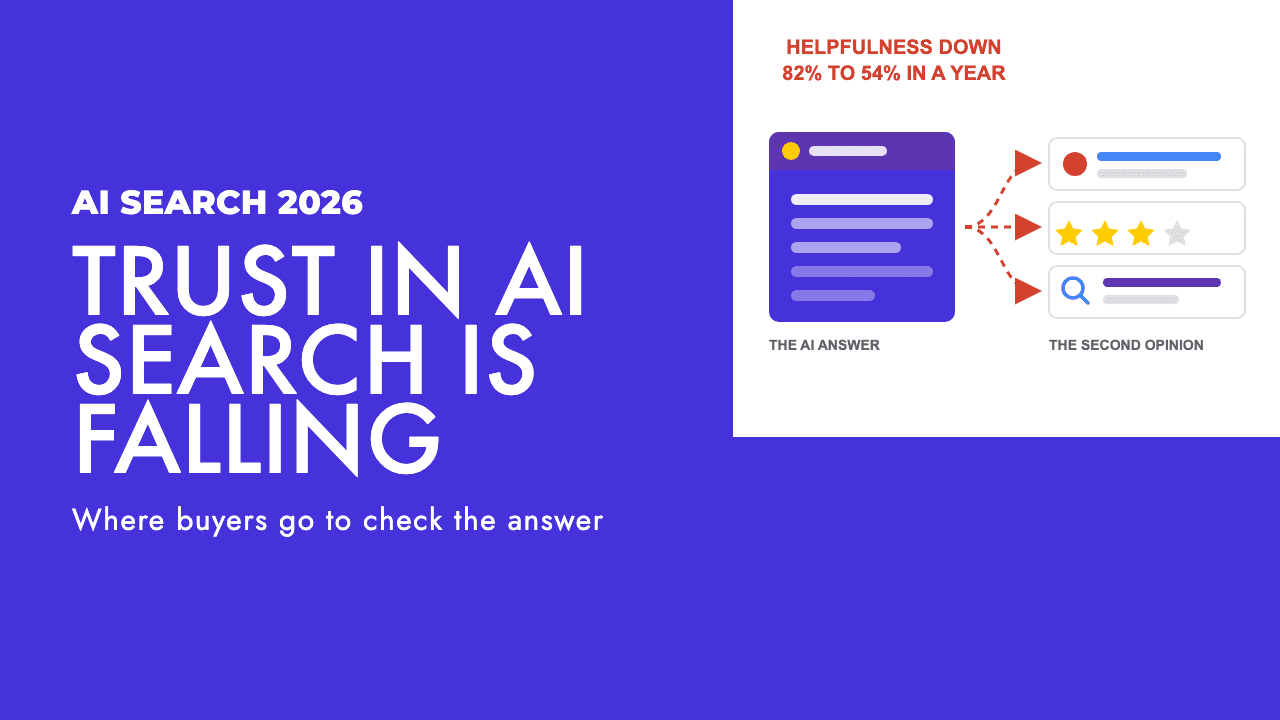
New research from Fractl and Search Engine Land, surveying just over a thousand US consumers, found that 70 percent are using AI tools for search more than they did last year. In the same survey, the share who say AI search is more helpful than traditional search fell from 82 percent to 54 percent. The outright skeptics went from 3 percent of respondents to 17 percent (Fractl).
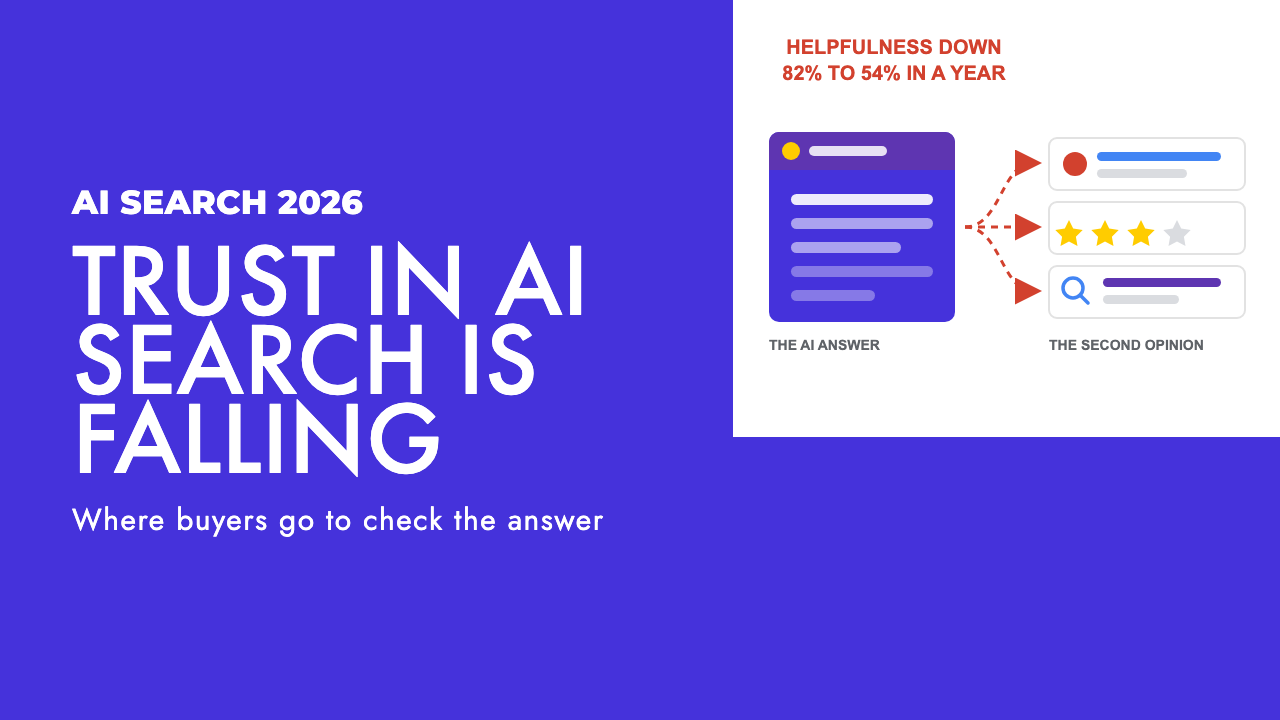
Read those two numbers together and you get the shape of the problem. People are not using AI search because they have come to believe it. They are using it because it is fast and it is right there. Convenience won, credibility did not follow, and the result is a buyer who takes the AI answer and then goes looking for a second opinion.
That second look is the part almost nobody is optimising for.
The answer box is not the finish line anymore
The Fractl data puts it plainly: consumers check an average of 2.4 platforms before making a purchase decision. AI assistants sit third for product recommendations at 14 percent, behind Google at 39 percent and Reddit at 15 percent. YouTube leads for how-to questions.
Reddit's own Path to Purchase 2026 survey, run across 13,956 US adults and 6,485 UK adults in May 2026, found the same behaviour from the other direction. Half of US shoppers now verify AI recommendations on Reddit before they buy, and 60 percent said they trust Reddit more than family or friends for that specific job (PPC Land).
So the real journey in 2026 looks like this. Ask the assistant. Get a shortlist. Leave. Search the brand name. Read a thread. Watch someone actually use it. Then decide.
Most GEO work we see being sold right now optimises exactly one step of that sequence, the first one. Getting cited is treated as the win condition. It is not. It is the introduction, and the buyer is on their way out of the room to check whether you are real.
Our take: stop putting "AI-powered" in your own marketing
This is the finding that should change something in your copy this week, and it is the one we expect the most pushback on.
The same research found that the share of consumers who say heavy AI use reduces their trust in a brand climbed from 20 percent to roughly 40 percent in a year. Gen Z penalises it hardest, at 54 percent. That is the opposite of what most positioning decks assumed about digital natives (Fractl).
For two years "AI-powered" has been free credibility on a homepage. That trade has flipped. When a third of your market is actively discounting brands that lean on AI, putting it in your hero headline now works as a filter, and it filters out the more skeptical half of your audience.
We are not saying stop using AI. We use it daily. We are saying stop selling it. Sell the outcome, put the AI in the methodology section where the people who care can find it, and let the work carry the claim.
There is a second half to this that most businesses are ignoring. Between 84 and 91 percent of consumers want AI-generated content labelled, and only around 20 percent of organisations do it. Google's own guidance in its helpful content documentation asks whether the use of automation, including AI generation, is self-evident to visitors through disclosures (Google Search Central). Everyone treats that as a compliance question. In a market where trust is falling, it is a positioning one.
What to actually put in the verification step
The practical question is simple. When someone leaves the AI answer to check you out, what do they find? For most small and mid-sized businesses the honest answer is a homepage and nothing else.
Here is what fills that gap, in rough order of how much difference it makes.
1. Be findable where the checking happens
Verification is not happening on your site. It is happening on Reddit threads, YouTube, review platforms, industry forums and branded Google searches.
You cannot buy your way into most of those, and trying to is how accounts get banned. What works is being genuinely present: answering questions in the subreddits where your category is discussed, getting real customers to leave real reviews, and putting a face on camera. We wrote the rules for the Reddit side in our Reddit SEO guide, and we run the ongoing version of it as a Reddit marketing service, but the principle is the same everywhere. Be useful in the room before you need anything from it.
2. Make your facts identical everywhere
When a buyer verifies you, the thing that quietly kills the sale is inconsistency. Different pricing on your site than on a directory. A service listed on the homepage that has no page behind it. Opening hours that disagree with your Google Business Profile. Cleaning that up is local SEO basics.
Each mismatch is small. Together they read as sloppiness, and to an AI engine assembling your entity they read as low confidence. Consistency is unglamorous and it is the highest return hour you will spend this month.
3. Put real humans in the content
The verification step is fundamentally a question of "is there anyone actually there." Named authors, real photos, a genuine about page, specifics that only someone who does the work would know.
This has always been the E-E-A-T argument, but the stakes changed. When the assistant's answer feels generic, a page written by an identifiable person with an opinion is the thing that resolves the doubt.
4. Publish something only you could publish
Most marketers are chasing the easy AEO tactics, FAQ blocks and schema, while skipping original research, which is the one asset that cannot be replicated by a competitor prompting the same model.
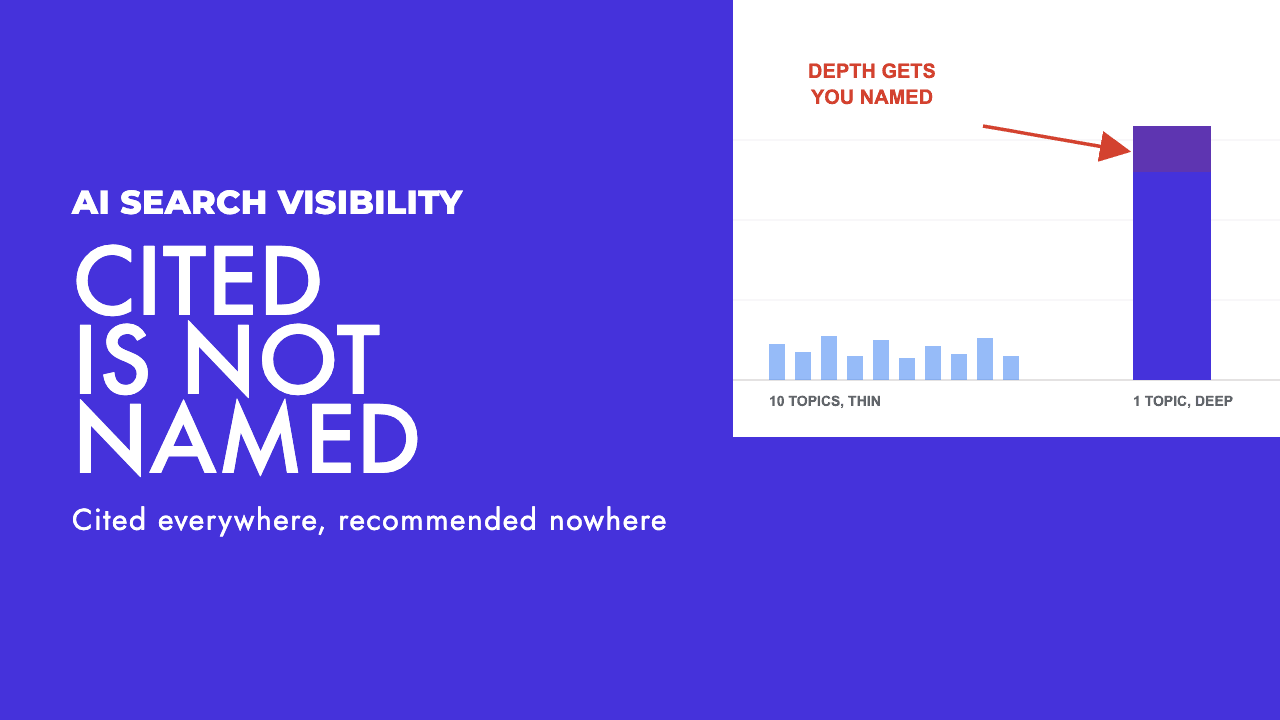
You do not need a fourteen thousand person survey. Publish what you see across your own customers, consistently, with a name on it. A small dataset you own beats a large one you summarised, both for buyers checking you out and for engines deciding who to cite. This connects directly to the ghost citation problem: unnamed generic advice gets used without credit, named research does not.
5. Label your AI use before you are asked to
Given the numbers above, a short, plain disclosure about how you use AI in your work is a trust asset, not a liability. It costs a paragraph. It signals you are not hiding the thing 40 percent of your market is worried about. If you are not sure how much of your existing copy reads as machine-written, an AI writing detector will tell you before a customer decides for themselves.
Cyprus and the US are on different points of the same curve
Two markets, one pattern, different timing.
In the US, verification behaviour is already mature. Buyers know to check Reddit, they know AI answers can be confidently wrong, and the brands winning are the ones with depth across multiple platforms. The competition there is for the second look, not the first.
In Cyprus, and in small markets generally, AI answers carry more weight for longer because there is less to check against. Thin local coverage means fewer threads, fewer reviews in the local language, fewer independent sources. That is a short-lived advantage for whoever fills the gap first, and it closes fast. If you sell in Cyprus, the verification layer for your category may still be mostly empty, and building it now is cheaper than competing for it in a year. We go deeper on the local picture in our Cyprus SEO work.
The short version
AI search adoption is still climbing and will keep climbing. Trust in it is going the other way, and the gap between the two is a real buying behaviour: people check.
Winning the citation is worth doing, and it is half a strategy. The other half is making sure that when the buyer leaves the answer and starts checking, there is something solid waiting for them.
If you are not sure what someone finds when they go looking, that is a diagnosable problem. Search your own brand name, ask ChatGPT about your category, and read what comes back the way a customer would. Or get a free SEO review and we will do it with you.
Update, September 2026
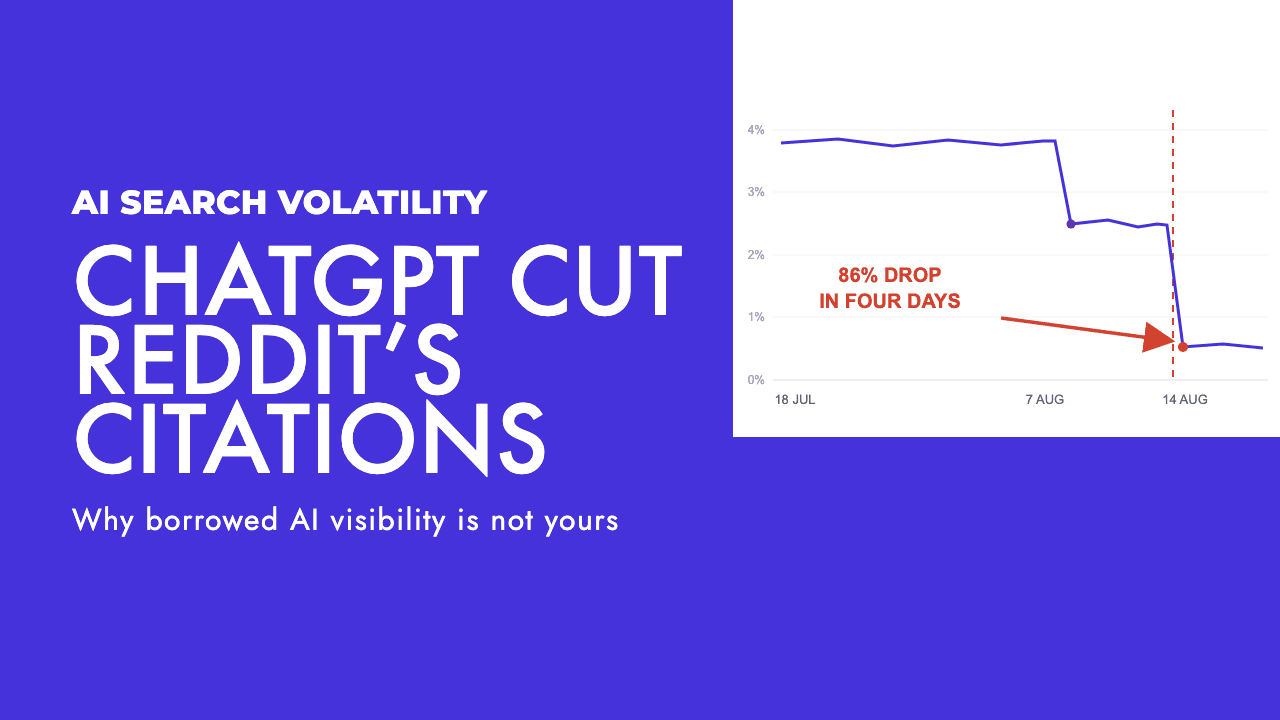
Two things moved after this was published. In mid-August, Reddit's share of ChatGPT Search citations fell from 3.83% to 0.52% in Promptwatch's tracking, with no explanation from OpenAI (Search Engine Land). That changes what ChatGPT quotes, not where buyers go to check, and the Reddit survey above was about the second thing. We covered what the drop says about borrowed AI visibility separately.
Google also updated its guide on optimising for generative AI features in July, and it now says in plain terms that seeking inauthentic mentions across the web "isn't as helpful as it might seem". That is the official version of point 1 above: be present where the checking happens, and do not try to fake it.
Sources: