You can win the citation and still lose the customer. An AI engine reads your page, uses your explanation, drops a small link icon next to the sentence, and never once says who you are. The reader gets the answer, keeps scrolling, and walks away with no idea your business exists.
The industry has started calling this a ghost citation, and new data suggests it is not an edge case. An analysis by Writesonic of roughly 16 million brand appearances across seven AI platforms found that around 40 percent of citations do not name the brand in the answer text, rising to 52 percent on Perplexity (Search Engine Land).
So the honest read on AI visibility in 2026 is this: being cited and being known are two different outcomes, and most businesses are only tracking one of them.
What a ghost citation actually looks like
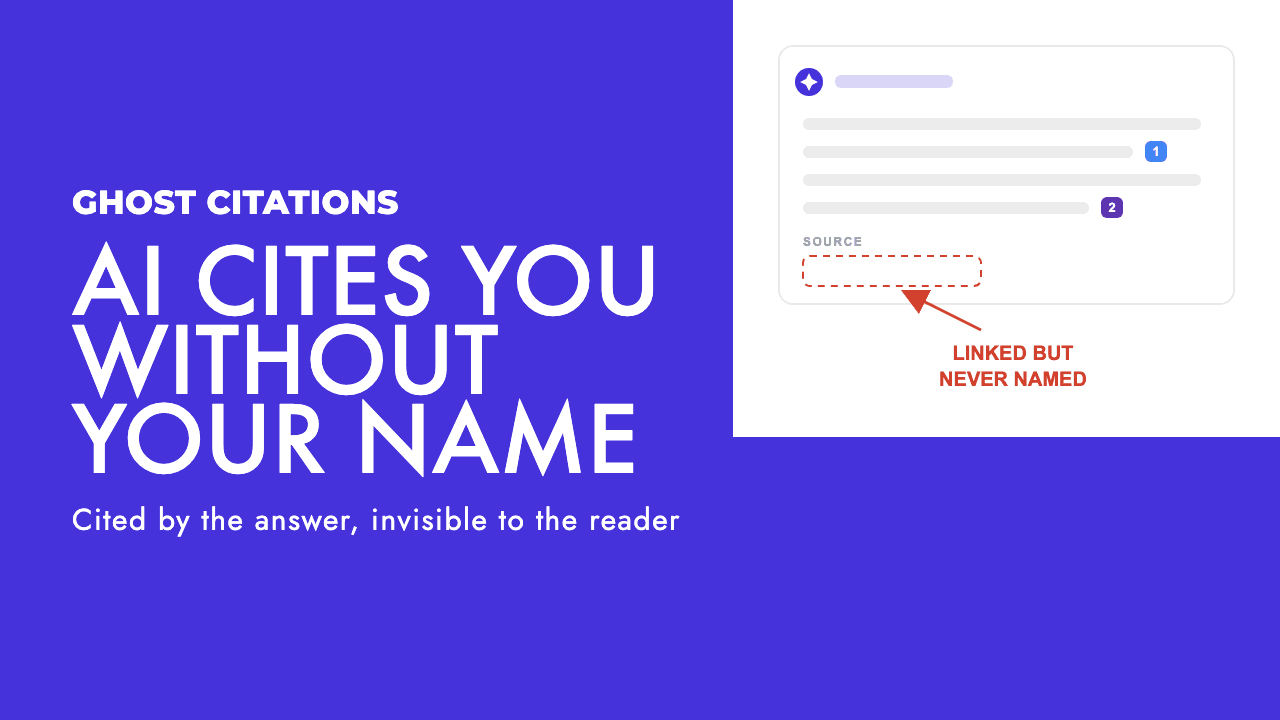
A ghost citation is when the engine links your page as a source but the generated sentence gives the credit to nobody.
The answer says "registration usually takes about a month" with a tiny link marker at the end. Your page is behind that marker. Your name is not in the sentence. The user learns the fact, trusts the assistant that told them, and forms zero association with you.
Compare that to "according to SEO Turtle, registration usually takes about a month." Same link, completely different commercial outcome. One builds a brand, the other donates one.
The split shows up by platform in a way that makes sense once you look at how each engine is built. Perplexity and Google's AI surfaces link generously but attribute loosely. Gemini and Microsoft Copilot name brands more often but cite fewer sources (Search Engine Land). There are citers and there are namers, and your visibility profile can look strong on one and empty on the other.
Why the engines do this
This is not a bug someone forgot to fix. It falls out of how these systems write.
An LLM is synthesising a single answer from several sources. Naming every one of them mid-sentence makes the prose clunky, so the model compresses. Facts get merged, attributions get dropped, and the link becomes a footnote rather than a credit. The model keeps the claim and discards the claimant.
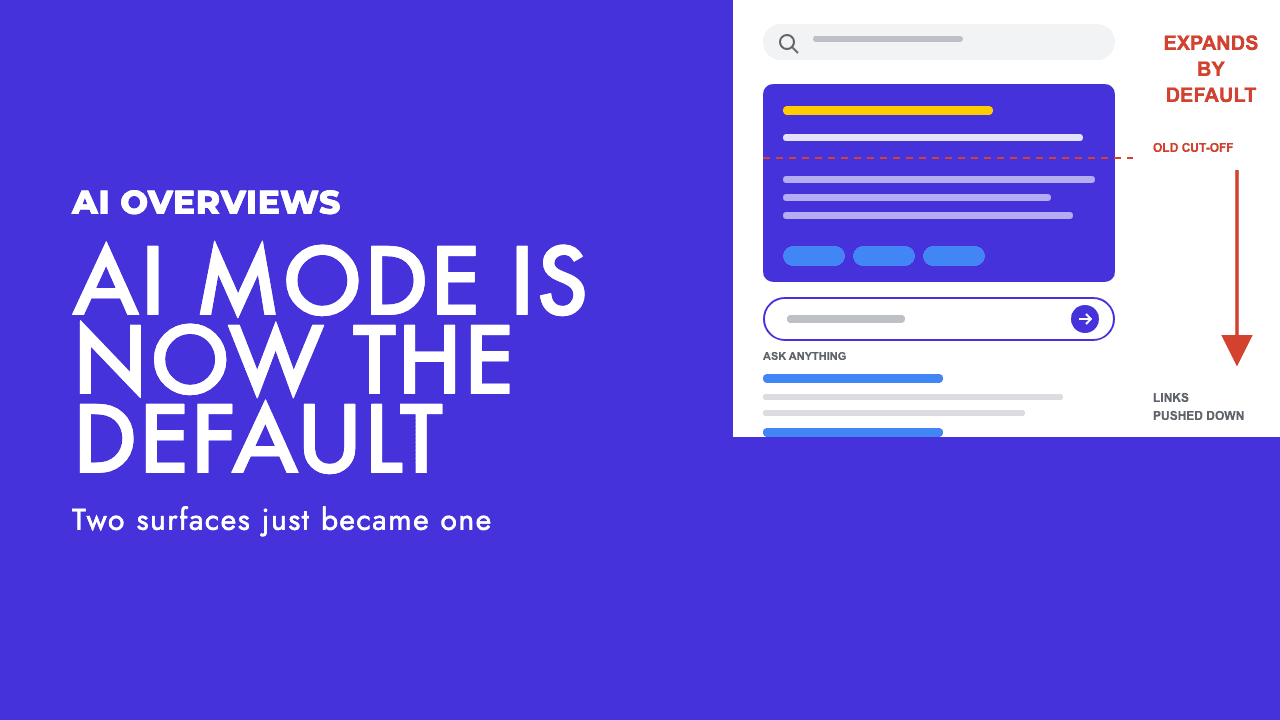
Google's own documentation frames links in AI features as a way for people to explore further, not as an attribution system (Google Search Central). That is a design intent worth reading carefully. The link is there for the user's benefit, not for yours. Nobody at Google or OpenAI promised you a byline.
There is also a plain content reason, and it is the one you can actually control. If your page never states who is making the claim, the model has nothing convenient to attach the claim to. Anonymous writing produces anonymous citations.
Our take: stop treating AI visibility as one number
Here is where we part company with a lot of the GEO tooling being sold right now.
Most AI visibility dashboards collapse everything into a single score. Mentions, citations, links, sentiment, all blended into one line that goes up or down. That number is close to useless for deciding what to do on Monday morning, because the two failure modes it hides need opposite fixes.
Cited but not named is a content and framing problem. Your material is good enough to be used and anonymous enough to be uncredited. The fix is in how your pages attribute claims.
Named but not cited is an authority and coverage problem. The model knows your brand from its training data and the wider web, but is not finding a page of yours worth linking on this specific query. The fix is publishing the page that deserves the link.
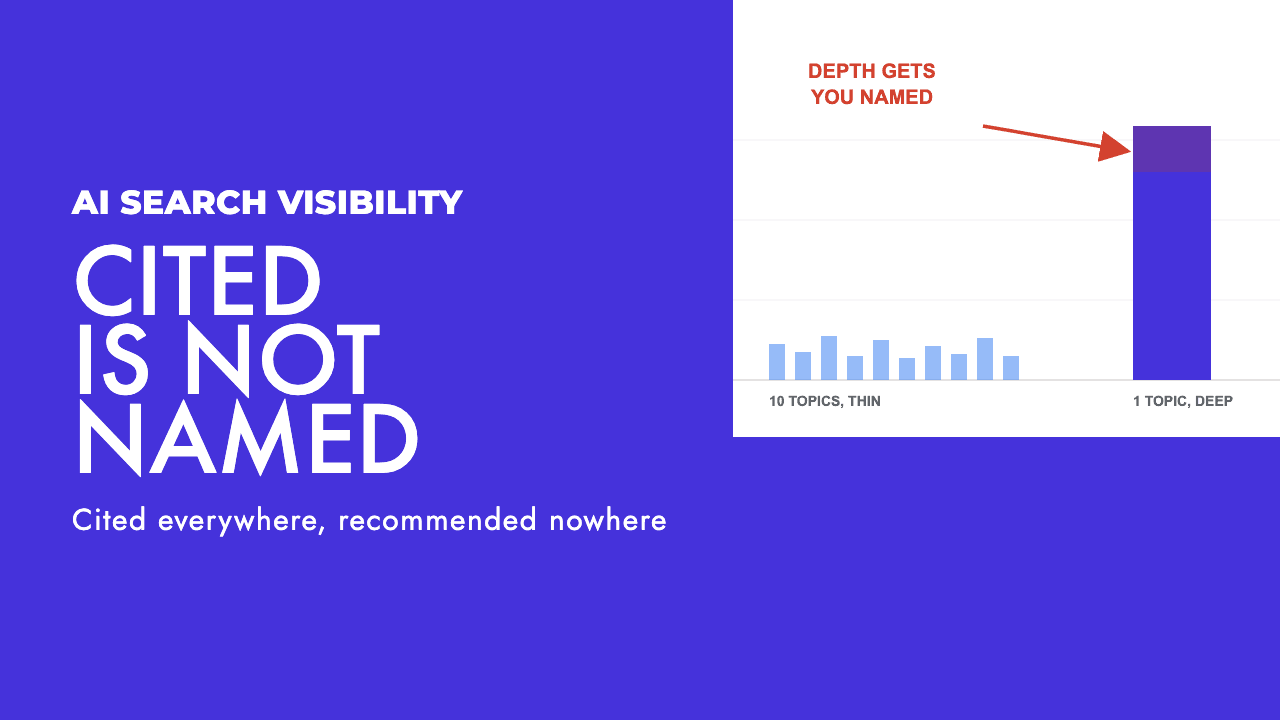
We see both constantly with client sites, and they get confused with each other all the time. The follow-up research on citations versus recommendations shows the second gap closes with depth inside one category, not breadth across many. A business will pour effort into more content when its actual gap is that nothing it publishes carries its name, or will chase brand mentions when the real issue is that it has no page answering the question at all.
Track citations and mentions as separate metrics. Search Engine Land made a similar argument about the weakness of blended AI share of voice scores, and we would go further: if your reporting cannot tell you which of those two failures you have, it is not reporting, it is decoration (Search Engine Land).
Four things that actually move the needle
1. Put the brand next to the claim, not near it
Models lift sentences, not pages. If your name sits in the header, the footer, the author box and the schema but never inside the sentence that carries the useful fact, the model will happily take the fact and leave the name.
Write the attribution into the claim itself. "In our audits of Cyprus service businesses, the pattern we see is X." "Our rule of thumb is Y." It reads naturally to humans and it gives the model a phrase where brand and fact travel together.
Do not overdo this. One in every sentence reads like a press release and will get you dropped for a cleaner source. Anchor the claims that matter.
2. Own something that has a name
The strongest anti-ghost-citation asset is a thing that cannot be described without saying your brand. A named framework, a named annual survey, a proprietary dataset, a benchmark you publish and update.
If the useful fact is "the Turtle Index says A," the model cannot strip the attribution without breaking the sentence. Generic advice is separable from its author. Named research is not.
This is a real barrier for small businesses, and worth being honest about. You probably cannot run a 16 million data point study. You can publish what you observe across the clients or customers you do have, consistently, with a name on it.
3. Be the answer to the question, not a page about the topic
Ghost citations still require a citation, which still requires being retrieved. The retrieval side has not changed much: clear structure, a direct answer near the top, specifics rather than throat-clearing. We covered the mechanics of that in our guide on structuring content so LLMs cite you, and the window is smaller than most people think: ChatGPT judges most pages on a title and about 200 characters.
Google's guidance on optimising for generative AI features says much the same thing in more diplomatic language, and it is worth reading in the original rather than in summary (Google Search Central).
4. Feed the memory, not just the index
A large share of AI answers never run a live web search at all, which means the brands that get named are often the ones already sitting in the model's training data. We wrote about that split in what happens when ChatGPT answers without searching.
That is the long game behind ghost citations. Third-party coverage, industry directories, podcasts, forum discussion and earned press mentions are what teach a model that your name belongs next to your subject. Content gets you cited. Being talked about elsewhere gets you named.
What this means for a Cyprus or US business right now
If you are a smaller operator competing against national brands, the ghost citation problem is not evenly distributed, and that cuts both ways.
Big brands get named more because models already know them. You will more often be the invisible source, the one whose page taught the answer without earning any credit for it. That is genuinely unfair and there is no clever schema tag that fixes it.
What you do have is specificity. A model synthesising a generic answer strips generic attributions. It is far less likely to strip the only source that knows what the actual filing timelines are in Limassol, or what a clinic in Austin actually charges. Local and vertical precision is harder to compress into anonymity, because there is no other source to blend you with.
That is the practical strategy: stop competing to be one of five interchangeable sources for a broad question, and start being the only sensible source for a narrow one. Our AI search optimisation work starts there for exactly this reason.
The uncomfortable summary
AI search has quietly separated two things that used to arrive together. A ranking used to deliver a click, a visit and a brand impression in one package. Now the answer takes the fact, the link takes the credit only sometimes, and the brand impression is optional.
Treating "we got cited" as a win without checking whether anyone saw your name is how businesses end up with rising AI visibility and a phone that does not ring.
Check both. If you want a second opinion on which of the two gaps you actually have, our free SEO review is a reasonable place to start.