
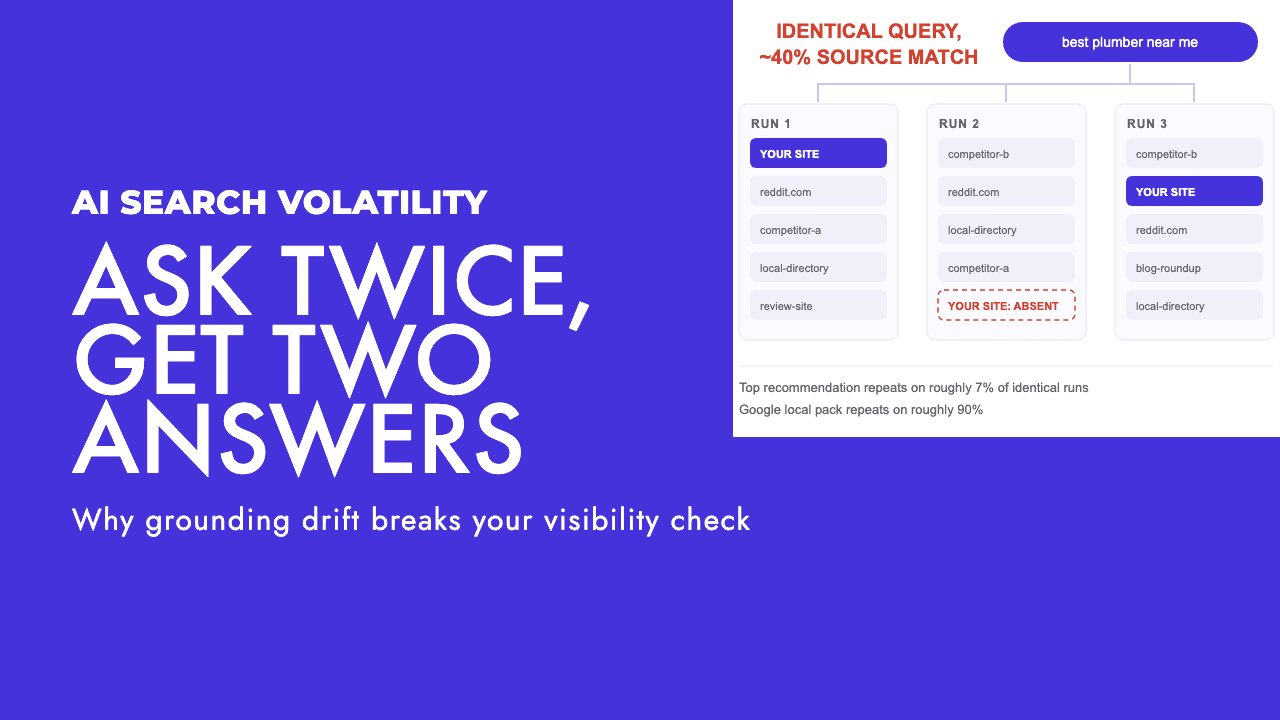
A client asked ChatGPT who the best supplier in their category was, got a competitor, and forwarded the screenshot with a one line email. We ran the same prompt twice. They were named in one and absent in the other.
That is not a bug in the model and it is not a ranking. It is grounding drift, and it is now measured well enough that you can plan around it.
What the research actually found
Steady Demand ran 1,487 local service queries across 50 US metros at the end of July and logged all 14,472 resulting citations (methodology). The headline number was that business websites take about 60% of Gemini's local citations, more than every directory, forum and review platform combined, with Reddit second at 13.7% (MarTech).
The number that matters more is buried underneath it. Ask Gemini the exact same question word for word twice in a row, and the cited sources overlap only about 40% of the time. The top recommended business is the same on roughly 8% of repeat runs. Google's classic local pack returns the same top result about 90% of the time.
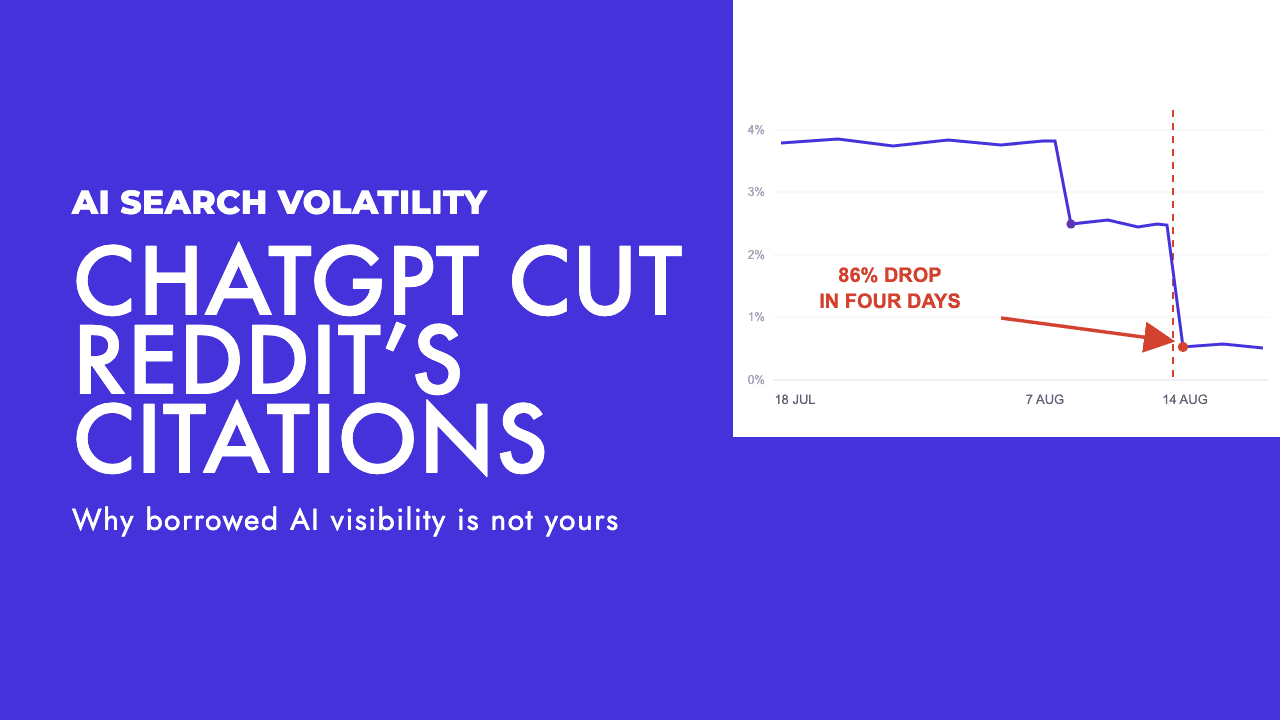
Cross-engine agreement is worse. Gemini and ChatGPT cited the same domains on 8% of identical queries and named the same top business 4.2% of the time. Gemini leans on business websites. ChatGPT leaned on Reddit and community content in the July data, and then stopped: by mid-August Steady Demand's re-run had ChatGPT's Reddit citation rate at zero, with the weight shifting to business websites and directories.
This is not a local-only quirk. Profound tracked roughly 80,000 prompts per platform across June and July 2025 and found month-on-month citation drift of 59.3% on Google AI Overviews, 54.1% on ChatGPT, 53.4% on Copilot and 40.5% on Perplexity, rising to 70-90% when it compared January with July (Profound).
Why it happens, in one paragraph
These systems generate text probabilistically. Every answer involves sampling, and the retrieval step that feeds the answer is itself re-run each time with slightly different query expansions.
Google has been fairly open that AI Mode fans a single question out into multiple background searches and synthesises across them (Google). If the fan-out set changes between runs, the source set changes with it. Stability was never a design goal.
The practical version: there is no fixed position to hold. There is a probability that you appear.
What this breaks
Three things, and businesses are currently doing all three.
The screenshot check. One prompt, one screenshot, one conclusion. On Gemini's local numbers, a single run tells you almost nothing about whether you are actually in the consideration set. You are reading one roll of the dice as a league table.
Panic and celebration. We see clients react hard to a single bad answer and reorganise a content plan around it. We also see the reverse, where one good answer gets treated as proof the GEO work landed. Both are noise being read as signal.
Single-platform reporting. With 8% cross-engine overlap on identical queries, being strong in Gemini says close to nothing about ChatGPT. They are separate ecosystems with separate source preferences, not two windows onto the same index.
There is a fourth, quieter problem. Drift makes it very easy for a tool to sell you a number that moves impressively every week without anything real having changed. If your AI visibility dashboard swings 30% month to month and the vendor cannot tell you their sample size or run frequency, you are paying for variance.
Our take: stop optimising for the answer, start optimising for the pool
Here is our position, and it is a bit unfashionable in a market selling AI rank tracking.
Trying to win a specific AI answer is the wrong goal. The answer is resampled every time it is asked, so winning it once is not a state you can hold. What you can influence is whether you are in the pool of sources the model considers credible enough to pull from at all.
Think of it as eligibility rather than ranking. A business cited in 4 of 10 repeat runs and a business cited in 0 of 10 are in completely different positions, even though on any given single check they can look identical. Moving from 0 to 4 is the real work. Moving from 4 to 6 is the follow-up work. Neither shows up in a screenshot.
This also reframes what "consistency" means on your side. If your business facts, service descriptions, locations and category language differ across your site, your Google Business Profile, your directory listings and third-party mentions, you are giving the retrieval layer several different versions of you to sample from. Drift will happily pick the weakest one. Consistency across sources directly narrows the range of answers a model can produce about you.
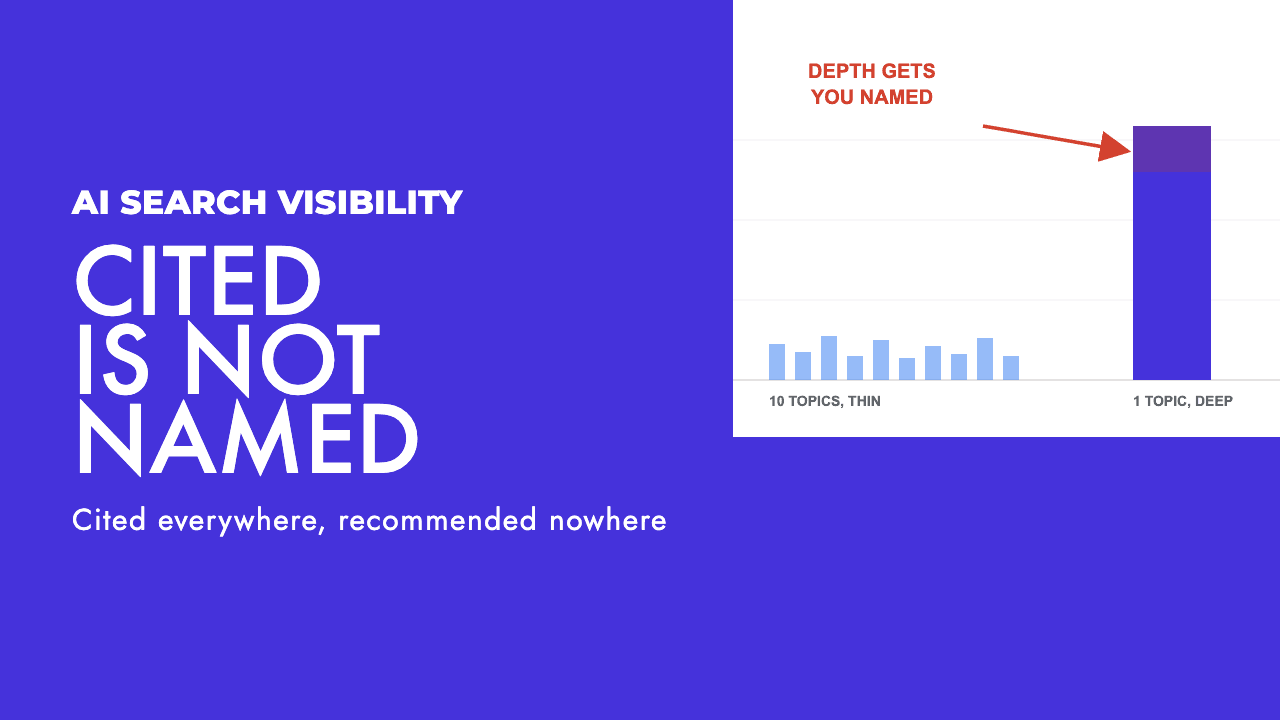
It connects to something we wrote about earlier this month: engines will cite you almost anywhere but only recommend you where you go deep. Depth in one category is what raises your appearance probability enough to survive resampling. Thin coverage produces exactly the kind of presence that vanishes on the second run.
What drift means if you are in Cyprus or a smaller US metro
Smaller markets cut both ways here, and the direction depends on how many credible sources exist for your category.
In a thin market the eligible pool is small. If there are six real providers in Limassol and only two have a properly structured site with clear service pages and consistent listings, your odds of appearing in any given run are structurally high. Drift is working in your favour because there is not much to drift between.
In a dense US metro the opposite applies. Twenty credible competitors means twenty ways for a single run to not include you, and appearing in one of five checks is a genuinely reasonable outcome that will feel like failure to a client looking at one screenshot.
The other Cyprus-specific factor is source supply. ChatGPT weights community and licensed data heavily for local answers, and we covered how much of that ground is now licensed rather than crawled. Where there is little local Reddit discussion or thin review coverage in your category, business websites and profiles carry more of the load, which is the part you control.
How to measure this without buying another dashboard
You need repetition and a written record. That is genuinely most of it, and a spreadsheet is enough. Our SEO template library includes a KPI dashboard you can adapt for it.
- Write ten real buyer questions. Full sentences, the way someone actually asks. Not keyword strings.
- Run each one five times on ChatGPT, Gemini and Perplexity, in a fresh session with personalisation and memory off. Yes, that is 150 runs. It takes an afternoon once a month.
- Record appearance rate, not position. For each question and engine: named in X of 5, cited in Y of 5. That fraction is your metric.
- Compare month to month on the fraction. A move from 1/5 to 3/5 across several questions is a real change. A move from 2/5 to 3/5 on one question is noise.
- Log which sources the answers pulled from. Over a few months you will see which third-party properties keep feeding your category, and those become your outreach list.
If you would rather automate it, most of the credible tools now run repeated sampling under the hood, and we compared the options in our Perplexity rank tracker review. The buying question to ask a vendor is simple: how many times do you run each prompt, and do you report the variance. If they cannot answer, they are showing you one dice roll with a nicer chart around it.
What actually raises your appearance probability
The unglamorous list, in the order we work through it with clients.
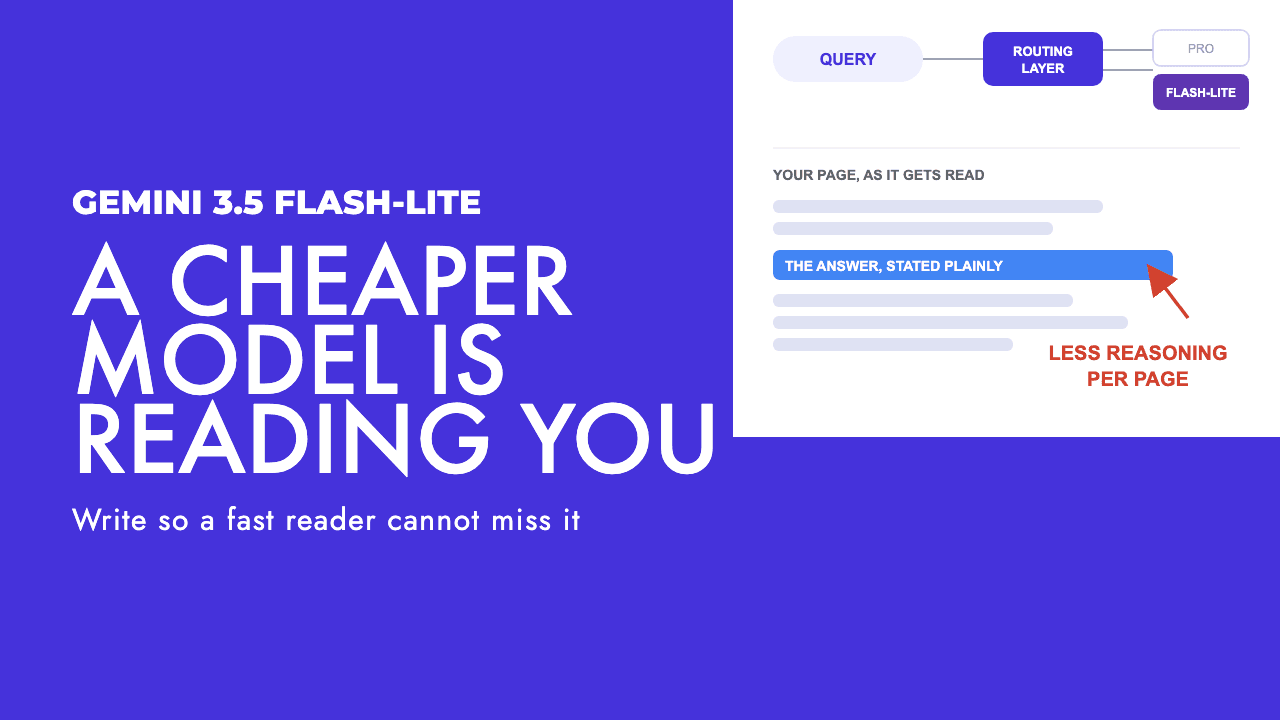
- One clear page per service, with the answer stated plainly near the top. Retrieval favours passages that resolve a question without inference. We covered the page mechanics in structuring content so LLMs cite you.
- Identical business facts everywhere. Name, categories, service list, locations, hours. Same wording, not just same meaning. This is ordinary local SEO hygiene doing double duty.
- Depth in one category before breadth across five. Repeat presence beats coverage.
- Third-party presence where your buyers already talk. Reddit at 13.7% of Gemini's local citations is a bigger share than every directory combined, even after ChatGPT's mid-August retreat from it. We looked at what that retreat means for visibility you rent rather than own.
- Crawlability for the AI crawlers specifically. If GPTBot or Google-Extended cannot fetch you, none of the above matters. Worth checking your robots.txt and any CDN bot rules before anything else, and you can check whether GPTBot can fetch a given page in a few seconds.
Google's own guidance on AI features has not changed much through 2026, and it still amounts to standard technical and content quality work (Google Search Central). We broadly agree. Drift changes how you measure, not what you build.
The one thing to take away
Your AI visibility is a probability, not a position.
Report it as a fraction, act on trends across repeated runs, and ignore any single answer no matter how good or bad it looks. If you want a second opinion on whether your site is even eligible for the pool in your category, our AI search optimisation work starts there, and the free SEO review will tell you if something technical is blocking you before you spend anything on content.
Update, September 2026
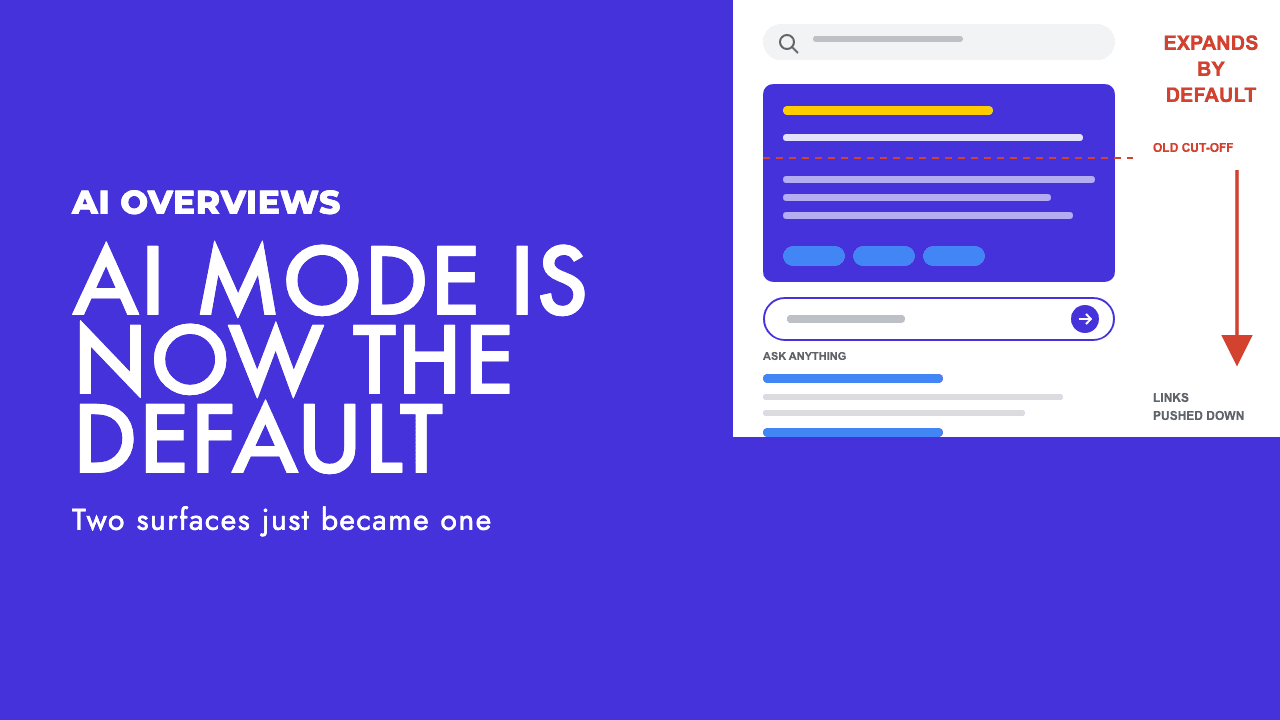
Steady Demand followed up on 22 August with a second run of about 8,000 local queries comparing Google's two AI surfaces, and they pull from almost opposite places. For local-intent questions, AI Mode cited Google Maps and Business Profile listings 79.8% of the time and the business's own website 19.7%. For informational questions, AI Overviews cited the business website 73.5% of the time (Steady Demand). The authors also note the whole dataset was collected over a few days and a run at another time could land differently, which is the point of this post.
Separately, Google's Search Console report for generative AI features finished rolling out globally on 31 August. It shows impressions from AI Overviews and AI Mode by page, country and device, and no click data (Search Engine Land). It is a useful floor for the Google side, and it does not replace the repeat-run check above for ChatGPT, Gemini or Perplexity.