
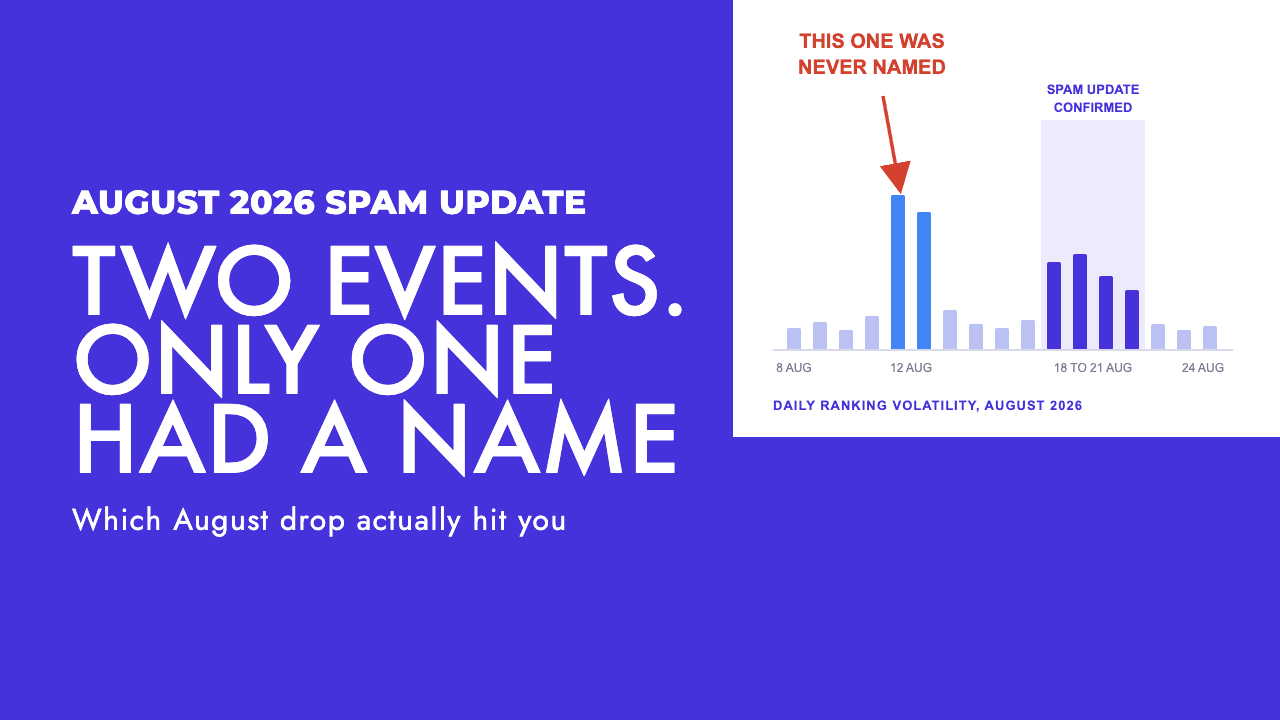
A client forwarded a headline last week with three words attached: "is this us?" Their traffic had dropped on 13 August. The update in the headline started on 18 August.
Those cannot be the same event. The gap between them is where a lot of bad SEO decisions get made.
What Google actually confirmed
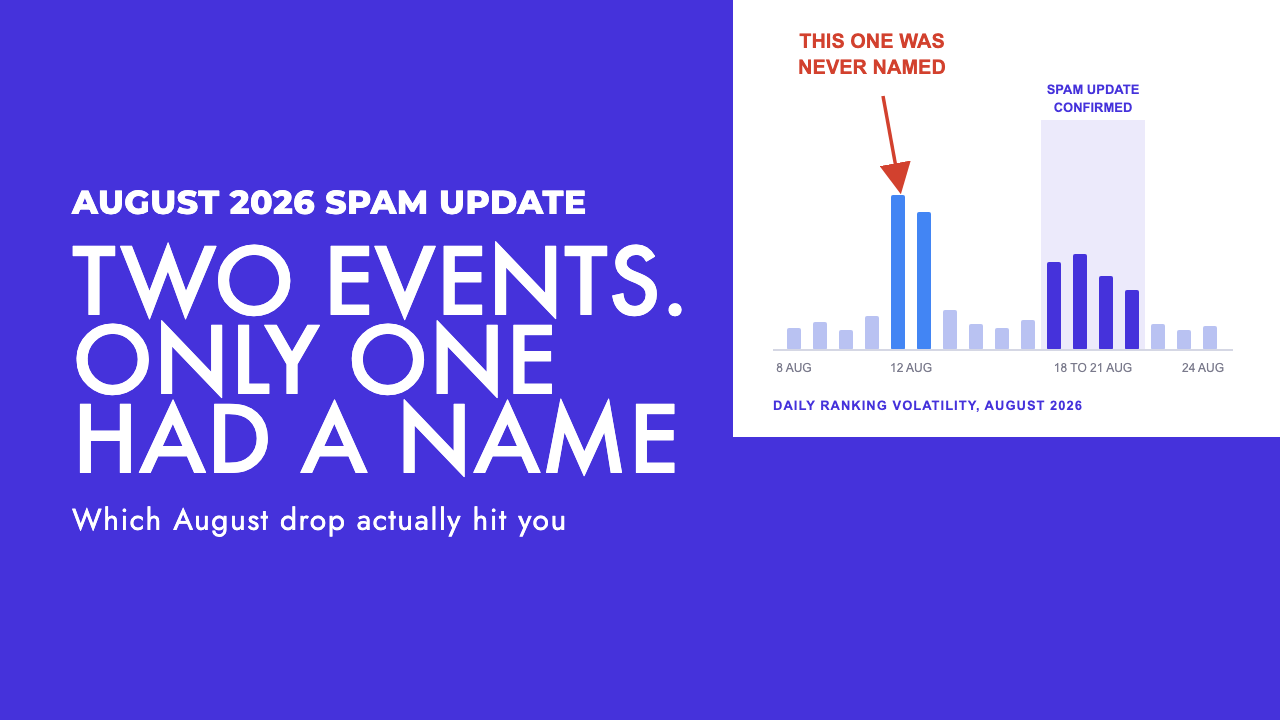
The August 2026 spam update began rolling out on 18 August and Google marked it complete on 21 August, a little under three days end to end. It was global, covering every language and region, and it was the third spam update of the year after March and the June update (Google Search Status Dashboard).
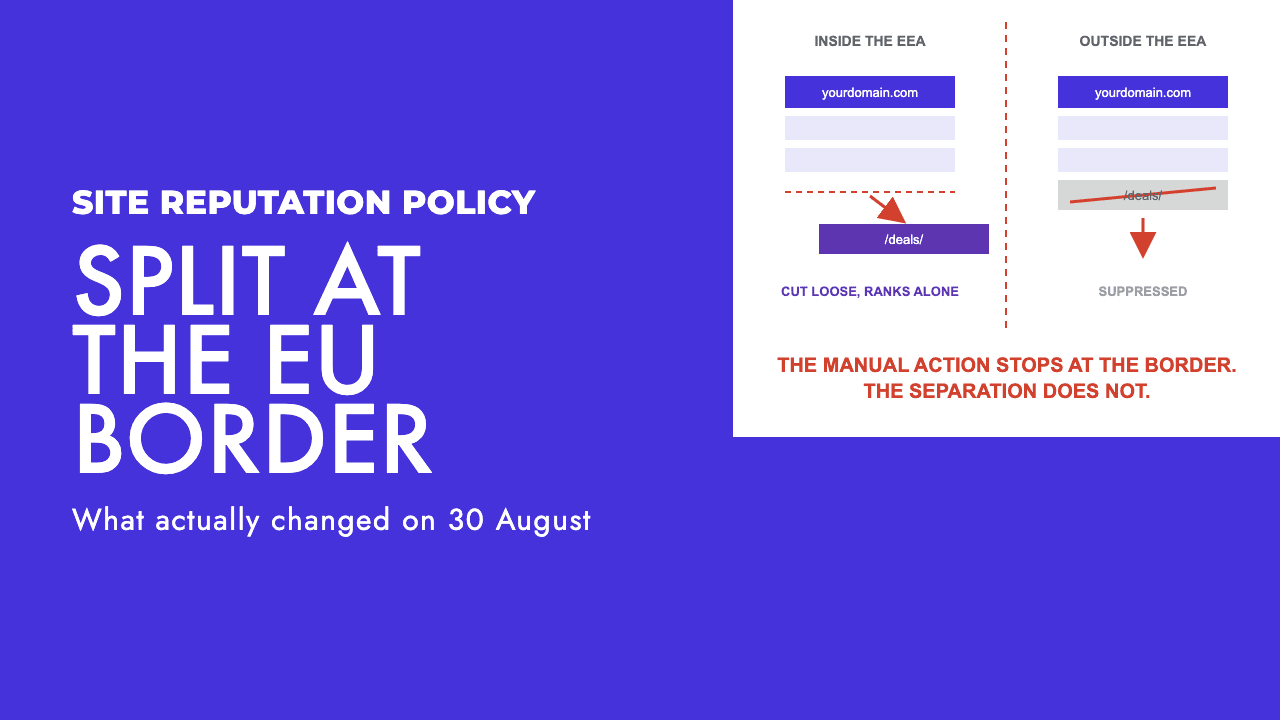
That is close to everything Google said. The dashboard entry carries a name, a start and an end. No list of targeted behaviours, no scoring detail, and no policy change announced with it. (Update, September 2026: a week after the rollout Google did rewrite one policy, the site reputation policy, for EEA searchers. That was a separate event driven by the European Commission, and we covered it in our post on the EEA split.)
The useful part is what Google said it isn't
Google confirmed the update does not target link spam, and it did not claim to cover every spam policy either (Search Engine Roundtable).
That is one exclusion, but it matters. Links are exactly what most agencies reach for when a client drops. If your rankings fell during the rollout window and your working theory is "our backlink profile", Google has already ruled that out for this particular update.
What it does target is some subset of the existing spam policies, unnamed. Anything you have read claiming it went after scaled content abuse, parasite SEO or AI writing is an assumption wearing a headline. It might turn out to be right. It is not confirmed, and there is a real difference between those two states.
The volatility that came before it was something else
Rank trackers logged a sharp spike around 12 and 13 August, on top of smaller ones on 24 July and 1 to 5 August (Search Engine Roundtable). Google never confirmed an update on any of those dates. (The trackers themselves were also being squeezed that month, which we covered in Google's goto redirects and rank tracking data.)
When people asked whether that early movement was the spam update landing quietly ahead of the announcement, John Mueller said Google does not work that way: "We don't roll them out beforehand." Google tries to put the announcement as close to the button press as time zones allow (Search Engine Roundtable).
So August contained at least two separate events. One unnamed and unconfirmed around 12 to 13 August, which registered larger in the trackers. One named and confirmed from 18 to 21 August. A lot of the sites currently publishing recovery plans for "the August spam update" were moved by the one nobody named.
Our take: named updates are the most over-attributed thing in search
This is opinion, and we hold it strongly. Named updates cost clients money not because of what they do, but because of what gets blamed on them.
An update arrives, it gets a headline, and every drop in the surrounding four weeks quietly gets filed under it. The name is the whole problem. It gives an unexplained loss a story, and a story feels like a diagnosis.
It is not one. Google announces a small fraction of what it ships. Core systems refresh continuously, spam systems run continuously, and the AI layer sitting on top of the results has its own retrieval behaviour that moves independently of classic ranking. Named updates are the events Google chose to publicise. They are not the full set of things that can move your traffic in any given month.
Attribution matters because the remedies are not interchangeable. Spam remediation and quality rebuilding are different projects, on different timelines, at different costs. Picking the wrong one buys you a quarter of work aimed at a problem you never had.
How to work out which one hit you
Five checks, in the order we run them.
- Line the dates up properly. Find the exact day performance changed, remembering Search Console data lags by a couple of days. A drop that begins on 13 August and flattens by the 16th is not an update that started on the 18th. Compare day by day, never week by week, because weekly views smear a sharp drop across a range that touches both events.
- Check whether it is sitewide or page level. Spam actions tend to be blunt and broad. Quality and relevance movements tend to be uneven, with some URLs up, some down and plenty untouched. If half your pages gained while your commercial pages lost, that is a relevance reshuffle, not a spam hit.
- Separate rankings from clicks. Positions holding steady while clicks fall is a results page layout story, not a ranking story. We went through that pattern in detail in the great decoupling.
- Split by query type. Informational queries losing ground while transactional queries hold is almost always an AI surface story rather than an algorithmic penalty.
- Rule yourself out first. A deploy, a robots.txt change you never re-tested, a CDN bot rule, a migration, an expired plugin, a template change. The single most common cause behind the "mystery update hit" calls we take is a change the site made to itself in the same fortnight.
If it really is a spam issue
Go and read the actual spam policies and find the specific behaviour you are matching. Not the vibe of the policy, the behaviour.
Then remove it rather than soften it. Half-measures against spam systems tend to buy nothing, and the timeline is unforgiving: re-evaluation generally waits for the systems to run again, which can mean the next refresh rather than the next crawl.
If it is the unnamed event
Treat it as an ordinary quality and relevance shift, because that is what unconfirmed volatility usually turns out to be. The work is the same as after a core update, and we set out that approach after the May 2026 core update. Nothing to disavow, nothing to confess to, no reconsideration request to file.
Worth saying plainly: if you did not violate a policy, there is no penalty to lift. You are competing, and something in the competitive set changed.
If you are in Cyprus or a smaller US market
Thinner results pages mean a single competitor change registers as volatility. A rival relaunching one page, or a national brand deciding your city is worth targeting, will move you further than most algorithm updates ever will.
Before planning any update recovery, open the results page for your three main queries and look at what is actually sitting above you. Half the time the answer is right there and it has a brand name on it. If you want a fast read on the pages beating you, run a one-click SEO audit on those pages before you write a single brief. We cover this pattern constantly with SEO clients in Cyprus, where a market of this size simply does not produce statistically calm data.
Update, September 2026
The volatility did not settle after 21 August. Search Engine Roundtable logged continued movement through the following week with no confirmation from Google, which reads as one more unnamed event on the pile (Search Engine Roundtable). SE Ranking's data, reported by Search Engine Land, put some numbers on the named one: during the rollout, top 10 URLs were about 1.8 times more likely to fall out of the top 100 than in a July baseline week (16.71% against 9.2%), but the data "doesn't show whether particular types of sites, content, or spam tactics were disproportionately affected" (Search Engine Land). So the update hit harder than a routine spam refresh, and we still do not know what it targeted. When the SEO community asked whether the spam team was even still staffed, Google's VP of Engineering for Search, Rajan Patel, answered "Yes it is" (Search Engine Roundtable).
The takeaway
The August 2026 spam update is a real event with a start date, an end date, and one exclusion Google confirmed out loud. It is not a universal explanation for anything that went wrong in August.
If your traffic moved this month and you cannot yet say which day it moved on, that is the first thing to fix, before any content plan or link project. Our website audits start with exactly that timeline reconstruction, and the free SEO review will tell you whether something on your own site changed before you go looking for an algorithm to blame.