
Your rankings report is about to get worse, and nobody is going to send you an email about it.
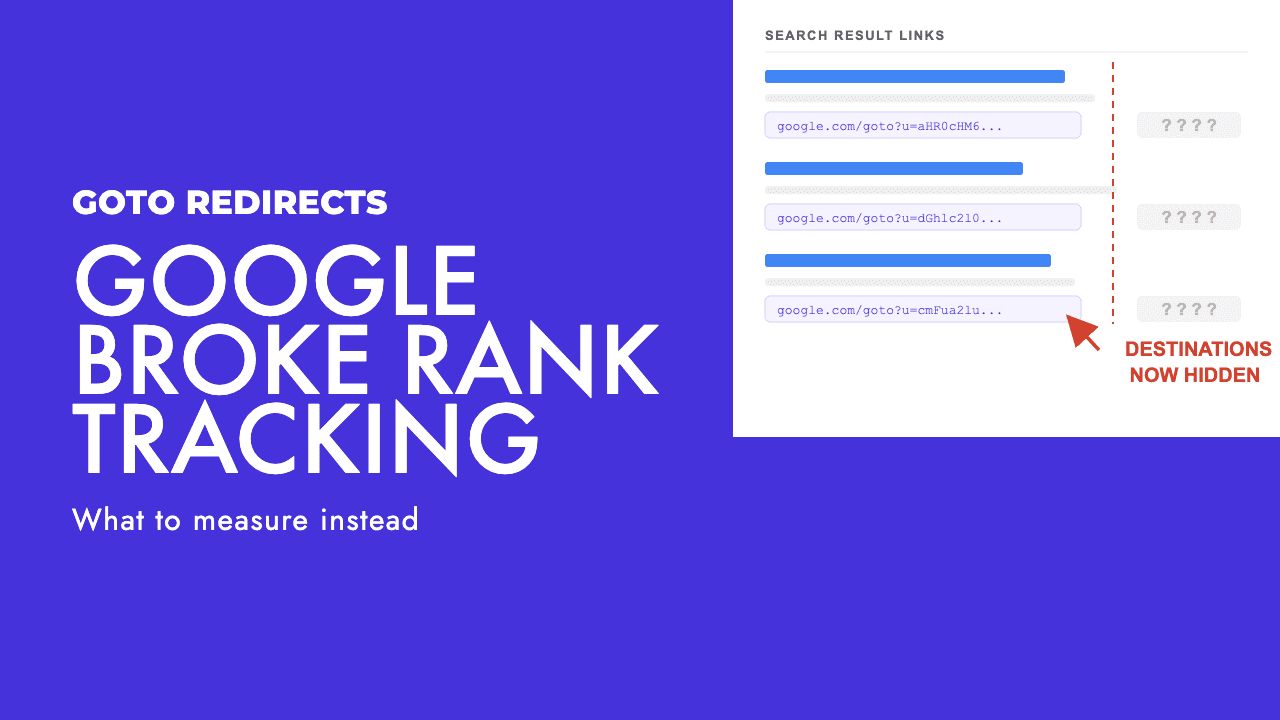
Over the last week of August, Google all but finished rolling out google.com/goto passthrough URLs across search results. The link behind a result no longer points at the destination site. It points at a Google redirect with an encoded parameter that third parties cannot decode. Search Engine Roundtable tracked the rollout from a July test to near-total deployment by 26 August.
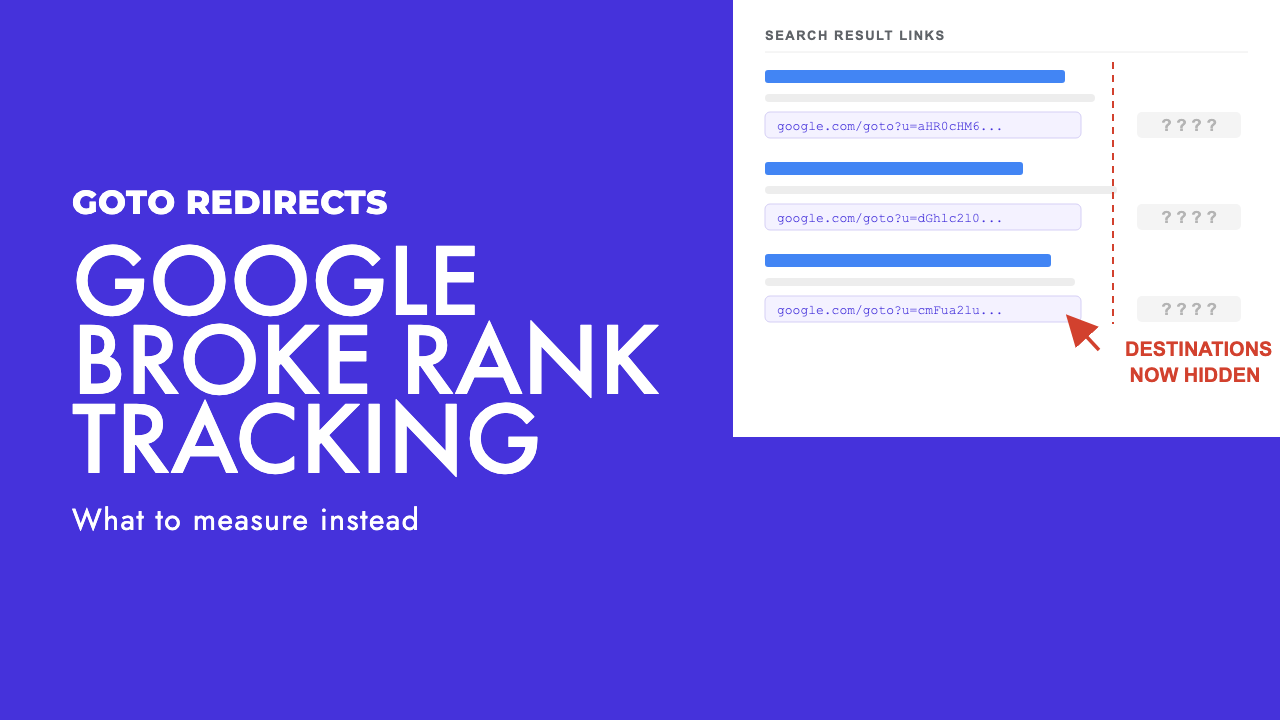
If you only read one line about this, read the next one. To find out which sites actually rank for a keyword, a tool now has to click every link on the page and see where it lands.
What actually changed
A search results page used to hand over its answers in the HTML. Scrape once, read the destination URLs, done.
Now those links are opaque. PPC Land reported that resolving the links for a single five-page ranking check takes 500 to 1,000 requests where it previously took none. Nozzle founder Derek Perkins described the mechanism as server side redirects replacing all client side links.
Google's line on it is short. A spokesperson told reporters the company has "a long history of deploying technical measures against evolving forms of abuse."
That framing is fair as far as it goes. Google is also being scraped at industrial scale by AI companies training and grounding models, and this change costs them nothing while making that scraping ruinous. Both things are true at once.
Why this compounds a problem that started last year
This is the second hit in twelve months. In September 2025 Google removed the num=100 parameter, which had let tools pull one hundred results in a single request. Overnight, checking the top hundred went from one request to ten.
Rank tracking vendors absorbed that quietly. Some raised prices, some cut refresh frequency, most just shipped slightly less data and said nothing loud about it.
Now multiply the request count again. Any vendor facing that maths has three options: eat the cost, charge you more, or track less. Most will pick the third, because it is the only one you will not notice on the invoice.
Our take: rank position was always a proxy, and it just got a worse one
Here is the opinion part, clearly flagged as opinion.
We think the industry has spent fifteen years treating average position as a primary KPI when it was never anything more than a convenient stand-in for visibility. It was a proxy that happened to be cheap to collect. Google has now made it expensive to collect, and the honest response is not to hunt for a cheaper scraper. It is to admit the metric was carrying more weight than it deserved.
A position is a single number describing a page that is different for every user, on every device, in every town, at every hour, with AI Overviews and local packs and product carousels shuffling the actual pixels above the thing you are "ranking" for. We have watched clients celebrate a move from position 6 to position 4 on a query where an AI Overview eats the entire viewport. The number went up. Nothing happened.
None of this means throw the trackers out. It means demote them. Rankings are a diagnostic, useful for spotting movement and answering "did something break." They are not the scoreboard.
What we are telling clients to measure instead
Start with Search Console, because it is first-party and it is not scraped. Queries, impressions, clicks and pages come straight from Google with no middleman to break. It has its own quirks, including sampling and anonymised queries, but nothing Google ships to block bots will ever degrade it. We wrote about how differently first-party data reads from tool estimates in small markets like Cyprus, and that gap only widens from here.
Watch impressions and clicks as a pair, not separately. Impressions climbing while clicks stay flat is the single most informative pattern in AI-era search, and it tells you more than any position number. We unpacked that in the great decoupling.
Check your money terms by hand. Not two hundred keywords. The ten or fifteen that actually produce revenue. If you cannot name them yet, our free keyword research tool is a quick way to build the shortlist. Look at the real SERP, logged out, in the location that matters, and note what is above you: an AI Overview, a local pack, three ads, a competitor's comparison page. That context is what you act on, and no dashboard gives it to you.
Track presence in AI answers separately. Google AI Mode, ChatGPT and Perplexity do not have positions in any meaningful sense, and treating them like blue links produces nonsense. Our methodology for this sits in Perplexity rank tracking.
Tie it to revenue. Leads, calls, bookings, sales. Boring, unfashionable, and the only layer of the stack Google cannot change under you. The SEO KPI dashboard template we give away is a reasonable starting shape if you are rebuilding the report around those numbers.
If you are a local business, read this bit twice
City-level and postcode-level tracking was already the weakest data in the category. Country-level tracking has always been reliable, major metros are usually fine, and small-city or postcode granularity has always carried real variance, particularly outside the United States.
That is exactly the data that gets cut first when a vendor needs to reduce request volume. Small markets and long-tail local terms are the cheapest thing to drop.
So if you run a business in Limassol or Nicosia and your monthly report is built on city-level rank tracking across a hundred keywords, expect that report to get quietly less accurate over the next few months. Search Console plus a handful of manual checks in the location you actually serve will beat it. Our local SEO work has been built that way for a while, mostly because the tool data never held up well enough here to trust on its own.
The question to ask your agency
One question, and the answer tells you plenty: what changed in our reporting when Google shipped the goto redirects, and how do we know the numbers are still comparable?
An agency that has thought about it will tell you which vendor they use, what that vendor changed, and where the reporting now leans on first-party data instead. An agency that has not will send you the same PDF as last month with a chart that no longer means what it did in July.
Google has been steadily closing the window it left open for the SEO industry. The num=100 removal, the goto redirects, and the general disappearance of free SERP data all point one direction. The teams that come out fine are the ones whose reporting was already anchored in first-party data and business outcomes.
If your rankings report has been doing the heavy lifting, now is a good moment to fix that. We are happy to look at what you are currently measuring as part of a free SEO review.