
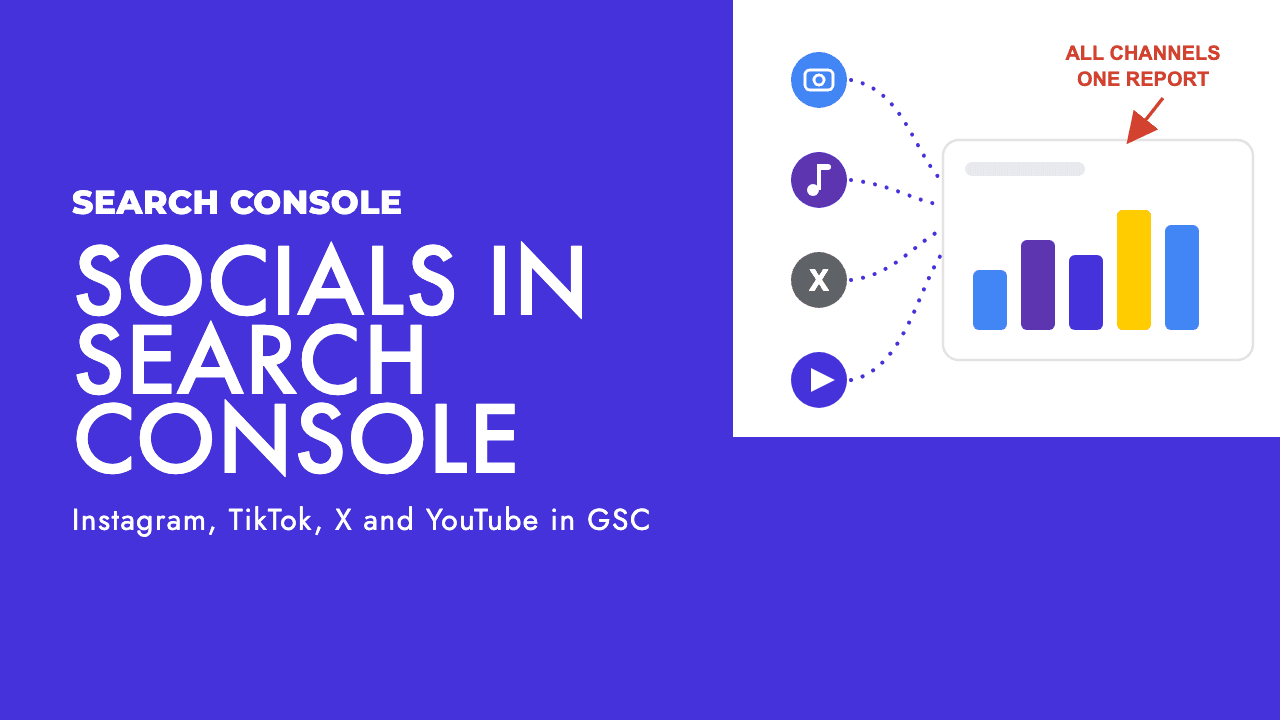
For as long as Search Console has existed, the first step was always the same: prove you own a website. No domain, no data. On July 7, 2026, Google quietly broke that rule. You can now verify an Instagram, TikTok, X, or YouTube account as a "platform property" and see how your posts perform in Google Search and Discover, with no website involved at all.
Most of the coverage has framed this as a reporting convenience for creators. That undersells it. Google just put a measurement layer on something it has always been coy about: your social and video content is search inventory, it shows up in Search and Discover, and now the same tool SEOs live in will tell you exactly which posts and queries are driving the traffic. Here is what changed and what a business should actually do with it.
What Google actually launched
Platform properties are a new property type in Search Console. You pick one of four platforms (Instagram, TikTok, X, or YouTube), run through Google's verification flow to authorize the connection, and you get a Performance report and an Insights report for that account, plus an Achievements view that flags milestones like a new 28-day clicks high.
The Performance report gives you clicks, impressions, and the search queries leading to your posts, so you can see which specific posts and which specific queries are pulling people in from Google. The Insights report is the friendlier summary view: recent traffic patterns and your best-performing posts. Both cover Search and Discover.
The headline detail in Google's Search Central announcement is the one everyone is skipping over. Google says it built this for site owners and creators "even those without their own website", which makes it the first Search Console property you can create without owning a domain. That is not a footnote. That is Google redefining what "your presence in Search" even means.
It is rolling out gradually over the coming weeks, so if you do not see the option yet, that is expected. (Update, September 2026: Google's help page still describes the rollout as gradual, and notes that metrics take a few days to appear after setup and cover Google Search performance only, not how the posts do on the platform itself (Search Console Help).) As Search Engine Journal noted, the whole point is to unify performance data that used to live in four separate walled gardens.
Why this is bigger than a new report
Here is the shift most people are missing. For years, the SEO conversation treated your website as the thing that ranks and your social channels as the thing that drives brand awareness. Two separate jobs. Two separate teams, usually.
Google has spent the last year blurring that line. Discover surfaces social posts, and the Search Profiles and Preferred Sources features that followed in the summer push further in the same direction, which we covered in how Google is turning user choice into a ranking signal. AI Overviews and AI Mode pull from a much wider pool of sources than the classic ten blue links. And now Search Console, the most SEO-coded tool Google ships, is treating a TikTok account as a first-class citizen next to your domain.
Read that as a signal about where Google's head is at. Search is no longer a list of web pages. It is an answer and discovery layer that spans surfaces and platforms, including ones you do not own. If your Instagram Reel answers a "how do I" question better than your blog post does, Google is increasingly happy to serve the Reel. Now you can measure it.
Our take: this feature is less about creators getting a dashboard and more about Google admitting, out loud, that a lot of search demand is being satisfied by content that never touches a website. If you have been treating social as separate from SEO, this is the clearest sign yet that the distinction is dissolving.
What it does not do
Let us be honest about the limits, because the hype will overshoot.
Verifying a platform property does not make your posts rank better. It is a measurement tool, not a ranking lever. You are getting visibility into performance that was already happening, not a new distribution channel.
It also does not replace your website analytics or your normal domain property. A click to your Instagram post is a click into Instagram, not onto your site. For most businesses the website is still where the money conversation happens: the booking, the quote, the sale. This tells you which social content earns attention in Search. It is on you to turn that attention into something that reaches your own pages, and to tag the links you do send with a UTM link builder so that traffic is not guesswork in analytics.
And the data is early. Google has a habit of shipping these reports thin and filling them in later, exactly like it did with the AI Overviews performance report earlier this year. Expect gaps and expect the feature set to grow.
What a Cyprus or US business should do about it
For a lot of the businesses we work with, the practical answer is genuinely exciting, and it splits by who you are.
If your business already lives on social, verify the platform property the moment it reaches your account. Restaurants, cafes, salons, gyms, trades, local services: your TikTok and Instagram often do more discovery work than your homepage. That is the premise our restaurant marketing work in Cyprus already runs on. For years you have been flying blind on how that content performs in Google specifically, as opposed to inside the app. This closes that gap. Find the posts that already pull search traffic and make more of them. This pairs naturally with the fundamentals in our local SEO for AI search guide.
If you are website-first, do not ignore this because "we are not influencers." The queries that surface your competitors' social posts are queries you are probably targeting with blog content too. Seeing which questions Google chooses to answer with a Reel or a short video tells you what format the search intent actually wants. Sometimes the honest answer is that a 40-second video will out-earn a 1,500-word article, and it is better to learn that from data than from a ranking drop.
Everyone should connect the dots across surfaces. The businesses winning right now are the ones that stopped thinking about "SEO" and "social" as separate budgets. Your domain property, your new platform properties, and the AI performance report are three windows onto the same thing: how discoverable your brand is across everything Google shows people. That is the same multi-surface reality we cover in our breakdown of GEO versus SEO, and it is where strategy is heading.
If you want a hand mapping where your brand actually shows up across Search, Discover, and AI answers, that is exactly what our AI search optimization work is built for, and you can start with a free SEO review.
The bottom line
Google did not just add a report. It moved the boundary of what counts as your search presence to include content on platforms you do not own. For creators and social-first local businesses, this is the first time Google Search performance data has ever been within reach without a website.
Verify the property when it lands, read it alongside your domain and AI reports rather than in isolation, and treat it as confirmation of a trend that has been building all year: search discoverability is now a portfolio, not a page. The businesses that measure the whole portfolio will out-execute the ones still guessing.