
Every time Google ships a spam update, two camps form within about an hour. One camp posts "AI content is finally dead." The other quietly checks whether their 4,000 programmatically generated pages just got vaporised. The June 2026 spam update, which Google began rolling out on June 24 and wrapped on June 26 (Search Engine Roundtable), produced exactly that pattern.
Both camps are reading it wrong. Google does not penalise content for being written by AI. It never has. What it penalises is using any tool, AI included, to flood the index with pages that exist to catch rankings rather than help a person. That is scaled content abuse. Google did not publish a target list for this update, and said only that it does not touch link spam or the site reputation policy (Search Engine Roundtable), which leaves scaled content abuse as the policy most of the panic is actually about.
The distinction sounds like hair-splitting. It is not. It is the whole ballgame, and businesses in Cyprus and the US that get it the wrong way round will either kneecap a perfectly good content operation out of fear, or keep doing the one thing this update was built to catch.
What the June 2026 spam update actually targets
Spam updates are not core updates. A core update reassesses quality broadly across the whole web. A spam update is narrower and meaner: it sharpens Google's automated detection (the SpamBrain system) against specific, named policy violations and then enforces them.
The named violations have not changed much. Scaled content abuse, cloaking, sneaky redirects, doorway pages, scraped content, hidden text. If you are doing any of those, this update exists to find you faster than the last one did. Google's own guidance is blunt about the consequence: violating sites "may rank lower in results or not appear in results at all."
The new wrinkle, and the reason this one matters more than a routine spam refresh, is that Google's spam policies now formally reach into AI surfaces. On May 15 Google rewrote the opening line of its spam policy to cover "attempting to manipulate generative AI responses in Google Search" (Search Engine Land). As Search Engine Journal reported, tactics built to game AI Overviews or AI Mode can be treated as spam under the exact same framework. No separate rulebook. The same policy that governs the blue links now governs the answer box.
"Scaled content abuse" is about intent, not authorship
Here is the line Google actually drew, in its own words. Scaled content abuse is "when many pages are generated for the primary purpose of manipulating search rankings and not helping users." And the policy says the quiet part out loud: "using generative AI tools or other similar tools to generate many pages without adding value for users" is the violation.
Read that twice. The trigger is not "AI wrote it." The trigger is "many pages," "primary purpose of manipulating rankings," and "without adding value." Authorship is not in the sentence. Intent and value are.
So the test for any page you publish is not "did a human type this." It is:
- Would this page exist if search engines did not? If the honest answer is no, it is a ranking play, not a content asset.
- Does it answer a real question better than what is already ranking, or does it just exist to occupy a slot?
- If you stripped the AI out and a person had to write it by hand, would they bother? If the only reason it is feasible is that a machine made it cheap to mass-produce, that is the tell.
We see this constantly with client sites. A business reads that AI content is risky, panics, and pauses a genuinely useful resource library. Meanwhile the actual problem (a competitor spinning up 800 near-identical location pages with the town name swapped) is the textbook scaled content abuse case Google is hunting. Fear gets pointed at the wrong target. Doing local SEO for each town properly looks nothing like that.
The AI surface is now in scope, and that is the bigger story
Google extending spam enforcement to AI Overviews and AI Mode is the part most coverage is underplaying. For two years the industry has treated "getting cited in AI answers" as a frontier with no rules. That window is closing.
We wrote in detail about this when the policy first shifted in May, in our piece on whether you can buy your way into AI citations. Short version: manufacturing fake mentions, paying for citations, or pumping out inauthentic content to seed AI answers is now spam, same as paid links were spam in the link era. The June update is the enforcement muscle catching up to the May policy text.
If your generative engine optimisation strategy depends on tricking the model rather than earning the mention, you are now exposed on two fronts at once. The same SpamBrain that demotes you in classic results can suppress you in the AI answer. That is new, and it changes the risk maths on every "guaranteed AI citations" pitch landing in your inbox.
What this means if you use AI to produce content (most people should)
Using AI in your workflow is fine. We do it. The agencies telling you to swear off it entirely are giving you a competitive disadvantage dressed up as caution. The question is how you use it.
Safe use looks like this: AI as a drafting, research, and editing assistant on top of real expertise, real opinions, and real first-hand experience, with a human deciding what is worth publishing and why. The page has a reason to exist beyond the keyword.
Risky use looks like this: a feed of keywords going into a model, pages coming out the other end, nobody reading them, the only goal being coverage. That is the scaled content abuse pattern whether a human or a machine pressed the button. The button is irrelevant.
If you have inherited a content library and cannot tell which side of that line it sits on, our free AI content detector is a quick way to triage it before you decide what to keep.
A practical gut check we run before anything ships:
- One owner per page. A named person who can defend why it exists and what it adds. No owner usually means no reason.
- Publish fewer, deeper pages over thin coverage at volume. Depth is the opposite signal to scaled abuse.
- No template farms. If your pages differ only by a swapped town or product name, you are building doorways, not a site.
- Earn citations, do not stage them. Original data, a genuine point of view, and clear expertise are what get pulled into AI answers and survive a spam update.
This is the same discipline that wins core updates, which is not a coincidence. As we argued after the May 2026 core update, recovery and AI visibility now run on the same quality systems. Spam updates are the floor of that system. Clear it, and you are free to compete on quality.
Update, September 2026
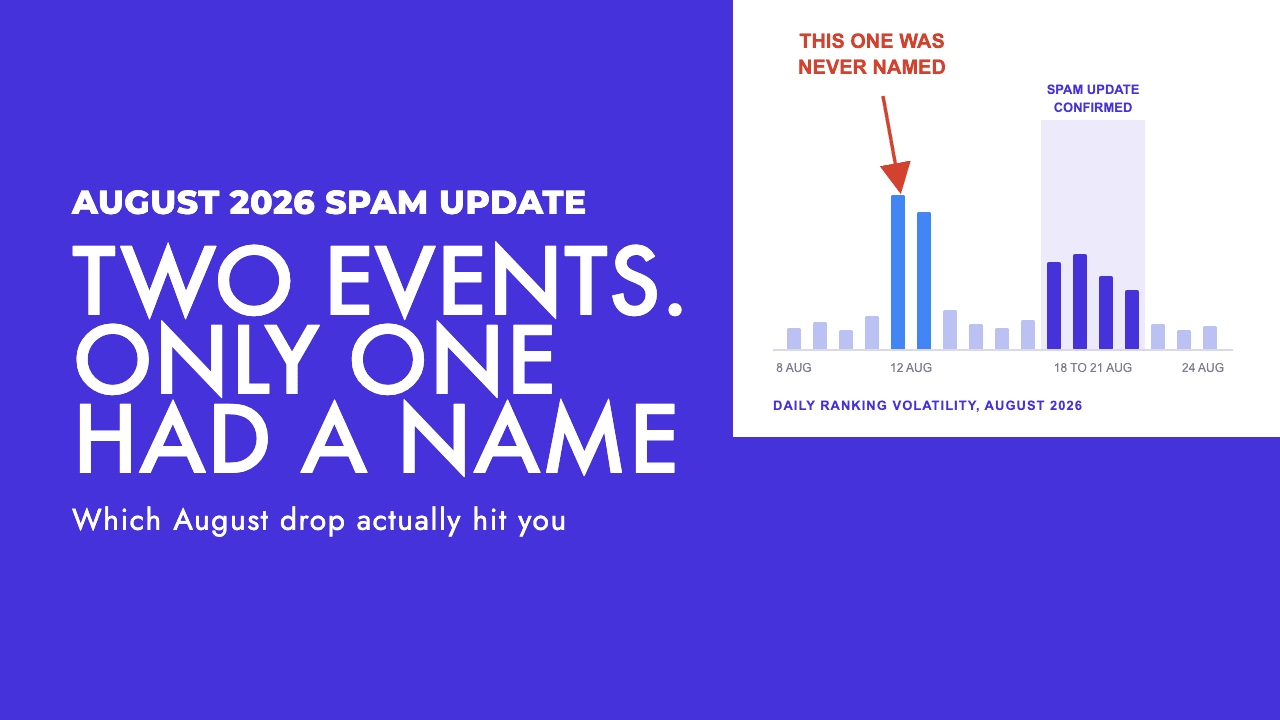
The rollout completed on June 26 at about 2pm ET, two days after it started, and the Search Status Dashboard logs it at 2 days and 1 hour (Google Search Status Dashboard). Search Engine Land called it "a bit bigger than the March 2026 spam update" and repeated the usual caveat that "there will always be cases of sites not spamming Google that get hit by a spam update" (Search Engine Land). Reports in the SEO community were mixed, with some sites reporting steep losses and others complaining that more spam, not less, was surfacing after the rollout (Search Engine Roundtable). Google published no new policy alongside it, so the reading above still holds. It was followed by a run of unconfirmed volatility in July and August and then the August 2026 spam update, which is where most of the later "was it the AI content" panic actually belongs.
The bottom line
Google's June 2026 spam update is not the death of AI content. It is the death of using AI (or any method) to mass-produce pages nobody needs, and the first real enforcement against gaming AI answers. Those two things were always against the rules. Now the detection is sharper and the rules cover the answer box too.
If you publish content that a real person would want to read, made with help from whatever tools you like, you have nothing to undo this week. If your traffic moved, the honest first question is not "was it the AI." It is "would these pages exist if Google did not."
Not sure which side of that line your site sits on? A free SEO review will tell you fast, and if you want a second opinion grounded in how these systems actually behave, our content strategy and AI search optimisation work is built around exactly this question. For local context, here is how we approach it with our Cyprus client base.