
Yesterday Google's site reputation abuse policy became two policies. One for people searching inside the European Economic Area, one for everybody else.
Most of the coverage framed it as Google backing down under pressure from Brussels. That framing is going to cost somebody money, because the thing that actually removes the value from parasite SEO was never the manual action.
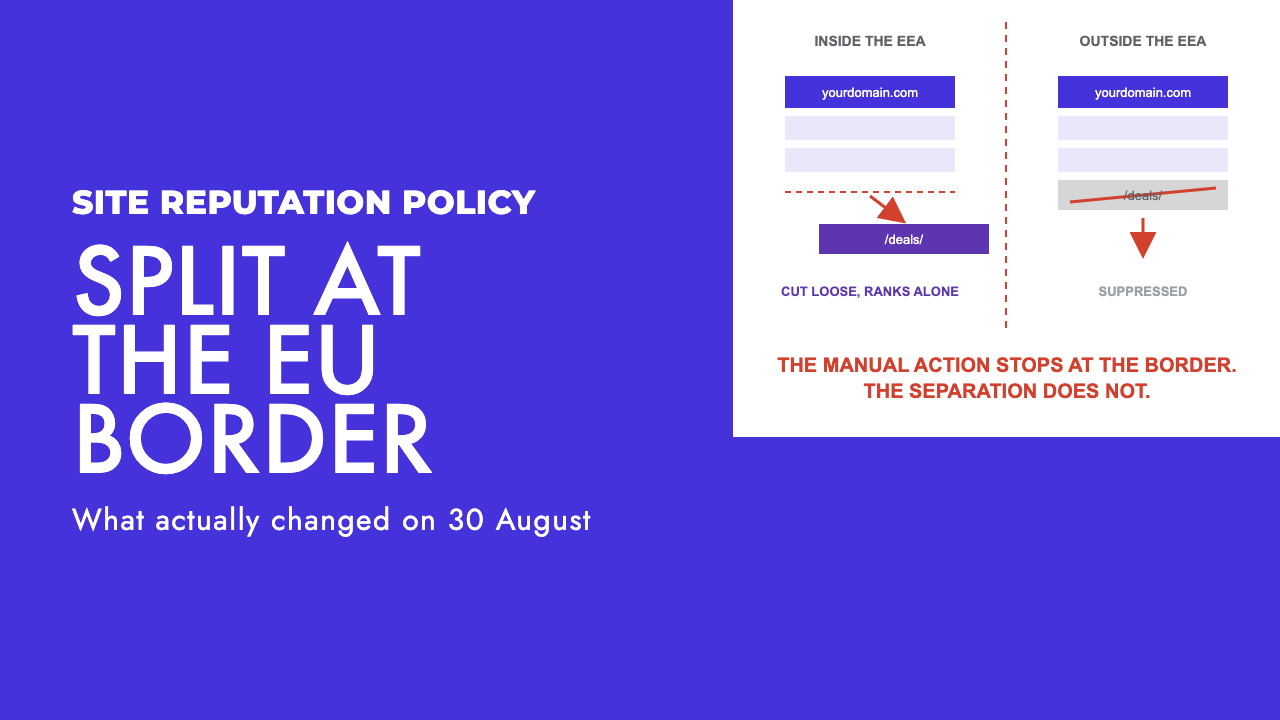
What changed on 30 August
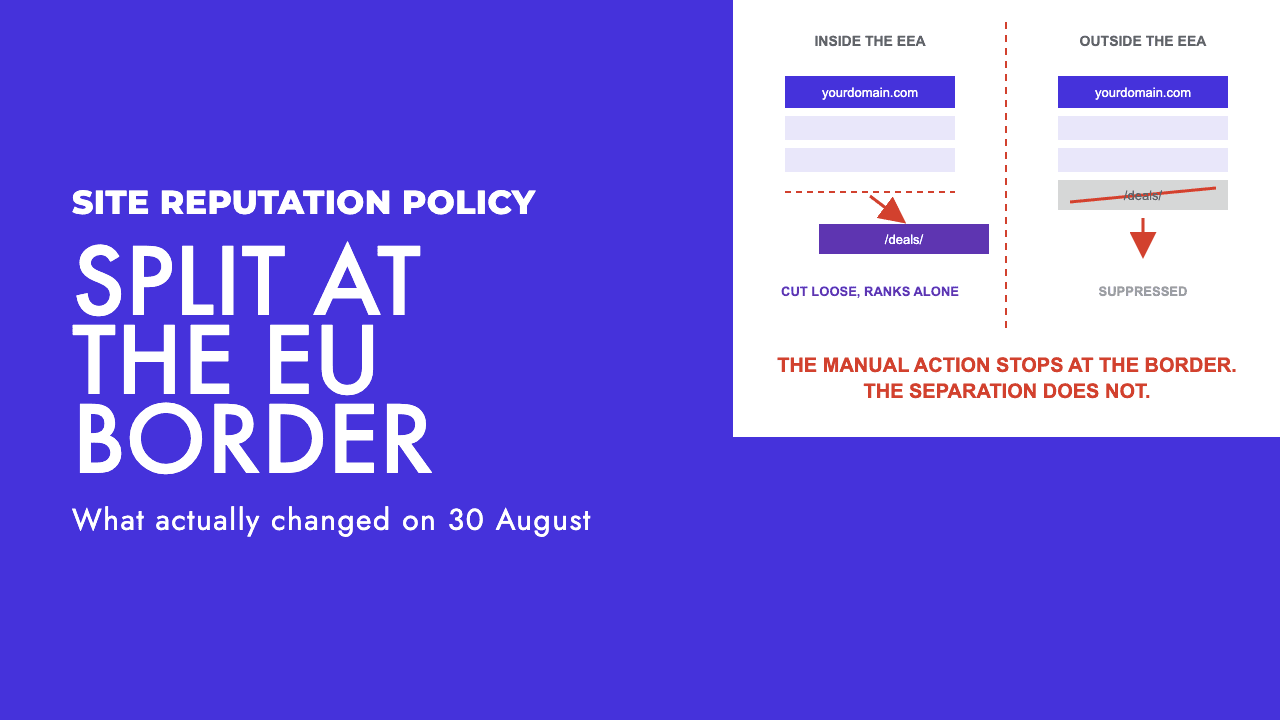
Google announced on 28 August, with effect from 30 August, that manual actions issued under its site reputation policy now behave differently depending on where the searcher is (Google Search Central).
Outside the EEA, nothing is different. A manual action still directly suppresses the affected section of the site in search results.
Inside the EEA, in Google's own wording, "the impact of the manual action won't apply." The affected section may instead "be separated in our systems so that, over time, it ranks independently from the rest of the site."
The policy page goes further than the blog post. Earlier manual actions under this policy are lifted for results shown to EEA users, and a manual action outside the EEA "isn't used as a signal for ranking that content within the EEA" (Google spam policies).
The change came out of a European Commission investigation into the policy itself. Google's spokesperson said it agreed to adjust enforcement for European users and clarify the policy to address the Commission's concerns (Search Engine Land).
Three things did not change, and they matter more than the headline:
- Search Console still notifies you. Google confirmed site owners continue to get the manual action notice regardless of where they are. Reconsideration requests still work, and eligible sites can now take a dispute to mediation after one.
- Separation still happens in the EEA. Google's systems can still treat parts of a site independently so they rank "on their own merits" (Search Engine Roundtable).
- Google is not pretending it likes this. It stated it remains concerned about efforts to weaken its spam policies, and that European users are just as annoyed by pay-for-play content as anyone else.
Why the swap is not a reprieve
Here is the part the "Google gives up in Europe" reads got backwards.
The entire mechanism of parasite SEO is borrowed authority. You publish on a domain that already has trust, and your content inherits ranking signals it could never earn standing alone. Remove the borrowing and the tactic has no engine.
That is exactly what algorithmic separation does. It does not bury the section. It cuts it loose from the host's authority and makes it compete as what it actually is: a thin affiliate directory with no links, no history and no brand.
So in the EEA, Google swapped a penalty that suppresses you for a treatment that de-links you. For an agency selling subfolder rentals, the second one is arguably worse. A penalty is a discrete event you can point at, appeal and recover from. Separation is quiet, gradual and permanent.
Our take: the manual action was always the loud, visible, slow half of enforcement. Google's spam policies say it detects violations "both through automated systems and, as needed, human review" (Google spam policies), and the EEA treatment is now explicitly a systems-level separation rather than a penalty. Anybody selling parasite placements to European clients this week on the basis of yesterday's headlines is selling a product whose engine Google has just said it will remove.
The four criteria are the real story
Buried under the regional politics, Google did something it has avoided for two years: it published the factors it actually weighs when deciding whether third-party content is site reputation abuse (Search Engine Journal). They now sit in the policy text itself.
- Visual presentation. Does the section look and behave like the rest of the site, or like a bolted-on template?
- Content quality relative to the host. Is it held to the same standard as the site's first-party work?
- Clear authorship and editorial responsibility. Is somebody at the host actually accountable for it?
- Duplication across sites. Is the same content sitting on five other domains?
Read those as a checklist and the distinction Google is drawing becomes obvious. It is not "third-party content is bad." Publishers have run guest contributors, sponsored sections and partner content for decades without issue. It is whether the host is exercising editorial control or renting out a subfolder and looking away.
This applies globally. The regional carve-out is about the penalty. The criteria are about the judgement, and the judgement happens everywhere.
If you run a site with a deals section, a partner directory, a guest column or a recruitment jobs board, that list is your audit. Consistent branding, real disclosure, a named editor, content written for your platform rather than syndicated onto it.
Your exposure follows your customers, not your registration
This is the practical bit most businesses will get wrong, and it applies squarely to the two markets we work in most.
The split is defined by where the searcher is, not where the site is hosted or the company registered. A Cyprus company that sells to Cyprus and EU buyers sits inside the carve-out. The same Cyprus company selling to American customers does not. Its US searchers see full manual action enforcement.
It cuts the other way too. A US publisher with a European readership now has a section of its audience for whom a manual action simply does not land.
So if you are trying to work out your position, the question is not "are we European." It is "where do the people who buy from us search from." For most of the Cyprus businesses we work with the answer is genuinely mixed: local service queries on one side, expat and international buyers on the other. Two different regimes, one site.
We think this is going to produce a wave of misdiagnosed reporting. A single site can show a section holding up in EU markets while the same section is suppressed in the US, and there is no field in any tool that explains why (and the tool data itself is getting thinner). If you see a geographic split like that in the next few months, check Search Console for a manual action before you start rewriting content.
What to actually do this week
If you host third-party content. Run the four criteria against every section that is not written by your own team. The manual action carve-out is a shield in one market only, and in that market Google has replaced it with separation, which removes the borrowed authority the placement exists for. Editorial control is the fix, not geography.
If you buy placements. Reprice them. What you are buying in the EEA is a page that will drift towards ranking on its own non-existent merits. This is the same arithmetic problem as buying backlinks: you are paying for borrowed signals that the platform is actively engineering away. Earning genuinely good links is slower and it does not evaporate when a policy is redrawn, which is why our backlink building work is built around earned placements.
If parasite pages are outranking you. Do not wait for enforcement, and especially do not wait for it in Europe where the manual action no longer bites. The separation treatment works on its own schedule ("over time", in Google's words). Spend the time building the topical depth that makes your page the better answer instead, which is the same work that gets you cited in AI answers.
If you got a notice. Read it carefully. It still arrives in Search Console even when the impact does not apply to your EEA traffic, and it still matters. It is Google telling you a section of your site has been classified, and that classification does not respect borders even when the penalty does.
The carve-out stops at Google
One more thing nobody is pricing in.
This is a change to Google Search enforcement, negotiated with a European regulator, applied to Google's result pages. ChatGPT, Perplexity, Copilot and Gemini's grounding layers are under no obligation to mirror it. None of them have an EEA exemption for content quality, and their selection of what to cite runs on entirely different logic.
A section of a site that Google separates but does not penalise in Europe is still a section that answer engines are unlikely to treat as an authoritative source. If the last two years have taught us anything, it is that visibility fragmented across systems faster than anyone's compliance strategy did. We covered the same dynamic when the EU forced Google to open its search data: regulation reshapes Google, it does not reshape the wider search surface.
Which brings this back to the boring conclusion that keeps being right. Regional enforcement rules change. What a good page looks like does not. Third-party content that a real editor stands behind was fine before 30 August and is fine after it, in Nicosia and in Nashville.
If you are not sure which side of the line your site sits on, or you are seeing a geographic split in your rankings you cannot explain, we will take a look.