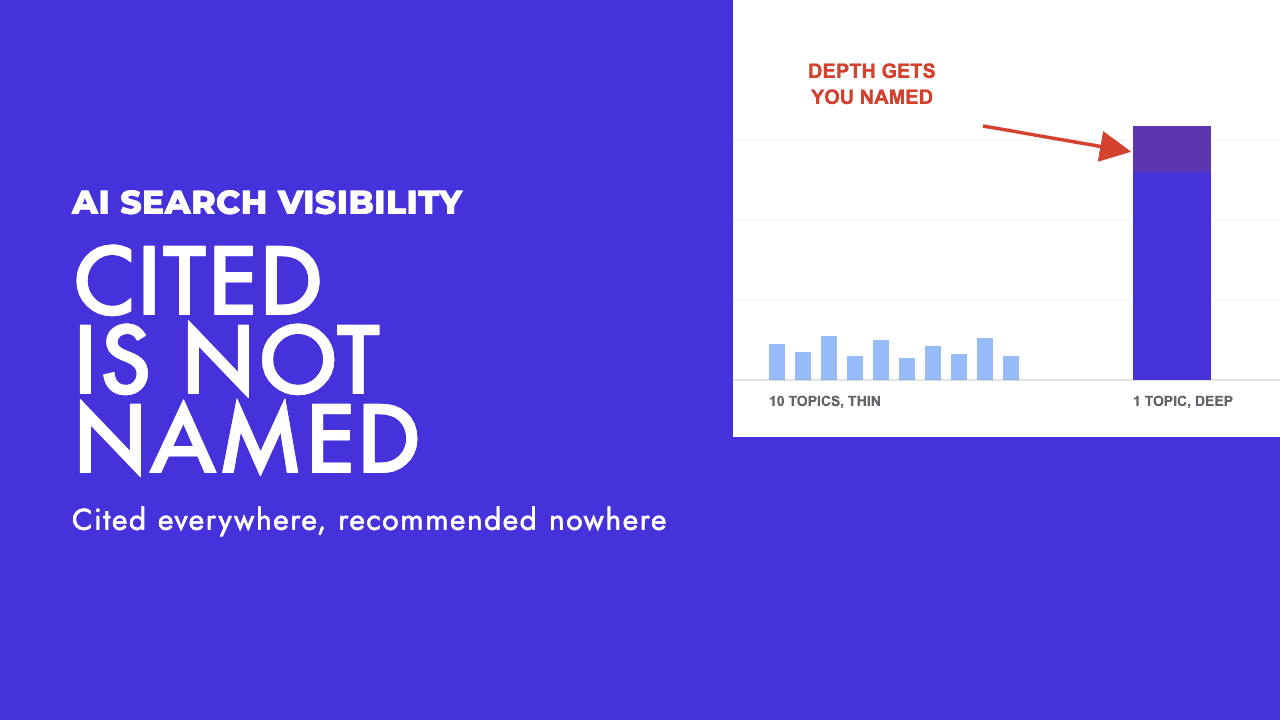

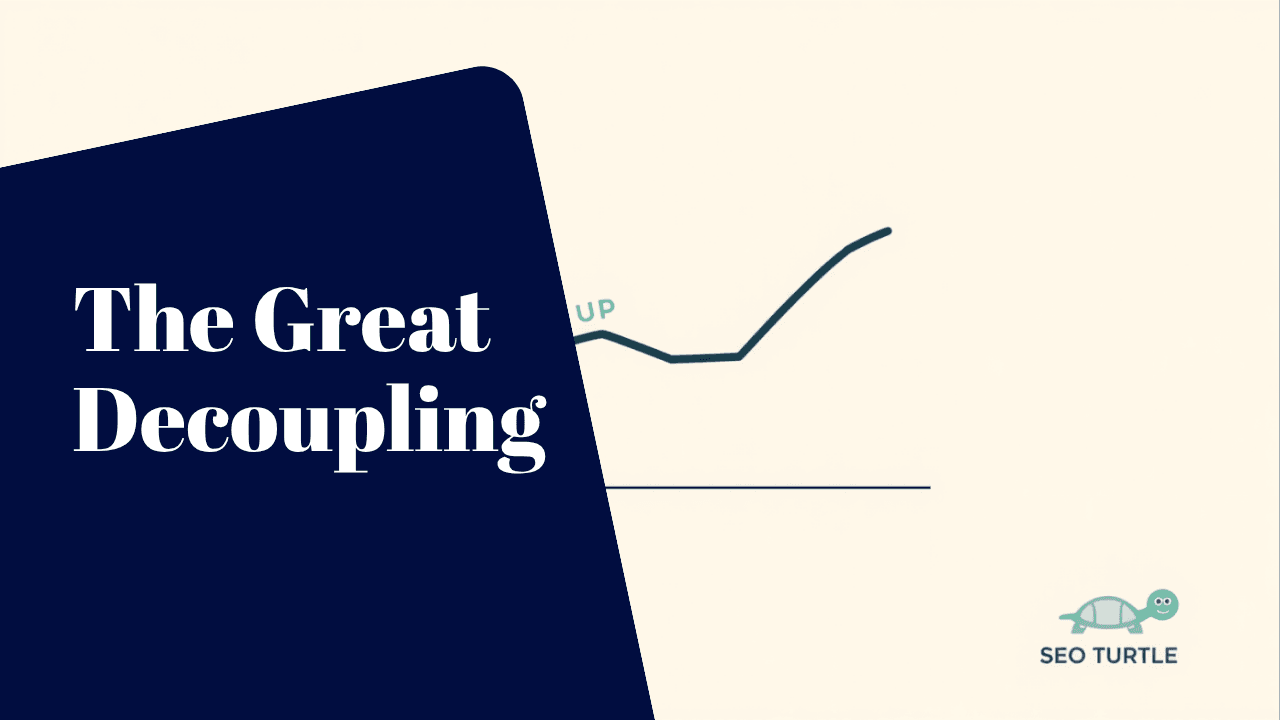
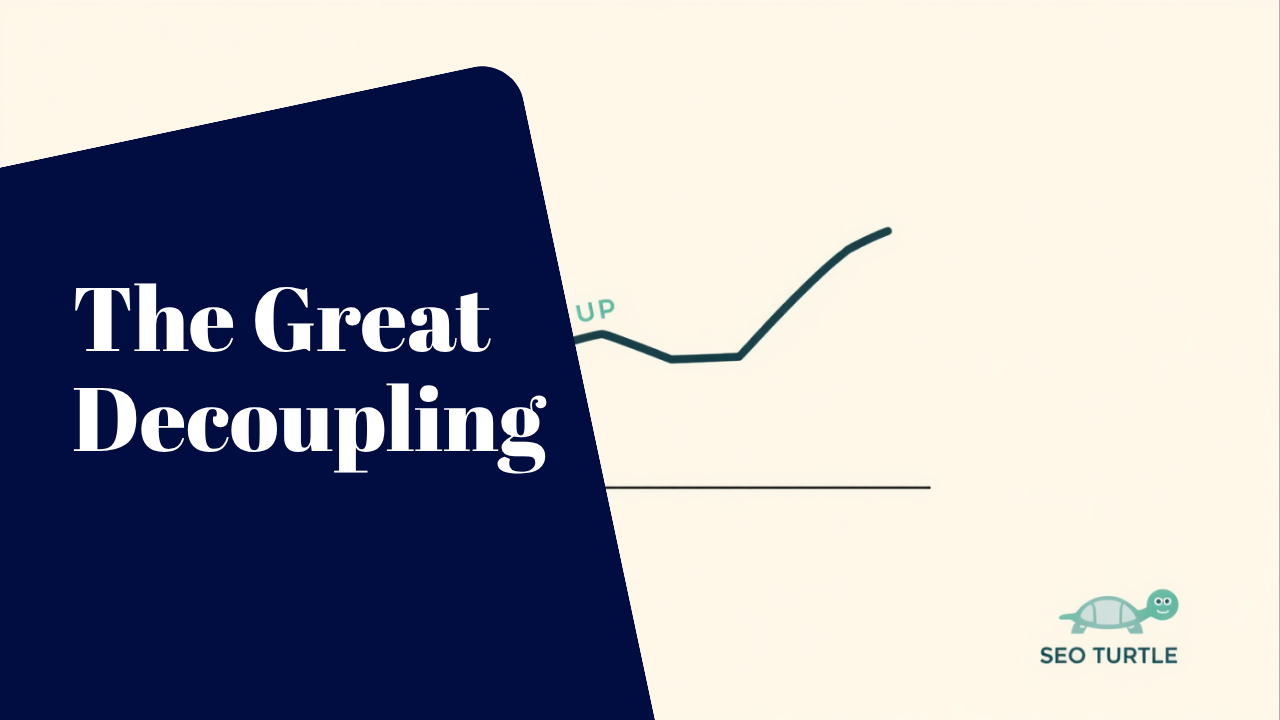
Open Google Search Console for almost any site right now and you will see the same shape. The impressions line climbs. The clicks line does not follow. For most of the history of SEO those two moved together, near enough hand in hand. When you ranked for more things, more people saw you, and more of them clicked. That link has loosened, and the industry has given it a name: the great decoupling.
It is one of the most talked about trends in search this year, and for once the talk is not pure hype. Google itself has acknowledged the pattern. Martin Splitt said in June 2025 that if your pages are shown in AI Overviews or AI Mode your impressions will probably go up while clicks stagnate or fall a little, which Search Engine Roundtable wrote up under the decoupling name. Moz gave it a Whiteboard Friday. Everyone has a take.
So here is ours, and it is not the take you have read ten times already. We looked at the decoupling the way it shows up in the Search Console accounts we manage, and then did the part most articles skip. We worked out how much of it is genuinely AI Overviews eating clicks, and how much is just normal SEO being misread.
What the great decoupling actually is
The great decoupling is the widening gap between how often your pages appear in search (impressions) and how often anyone clicks through to your site (clicks). You become more visible and get less traffic for it.
There are three things driving the gap, and it matters to keep them separate, because the fix for each is different.
The first is AI Overviews and the other answer boxes. When Google answers the question at the top of the page, the user has what they came for and never scrolls to your blue link. You still earn the impression. You lose the click. This is the part people mean when they say "zero click search," and it is the genuinely new force.
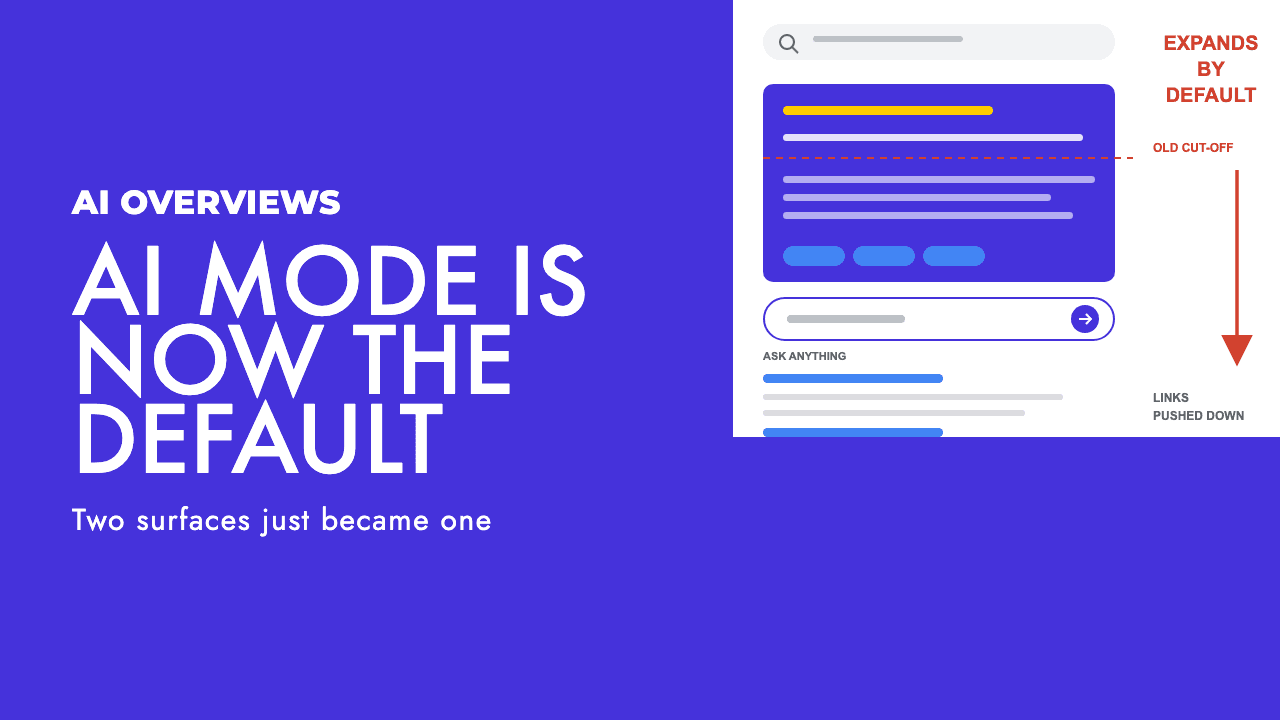
The second is the sheer expansion of the results page. AI Overviews, featured snippets, People Also Ask, video carousels, and knowledge panels all push the classic ten blue links further down. You can rank position six and sit below the fold on a phone. The impression counts. The click rarely comes.
The third is the least glamorous and the most overlooked. A lot of impression growth is just you ranking on page three or four for queries you were never going to win anyway. Google shows your page to more people on the fringes of relevance, those impressions pile up, and of course nobody clicks a result sitting at position 40. That is not AI stealing your traffic. That is normal search, and it has always looked like this.
Most coverage of the great decoupling lumps all three together and points the finger squarely at AI. We think that is lazy, and a single Search Console filter is a good way to show why.
Segment by position before you blame AI
Open the Performance report on almost any site, sort queries by impressions, and look at the top of the list. The pattern we see over and over is a set of queries with impressions in the hundreds or thousands, clicks you can count on one hand, and an average position somewhere between 30 and 80.
On the surface this is the great decoupling in textbook form. Lots of impressions, almost no clicks. If you stopped here you could write the same panic piece as everyone else.
But look at the position column. Position 30 to 80 is page three to page eight. Those impressions are not being intercepted by an AI Overview that quotes you instead of sending the click. They are low clicks because you are not ranking well enough to be clicked yet. This is not decoupling. This is a to-do list.
The real decoupling, the AI flavour, shows up somewhere else entirely. It is on the queries where you rank in the top five or top ten, where you used to expect a healthy click-through rate, and the clicks have quietly thinned out while impressions held or grew. That is the pattern worth worrying about, and you only find it by filtering your data to your strong positions and watching click-through rate over time. Looking at raw impression growth tells you almost nothing.
This is the single most useful thing we can tell you about the great decoupling. Do not read it off the top-line graph. Segment by position. The story on your page-one terms is a completely different story to your page-five terms, and only one of them is about AI.
How big is the AI effect, really
For the queries where AI Overviews genuinely do appear above your strong ranking, the hit is real and it is not small. Ahrefs compared 300,000 informational keywords with and without an AI Overview and found the top-ranking page's click-through rate was 34.5% lower when one was present. Pew Research tracked the real browsing of 900 US adults and found users clicked a traditional result on 8% of searches with an AI summary against 15% without one, and clicked a link inside the summary itself on about 1%. Informational, top-of-funnel content gets hit hardest, because that is exactly the kind of question an AI answer handles in two sentences.
The flip side, which the doom takes skip, is which queries barely move. Transactional and commercial searches, the ones where someone wants to buy, book, hire, or compare, still send the click, because the user needs to land on a real page to finish the job. An AI Overview can tell you what a hreflang tag is. It cannot file your tax return, sell you the running shoes, or take the booking. We see this split clearly across the different industries we work in. The harder the buying intent, the smaller the decoupling.
The honest counter-argument: maybe it is normalisation, not a crisis
There is a smart contrarian view here, and we have a lot of time for it. Search Engine Land ran a piece in late 2025 arguing that we should forget the great decoupling and call it the great normalisation instead. The argument goes like this. For ten years the SEO industry was rewarded for pumping out vast volumes of thin informational content that earned clicks and very little else. AI Overviews are now quietly killing that traffic, and honestly, most of it was never worth much. The visitor read your two-paragraph definition, bounced, and never became anything. Losing that is not a crisis. It is the market correcting.
We mostly agree, with one caveat, and a randomised field experiment published in July 2026 complicated the "it was junk traffic anyway" half of the argument by finding no engagement difference between the clicks AI Overviews remove and the ones they leave, which we covered in the clicks AI Overviews take are not low quality. Normalisation is the right frame if you were already doing real SEO, the kind aimed at people who might become customers. If your entire model was traffic volume from informational keywords, then "normalisation" is a polite word for your business model breaking. Both things are true at once. The era of easy informational traffic is ending, and the people who relied on it are not wrong to be worried.
What to actually do about it
The strategy that follows from all this is not complicated, and you have probably guessed most of it already. Here is what we are doing for clients.
Re-measure before you panic. Stop reading SEO health off impressions. Track clicks and click-through rate on the queries where you rank in the top ten, segmented from the long tail. If your strong-position CTR is holding, you are fine, whatever the top-line graph does. If it is sliding, now you have a real problem to work on, and the snippet is the first lever: rewrite the meta description and check how it renders in the SERP before you touch the page itself. This change in how you measure is the same shift we wrote about in GEO vs SEO, because the old dashboard genuinely will lie to you about the new surface.
Move weight toward intent. Shift effort from "what is X" informational pages, where AI answers win, toward pages that match commercial and transactional intent, where the click survives because the user has to come to you to finish. This is content strategy, not a trick, and it is most of what our content strategy work is about now.
Earn the citation, since you are getting the impression anyway. If your content is going to be read inside an AI answer whether or not anyone clicks, then being the source it quotes is the next best thing to a click, and it builds the brand recognition that drives the clicks you do still get. Leading each section with a clean, direct answer is the change that pays back most here. It helps the AI quote you and it helps human readers too. We go deep on this in our Google AI Mode playbook and it is the core of our AI search optimization work. If you want the wider context on why these surfaces matter, our breakdown of AI search engine market share and why users are switching to AI search both lay it out.
Track the AI surfaces directly. A rank tracker built for blue links will not tell you whether you are being cited in AI answers. You need tooling pointed at the answers themselves. We covered what actually works, and what is still half-baked, in our piece on Perplexity rank tracking.
Do not abandon the fundamentals. None of this replaces technical health. If an AI crawler cannot read your page, you are not in the answer either. Google has been consistent that there is no special markup for AI features and the advice is the same as it has always been, make useful, crawlable content and show your expertise, which it spells out in its own guidance on AI features. Getting the crawl and the structure right is plain technical SEO.
What it means if you are local
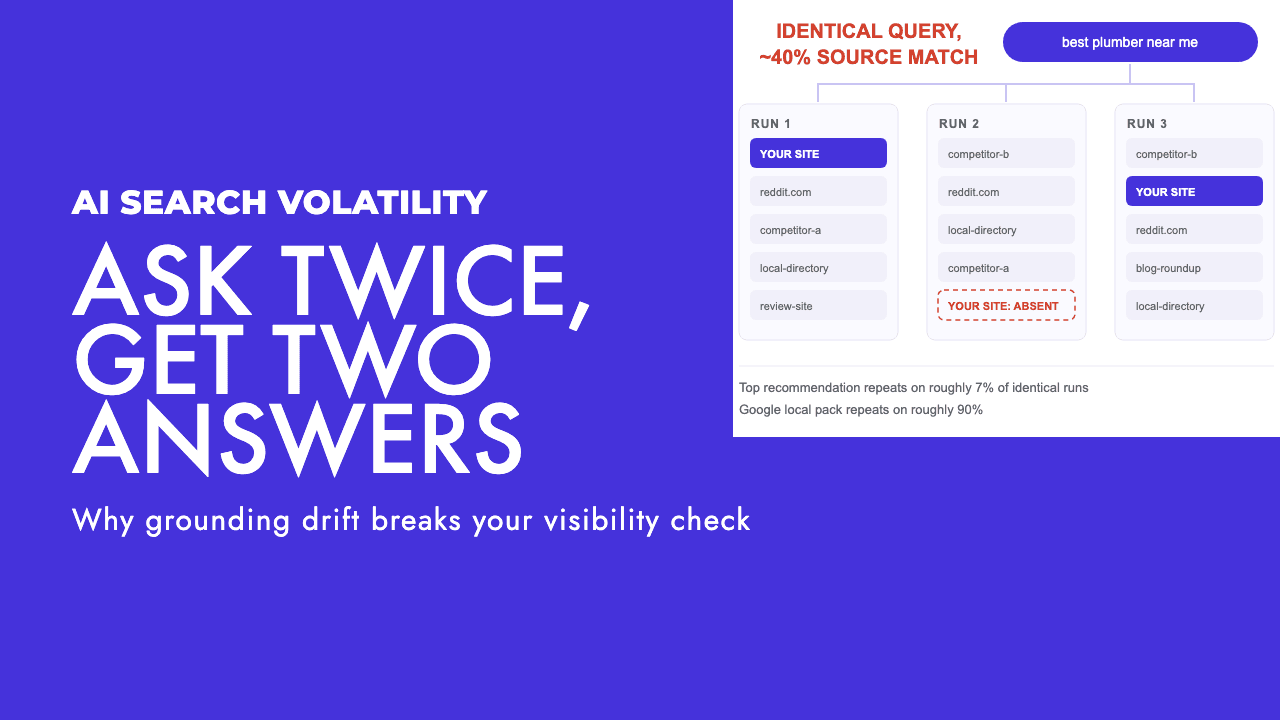
One group can mostly relax about this, and that is local businesses. If you run a law firm in Limassol, a dental practice, or a trades company, the great decoupling is barely your fight. Local searches still resolve to the map pack, reviews, and a phone call, and the AI answer for "best plumber near me" still leans on the same local signals you already need to win. For local intent the click is tied to action, so it holds up well. Get the local SEO fundamentals right and you are largely insulated from the worst of the decoupling. We see this across the Cyprus sites we work on, where the commercial local terms behave nothing like the informational ones.
The bottom line
The great decoupling is real. Impressions are rising, clicks are not following, and AI Overviews are a genuine reason why. But it is not the uniform apocalypse it gets sold as. A large slice of the gap is just normal SEO, low-position impressions that were never going to convert, and a real slice of it is the overdue death of thin informational content that was never worth much.
The work is to tell those apart in your own data, defend the queries where you rank well and intent is high, and stop grading yourself on a vanity metric that AI has quietly broken. Do that and the decoupling goes from a scary graph to a manageable shift.
If you want a straight read on which of your impressions are real opportunity and which are just noise, that is exactly the kind of thing we untangle. Grab a free SEO review and we will tell you where your clicks are actually going.
Update, September 2026
Two changes since June make the "segment by position" advice more important, not less. On 31 August Google finished rolling out a Search Console report for generative AI features to all properties. It shows impressions from AI Overviews and AI Mode by page, country, device and date, and Google says outright that it does not include click data (Search Engine Land). So you can now see the AI slice of the impressions line, and you still cannot see the clicks it costs you. We covered how to read that report when the first version landed.
A few days earlier Google confirmed that for some queries AI Overviews now expand automatically into a full AI Mode response, without the user clicking "show more", which pushes the classic results further down the page (Search Engine Roundtable). That is the second driver above getting stronger. Our read on what it changes is in AI Overviews expanding into AI Mode.