
Google's May 2026 core update finished rolling out on June 2, after nearly twelve days of heavy movement (Search Engine Land). If your rankings dropped, the first thing to know is that you almost certainly did nothing wrong in a way you can point to and fix line by line. Core updates do not penalise you. They re-score the whole web against Google's view of quality, and some sites come out lower.
The second thing to know is the part most recovery advice still gets wrong in 2026. Winning back your rankings and earning a spot inside AI Overviews are no longer two separate projects. They are the same one.
What actually happened in May
The update started on May 21 and Google confirmed it complete on June 2, running close to the two week window Google signalled at launch. It was not a smooth ride. Tracking tools logged several distinct spikes of volatility across the rollout, with the sharpest swings landing the weekend of May 30 and again in the final hours before completion (Search Engine Roundtable).
Google described it as "a regular update designed to better surface relevant, satisfying content for searchers from all types of sites." In other words, nothing exotic. The same quality signals Google has been pushing since the Helpful Content era, applied again with more force.
From what we are seeing across client work, the exposure pattern is familiar too. YMYL pages (your money, your life, so financial services, health, legal), thin commerce, and gambling-adjacent sites took the biggest swings. Sites with shallow content sitting on a strong brand held up better than the reverse.
Google's recovery advice has not changed. That is the point
Here is Google's official line, and it is worth reading slowly because people keep arguing with it. At launch it said "there's nothing new or special that creators need to do for this update as long as they've been making satisfying content meant for people" (Search Engine Land). Its core updates guidance adds that improvements can take months to register, and "if it's been a few months and you still haven't seen any effect, that could mean waiting until the next core update" (Google Search Central).
That sounds like a non-answer. It is not. It is Google telling you that recovery is not a checklist of technical tweaks. It is a verdict on whether your content genuinely deserves to rank, judged against everyone else who answers the same query.
The practical version we give clients: do not chase the update. Chase the gap between your page and the pages that beat you. Read the results that now rank above you and ask the honest question. Does that page answer the searcher better, with more credibility, than yours? If the answer is yes, that is your work. If the answer is no, the update may simply be testing and you give it time.
One timing note. Google advises waiting at least a full week after a rollout completes before you read anything into Search Console. The earliest clean comparison window for this update opened around June 9. Reacting to day-three data is how businesses talk themselves into rewriting pages that were never the problem.
The shift nobody is pricing in: recovery and AI citation are one problem
This is our actual take, and it changes how we are advising both our Cyprus and US clients this month.
Google's own documentation says there are "no additional requirements to appear in AI Overviews or AI Mode, nor other special optimizations necessary," and that both features build their answers by running multiple related Google searches, the "query fan-out" technique (Google Search Central). Read that again. The system that just re-scored your rankings in the core update is the same system that decides which pages get pulled into an AI answer.
So a core update does not only move your blue-link positions. It moves whether you get retrieved and cited inside AI Overviews at all. The two used to be tracked as separate dashboards and sold as separate services. After May 2026, that split makes no sense.
The content changes that help a page survive a core update are, almost line for line, the changes that make a page citable by an answer engine:
- Answer-first structure. A clear, direct answer near the top, before the throat-clearing. This is what core updates reward as "satisfying" and what an LLM lifts as a quotable passage.
- Verifiable, attributed claims. Specific facts with sources beat confident vagueness. Both the ranking system and the citation system favour pages that can back up what they say.
- Entity clarity. Be unmistakable about who you are, what you do, and where. This is E-E-A-T for rankings and grounding for AI retrieval at the same time.
- Real authorship and experience. First-hand expertise is the one thing thin AI-generated competitors cannot fake at scale, and it is increasingly the dividing line in both systems. If you are auditing pages you did not write, an AI text detector will tell you what you are dealing with.
We wrote a fuller breakdown of the extraction mechanics in our guide on how to structure content so LLMs cite you. The point here is narrower and more urgent. If you are planning a post-update recovery sprint, you are also, whether you mean to or not, doing your AI visibility work. Do it deliberately and you get two surfaces for the price of one. Do it blindly and you may fix rankings while staying invisible in the answer box that now sits above them.
What we would do this month
If you held steady, good. Document what your strongest pages have in common and apply it wider. Stability through a volatile update is signal, not luck.
If you dropped, here is the order we would work in:
- Wait for clean data, then segment. Look at which page types and topics moved, not your sitewide line. Losses usually cluster.
- Compare against the winners, not your old self. Pull the pages now ranking above you for your key queries and audit the quality gap honestly.
- Fix for both surfaces at once. Rewrite the top of the page to answer first, tighten claims with real sources, and make authorship and expertise unmissable. Track classic rankings and AI Overview citations together, because a genuine quality lift can move both.
- Hold your nerve on timing. Google has said plainly that meaningful recovery often does not show until the next core update. You may see some movement between updates, but the big reset comes with the next one. Improvements made now are an investment in that window, not a switch you flip.
There is no shortcut here, and anyone selling you a "core update recovery hack" in 2026 is selling the same snake oil they were selling before AI Overviews existed. The work is the work. It just pays off on two surfaces now instead of one.
Update, September 2026
The rollout finished as Google said it would. The Search Status Dashboard logs the May 2026 core update at 11 days and 21 hours, from May 21 to June 2 (Google Search Status Dashboard), and the June 2 volatility spike was the last one before completion (Search Engine Roundtable). Neither Search Engine Land nor Search Engine Roundtable reported a broad wave of reversals afterwards, so the advice above stands: what you had on June 9 was the real result.
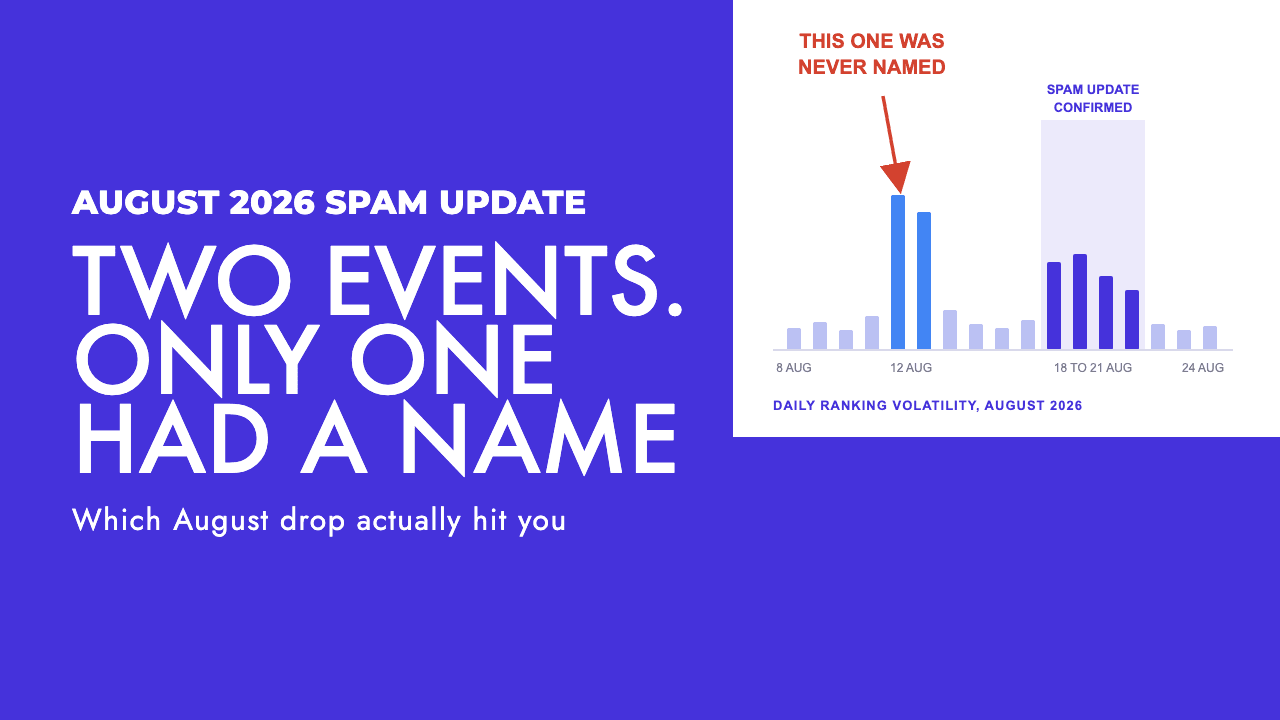
The quiet did not last. Google shipped a spam update on June 24 to 26, trackers logged unconfirmed spikes on July 24, August 1 to 3, August 5 and August 12 to 13 (Search Engine Roundtable), and then the August 2026 spam update ran from August 18 to 21. If you are reconstructing a summer of movement, line each drop up against those dates before you blame the core update for all of it.
If you want a second pair of eyes on what moved and why, our free SEO review covers both classic rankings and AI search visibility, and our AI search optimization service is built around exactly this overlap. For the bigger picture on why impressions and clicks have come apart in the AI era, our piece on the great decoupling is the companion read to this one.