
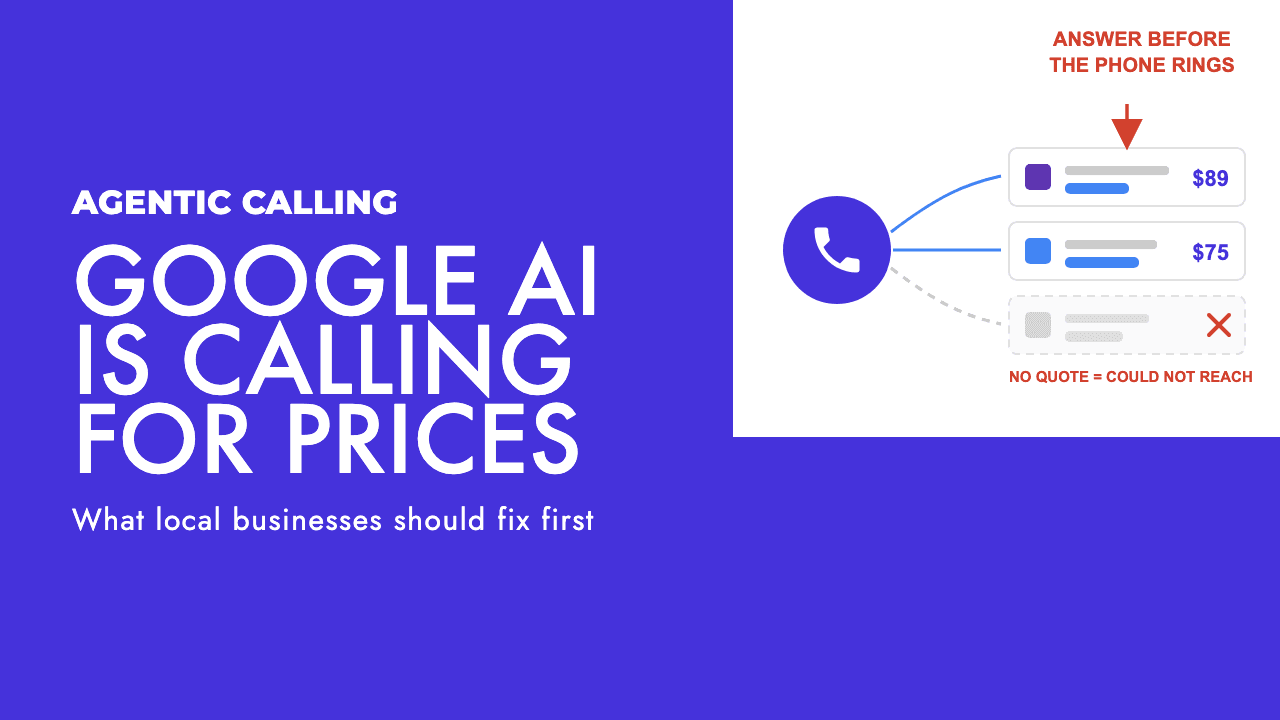
The phone rings at a body shop in Ohio. It is a synthetic voice, calling from Google, on behalf of a real person who wants to know what a brake inspection costs and when you could fit them in.
Eight of your competitors are getting the same call at the same time. In about ten minutes, the customer receives one email with all the answers side by side.
Most of the advice circulating about this feature is about the phone. Train your front desk. Have a price sheet by the till. Answer faster.
That advice is not wrong, but it treats a symptom. The call is what Google does when it cannot get the answer any other way.
What Google actually launched
Google's own Business Profile documentation is the clearest source on this. It confirms that Google places automated calls to businesses to complete customer requests, including booking appointments, checking restaurant wait times, and confirming price and availability of products and services.
The calls are live in select regions and languages. In the US that currently means every state except Indiana, Louisiana, Minnesota, Montana and Nebraska.
It started small. Search Engine Journal covered the original Search Labs test, which was limited to auto repair and nail salons and called roughly eight to eleven businesses per request, drawn from the top local results. Through 2026 it has widened considerably, and Google's own guidance now covers calling shops to check local stock on things like electronics and health and beauty products.
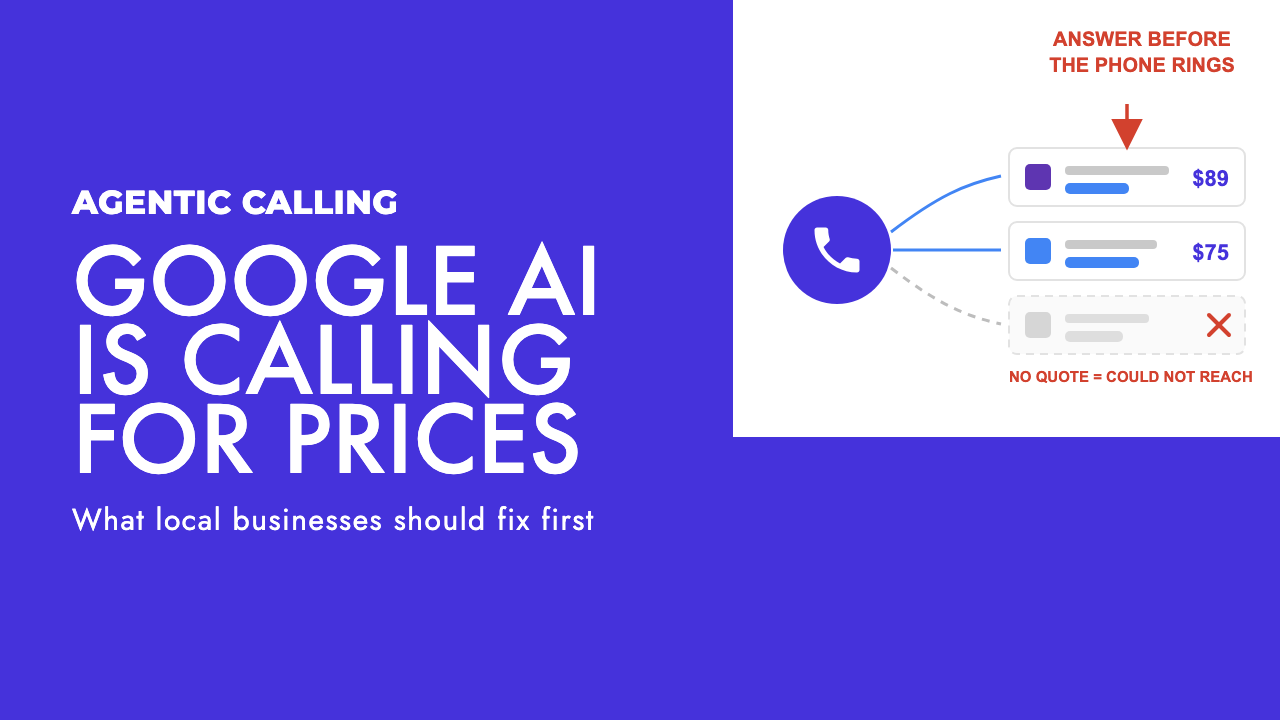
Sterling Sky ran a hands-on test on hair salons and documented the whole flow: request submitted at 1:30pm, comparison email back at 1:41pm. The email listed the salons that gave prices, and separately listed the ones Google could not reach.
Hold onto that second list. It matters more than anything else here.
The detail almost everyone skipped
Buried in that same Google help page is the line that changes the whole strategy: if a business already shares its product details through Google Merchant Center, Google uses that data instead of calling.
Read that again. The phone call is a fallback. It is what happens when the answer to "what does this cost and can I get it" is not already sitting somewhere machine readable.
This is the same pattern we have watched play out across every AI surface for two years. When a system can read your answer, it reads it. When it cannot, it either guesses, asks somebody else, or now, apparently, picks up the phone.
Our view is that the businesses winning here will not be the ones with the fastest receptionist. They will be the ones whose prices and availability were already published clearly enough that nobody needed to ask.
Why opting out is a trap
You can opt out. Google lets you do it in your verified Business Profile under Advanced settings, or you can simply tell the caller to remove your business from the list.
We would think very hard before doing that, and here is why.
The customer still gets their comparison email. Your competitors are still in it with real numbers. You are in it too, in the section headed with businesses that could not be reached. You have not removed yourself from the comparison. You have just changed which column you appear in.
There is a legitimate case for opting out. If your pricing genuinely cannot be quoted without a site visit, and a wrong number over the phone creates a real commercial problem, that is a business decision and it is yours to make. But make it knowing that "unreachable" is a visible state, not an absence.
The bigger risk is doing nothing and hoping the phone gets answered well. Sterling Sky cited testing showing that, on average, 48% of the businesses where a person answered did not give Google's AI a price at all. Those businesses paid the staff time and got nothing back for it.
"Call for a quote" is now an instruction to a machine
This is where we will be blunt, because it is the part clients push back on hardest.
If your services page says "contact us for pricing", you have written a page that answers no question. It was already weak for buyers. It is now literally unreadable by the system deciding whether to include you in a comparison.
You do not have to publish a single flat number to fix this. Scoped pricing works, and works better:
- A from-price with the conditions attached ("brake inspection from $X, most saloons, same day if booked before 11am")
- What is and is not included at that price
- What moves the price up, in plain terms
- Your realistic response or availability window
That is a quotable answer. A machine can lift it, a human can trust it, and neither has to phone you to get it.
There is a second reason to do this deliberately. The thing Google is assembling is a price comparison. If the only signal you give is a number, the number is the only thing you compete on. Publishing scope alongside the price is how you stay in a conversation about value rather than a race to the cheapest quote in the county.
Local rankings still gate the whole thing
Worth being clear about, because it gets lost in the excitement about AI: you cannot receive one of these calls if you are not in the top local results to begin with.
Independent testing found the calls go to the businesses already surfacing in the local pack. Everybody below that line is not in the running, has no chance to quote, and does not even appear on the unreachable list.
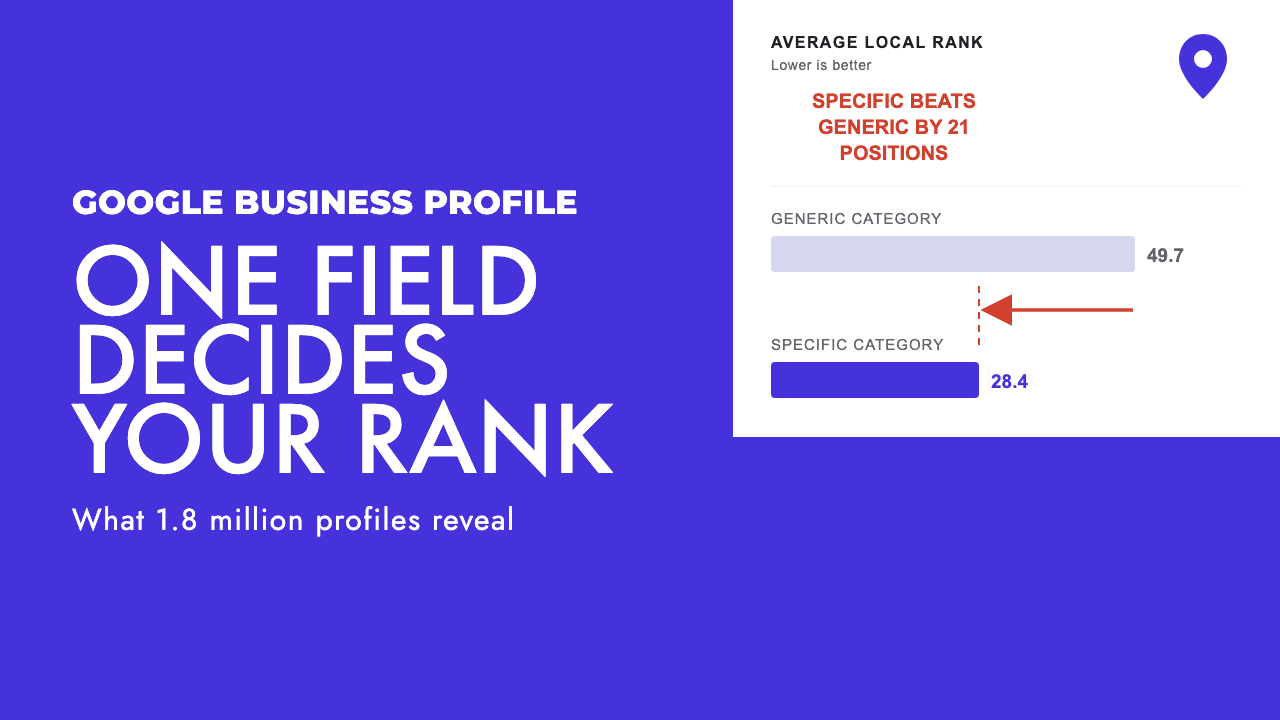
So none of this replaces the local SEO fundamentals. Your Google Business Profile categories, your review velocity, your proximity and prominence signals still decide whether you are in the pool at all. We wrote recently about how much weight category choice alone carries in local rankings, and that has not changed. The calling layer sits on top of the ranking layer, it does not bypass it.
What we would do this month
For a US local or home services business:
- Check whether you are actually opted in. Business Profile, Advanced settings, automated calls. Know your current state rather than assuming it. (And if the profile itself is suspended, none of this applies until you have worked through the reinstatement appeal.)
- Get your top five services priced on your own site, with scope, in text. Not in a PDF, not in an image, not behind a form.
- If you sell products, get a Merchant Center feed live with stock and price. That is the switch that answers Google without the phone ringing, and it is the same feed discipline that carries SEO for ecommerce stores.
- Brief whoever answers the phone. They should know a Google automated call is a real customer request, and they should have a quotable range in front of them rather than reaching for "it depends".
- Keep opening hours and holiday hours accurate. Being closed when the call lands looks identical to being unreachable.
Cyprus is not in this yet, and that is the useful part
The calls are not running in Cyprus. Nothing on your phone line is going to change this month.
The homework is the same anyway, because the same gap gets exploited by every agent that is already here. ChatGPT, Perplexity and the agentic browsers reading your site right now hit exactly the same wall when they land on a page that says "contact us for pricing". They do not phone you. They just move to a competitor who published something. The same wall shows up in every local category we work in here, from garages to restaurant marketing in Cyprus.
We have argued before that Cyprus businesses are getting a runway that US businesses did not, and this is another lap of it. Publishing real pricing and availability is a website with answers on it, which was the right idea before any of this arrived, and it needs no AI project to justify it.
The shift underneath all of it
For twenty years, local SEO was about getting found. The buyer did the rest of the work: clicked through, read your page, called you, formed an impression.
That middle section is being automated away. Something else now does the reading, the calling, and the comparing, and it hands the buyer a summary. Your website and your phone line stopped being places where you persuade a person, and became data sources that get queried by a machine on a deadline.
The businesses that treat that as a customer service problem will staff up to answer more calls that convert worse. The ones that treat it as a data problem will stop getting called and start getting quoted.
If you want a second opinion on whether your service pages are actually answerable, that is exactly what we look at in a free SEO review, and it is the sort of gap our local SEO work is built around closing.