
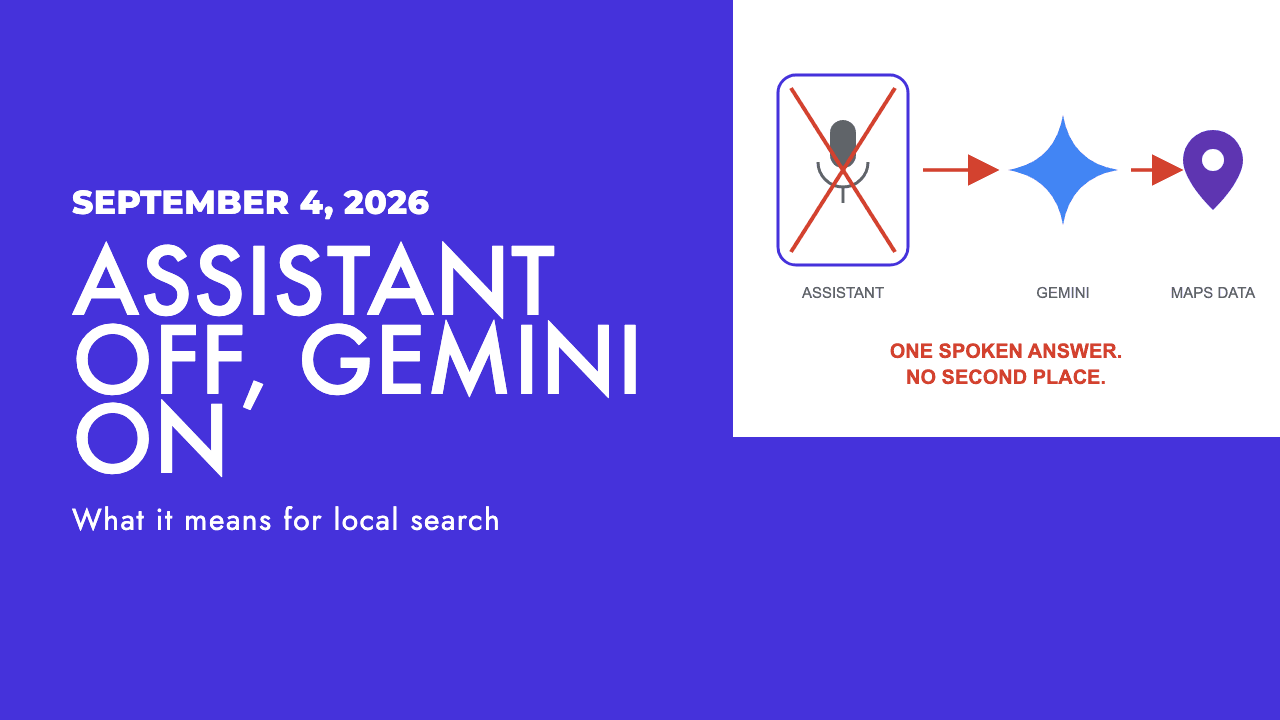
Google is switching off Assistant on Android starting September 4, and it is not offering a way back.
The notice went out by email at the start of August. Phones, tablets, Wear OS watches, Gemini-compatible earbuds and Android Auto projected from a phone all lose Assistant, with the rollout taking a few weeks to reach everyone. Google's wording leaves no ambiguity: once availability is removed you will not be able to use or switch back to Assistant on that device (Search Engine Land, 9to5Google). Cars with Google built in keep Assistant for now.
Most of the coverage has treated this as a consumer gadget story about lost features and slower smart home commands. That is the small half of it.
The bigger half is that hundreds of millions of people are being moved onto a large language model interface in a single month, without choosing it, and a decent share of what they ask it will be local and commercial. If you sell to people who are standing up, driving, or holding a phone in one hand, your discovery surface changed while you were reading this.
What actually changes when you speak to your phone
Assistant was a router. It matched what you said to a known intent, then fired the matching action: open Maps, call this place, start navigation, set a timer. Predictable, narrow, and when it worked, it worked the same way every time.
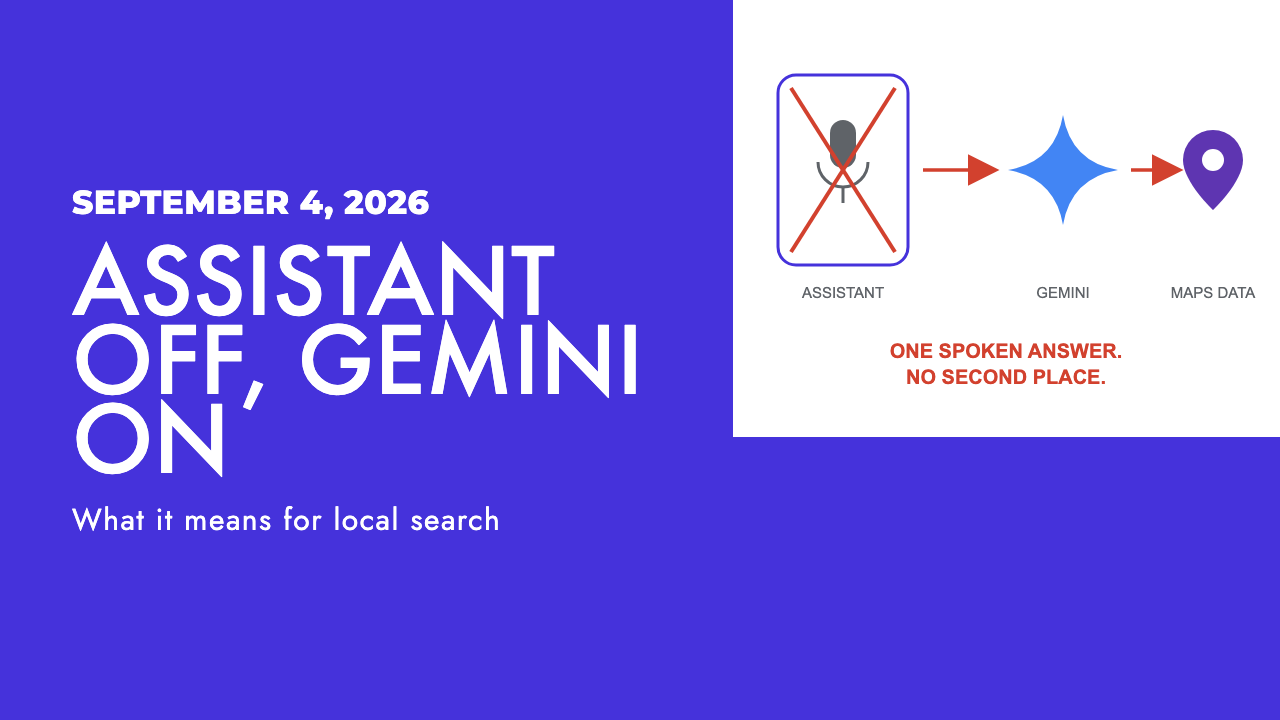
Gemini is not a router. It is a model that composes a response, decides what is relevant, and picks what to name.
That is the whole shift in one sentence. A system that matched your query to a listing has been replaced by a system that forms an opinion about your query. Ranking still exists underneath, but the last step before the user hears anything is a model making an editorial call.
Gemini answers local questions from Maps and Business Profile data
Here is the part with a direct line to your marketing.
Google made Grounding with Google Maps generally available last year, connecting Gemini models to live data on more than 250 million businesses and places. It pulls current opening hours and operational status (including temporarily closed), ratings, reviews, neighbourhood context and nearby amenities, and Gemini decides on the fly whether to ground a given query in Search, in Maps, or both (Google Developers Blog, Google AI for Developers).
So the assistant on the phone in your customer's pocket is not guessing about you from training data. For local queries it is reading your Google Business Profile, in real time, and speaking a summary of it out loud.
That makes the Business Profile something different from what most owners still treat it as. It has stopped being a directory entry that helps you show up in the map pack and become a retrieval source for a spoken answer where the user never sees a list of alternatives.
We see the consequences of neglected profiles constantly with client sites. Hours that were last updated before a seasonal change, a service list that stops at three items, categories chosen in a hurry five years ago. None of that was fatal when the profile was one card among ten. It is a lot more expensive when it is the raw material for the only answer a person hears.
Voice was always winner takes all. The winner is now chosen differently
Nobody listens to ten blue links. Voice has always collapsed to one or two results, which is why voice search never really became its own discipline: it was just local SEO with a smaller number of winners.
What changed is the selection logic. Proximity, prominence and relevance still drive Maps, but the model sitting on top now weighs things a ranking algorithm never did: how confident and coherent your information looks, whether your reviews describe what the user actually asked for, and whether anything about your listing conflicts with what it can see elsewhere.
Conflicting information used to cost you a little trust. Now it costs you the mention, because a model reconciling two versions of your opening hours will quietly favour the business whose data agrees with itself.
The sharp end of this is Android Auto. Someone driving asks for a pharmacy, a garage, a restaurant with a table free. That is about as high intent as local search gets, it is completely hands free, and from September it runs through Gemini on any phone projecting into the car. There is no screen to scan and no second chance.
Our take: ignore the AI adoption numbers you are about to be shown
Expect a wave of Q4 reports announcing that AI assistant usage has exploded. It will be true, and it will mean less than the headline suggests.
A forced migration is not adoption. Millions of people who liked Assistant fine are going to end up using Gemini because the alternative was removed from their phone, and their queries will land in the same bucket as those of people who genuinely chose an AI assistant. Anyone using that number to sell you an urgent AI strategy is selling you a rounding error dressed as a trend.
The honest read is more useful and slightly less dramatic. The behaviour is not changing much (people asked their phones for local businesses before and they will keep doing it), but the mechanism that decides who gets named has changed, and it now rewards clean, consistent, machine readable facts more than it rewards clever pages.
This is also why we keep telling clients not to build a separate "voice search strategy". There is no separate channel to optimise. There is your entity data, and how legible it is to a model. Google itself has been consistent that answer engine work is still SEO, which we covered in our piece on Google saying AEO and GEO are still SEO. It is also the basis of how we approach optimising for AI answers.
The other half of the market is heading the same way. Google has confirmed Gemini will power the rebuilt Siri, expected later this year alongside iOS 27 (MacRumors). Both major phone assistants become language models within weeks of each other.
What to fix before September 4
None of this is exotic work. It is the boring stuff, done properly, on a deadline that now exists.
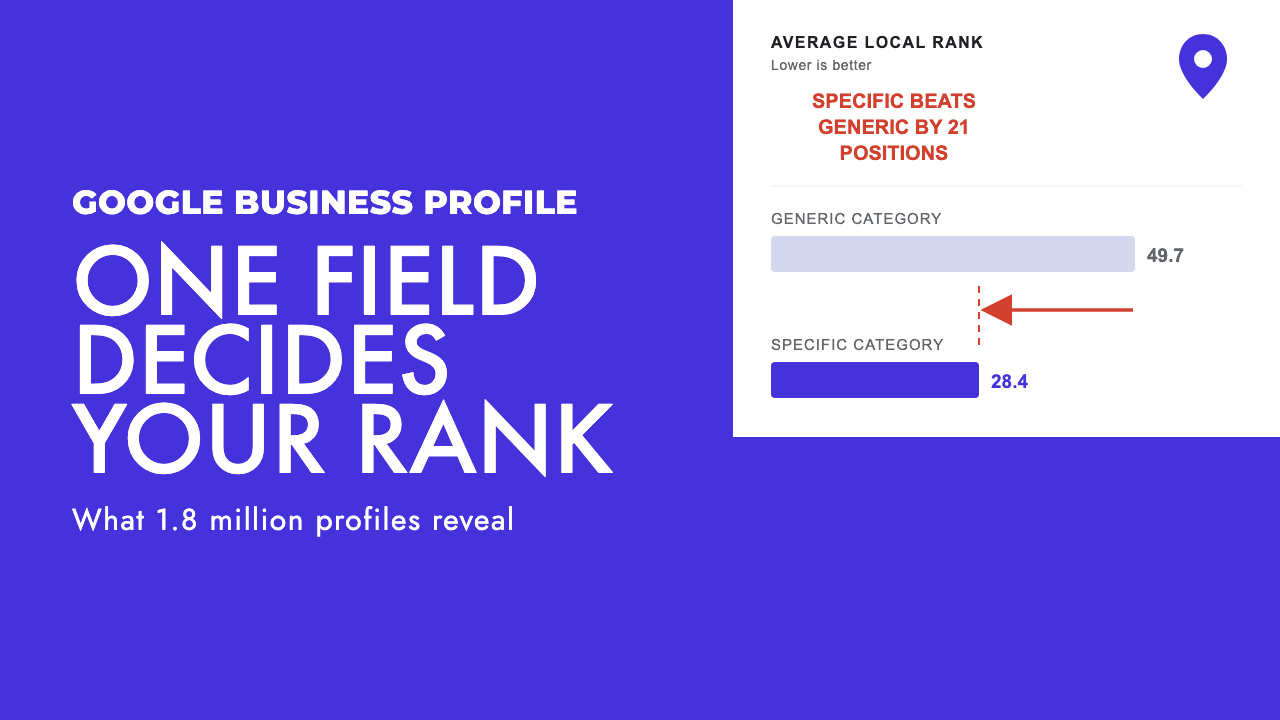
Audit the Business Profile like it is your homepage. Hours including holidays, every service listed explicitly, primary and secondary categories, attributes, current photos. If a customer would have to phone you to learn it, Gemini has to guess it.
Make your facts agree everywhere. Name, address, phone, hours and services should match across your site, your profile, and every directory that lists you. Contradictions are the single cheapest way to lose a spoken recommendation.
Answer the follow up, not just the query. Voice conversations continue. "Is it open now" is followed by "do they do emergency appointments" and "is there parking". Put those answers in plain sentences on the relevant page and in your profile, not buried in a PDF or a hero image.
Get reviews that mention the specific thing. Maps grounding can draw on review content for subjective questions, so reviews that name the service, the neighbourhood or the situation do more work than a five star rating with no text.
Ask Gemini about your own category and listen. Try the queries your customers would ask out loud, in your city, and note who gets named. That test takes ten minutes and tells you more than any tracking dashboard about where you stand today.
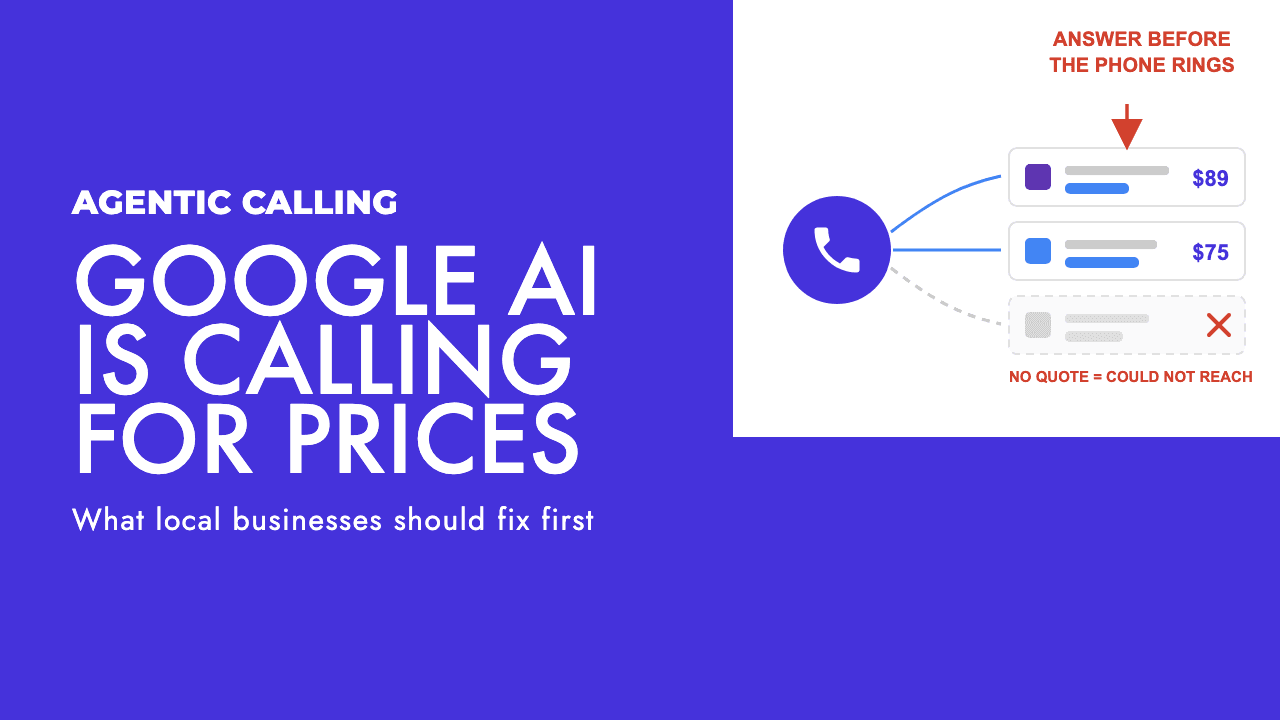
For a broader view of how near me behaviour has shifted this year, our local SEO in 2026 guide covers the ground beyond voice, and the AI Mode playbook covers the text side of the same problem. Voice now runs the other way too: Google's AI can phone your business for prices and availability on a searcher's behalf, which puts the same premium on whoever answers your phone.
The bottom line
September 4 does not create a new marketing channel. It removes a predictable layer between your data and your customer, and replaces it with a model that decides which single business to mention.
Businesses with tidy, consistent, specific information will quietly do better out of this. Businesses relying on a half finished profile and a website that agrees with none of it will disappear from a conversation they never knew was happening.
If you want another set of eyes on how your local footprint reads to an AI assistant, our local SEO service starts exactly there, and you can get a free SEO review if you just want to know where you stand first.