
Ask a local business owner when they last changed their Google Business Profile category and you get the same answer almost every time: never. They picked one when they claimed the listing, it was close enough, and the field has sat untouched ever since while everyone argued about content and links.
That dropdown is not a filing detail. It is the label Google uses to decide which searches you are even eligible for, and new data suggests it moves more positions than most of the work currently in your marketing plan.
What the data actually says
Whitespark analysed 1.8 million Google Business Profiles across 4,209 categories and compared category choice against local ranking position (Search Engine Land).
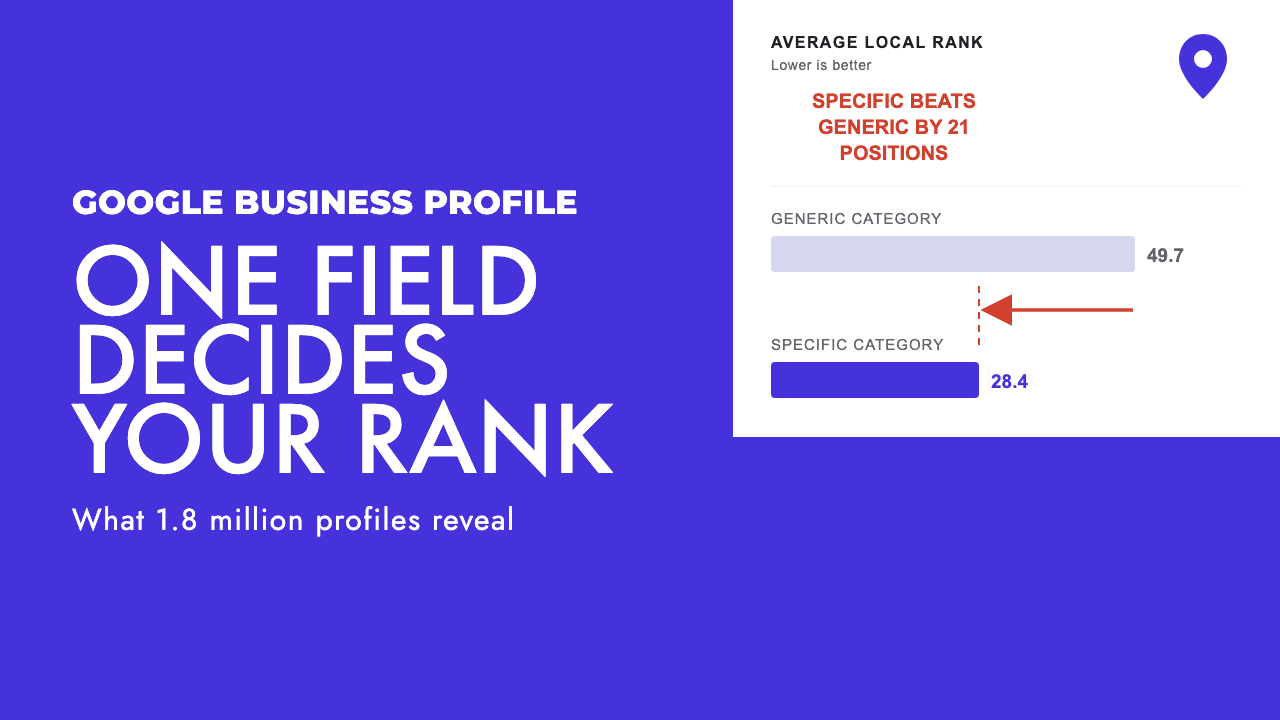
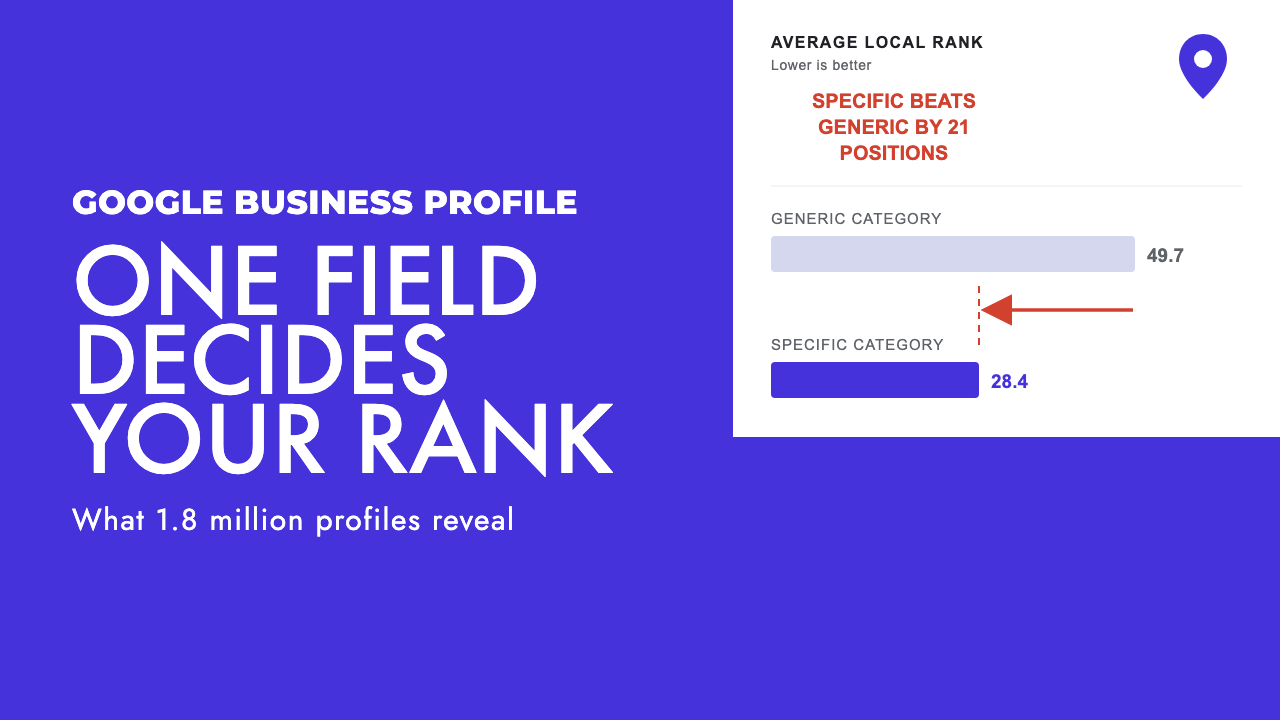
Specific primary categories outranked generic ones by an average of 4.2 positions, and appeared in the top 10 roughly 36% more often. The individual comparisons are blunter than the average. "Criminal justice attorney" averaged rank 44.7 against 57.1 for plain "Attorney". "Hawaiian restaurant" averaged 28.4 against 49.7 for "Restaurant".
That is a twenty position gap on the restaurant example, from one dropdown, at no cost, in about ninety seconds of work.
Additional categories are a precision tool, not a volume play
Well chosen secondary categories tracked improvements of six to seventeen positions. "Emergency veterinarian service" alongside "Veterinarian" averaged 33.9 against 51.2 for veterinary profiles without it.
The important half of that finding is the failure case. Vague additional categories such as "Service establishment" correlated with worse performance, not neutral performance. Adding categories is not free.
This is where people get confused, because Google's own guidance says to use as few categories as possible and to pick ones that complete the sentence "this business is a" rather than "this business has a" (Google Business Profile help). That reads like it contradicts the data. It does not. The same help page tells you to focus on adding the most specific categories for your business and let Google infer the general ones, so "Golf resort" already covers "Hotel".
Google is telling you to be precise. The data is telling you that precision pays. A second category earns its place when it describes a distinct thing you genuinely are, like emergency veterinary care. It costs you when it is a hedge you added because the list allowed it.
Completeness is five boring fields
The same study scored profiles zero to five on whether they had a website, a description, hours, photos and a claimed status. Profiles scoring five ranked around 19 positions higher than empty ones, with top 10 appearances at 13% against 4%.
Nothing on that list is difficult. Nothing on it is a strategy. It is a claimed listing with the hours filled in.
Darren Shaw is careful about this in the write up, and so are we: correlation is not causation. Businesses that complete every field are usually businesses that also chase reviews, maintain a real website and spend money on marketing. The complete profile is partly a marker of a serious operator rather than the whole cause of the ranking.
That caveat does not change what you should do. Whether the five fields cause the ranking or merely signal the kind of business that earns one, the fields take an afternoon and the ranking does not arrive without them.
Our take: this is the cheapest lever in local SEO and almost nobody pulls it
We will say this plainly as opinion. Category selection is the most under-worked field in local search, and the reason is that it does not feel like work.
There is no deliverable. Nobody bills for it. It does not produce a report, a content calendar or a link. So it gets skipped in favour of things that look like effort, and businesses spend four figures a month on content while sitting in a category that describes a different business to the one they run.
We see the same three patterns constantly. A specialist practice filed under the generic parent category. A business that pivoted three years ago and never updated the listing to match. And a company that added six additional categories to "cover everything" and diluted the one that was working.
The fix for all three is the same afternoon of work, and it is the first thing we check on any local SEO engagement, before anyone opens a keyword tool.
Why this matters more now that AI answers the question
The category field used to matter for the map pack. It now matters for a second surface that is growing faster.
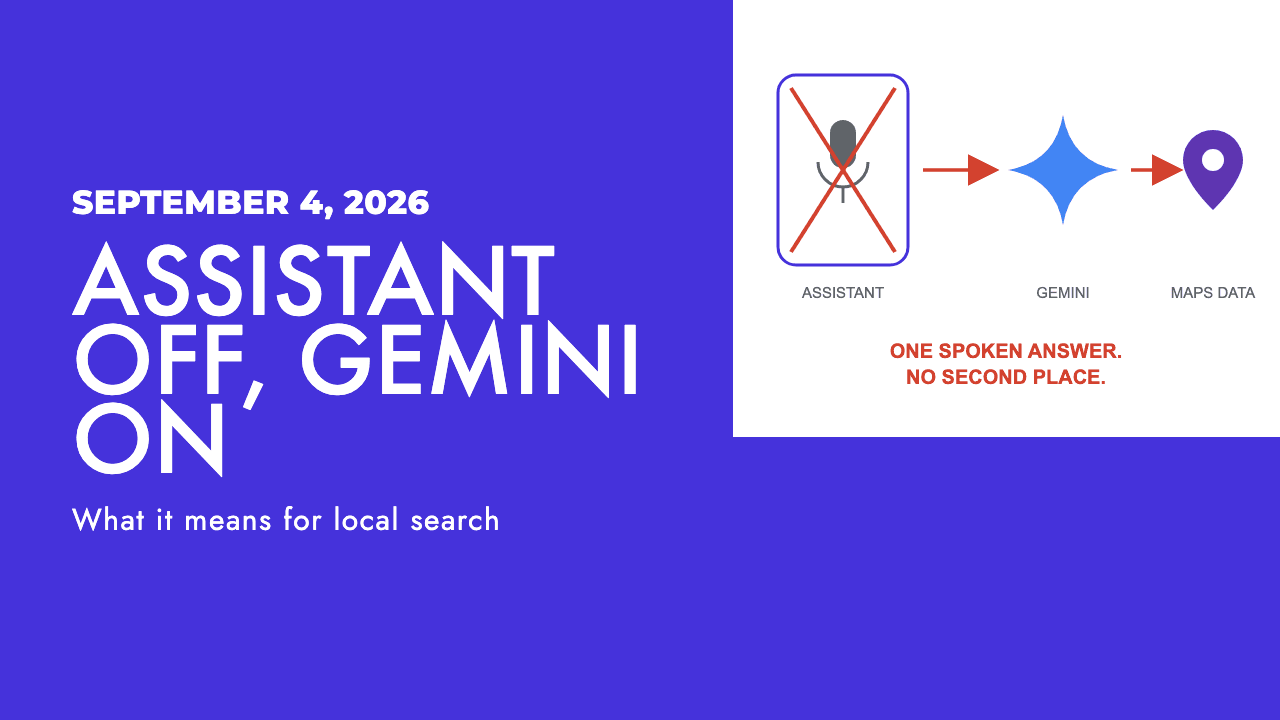
Gemini answers local questions using Maps and Business Profile data, which becomes the default behaviour on Android as Assistant is retired in September. And when researchers logged 14,472 citations across 1,487 local service queries, business websites took around 60% of Gemini's local citations, ahead of every directory and review platform combined (Search Engine Land).
Read those together. Your own site and your own profile are the two assets carrying local AI answers, and the category string is how the model decides whether you belong in the candidate set for "emergency vet in Nicosia" at all. Retrieval has to pick you up before generation can mention you.
There is a hard limit on what that buys you, and we covered it in grounding drift: the same local question returns overlapping sources only about 40% of the time. Getting the category right does not win you the answer. It gets you into the pool the answer is drawn from, which is the only part you control.
The Cyprus problem nobody mentions
Google's category taxonomy is shaped around US business types, and availability varies by country. That is a real constraint here.
Plenty of Cyprus businesses have no precise match. Categories that exist in the US list are missing locally, and some local business types simply do not have a label. The specificity advantage in the data assumes a specific category exists for you.
When it does not, the practical move is to take the closest genuine parent and carry the specificity in the parts of the profile you do control, the business description, the services list and the site itself. Do not force a category that describes something you are not just because it is narrower. A wrong specific category is worse than a right general one, because it makes you eligible for searches you cannot satisfy and ineligible for the ones you can.
This matters more in thin markets. In a Cyprus city, a handful of profiles compete for a category, so category fit decides the result far more sharply than it would in Chicago. We go through this on every Cyprus SEO project, and it comes up constantly in restaurant marketing across Cyprus.
Where specificity stops helping
The obvious failure mode is picking the narrowest category available and ranking beautifully for something nobody asks for.
Specificity works when it matches how people describe what they want. "Hawaiian restaurant" beats "Restaurant" because people search that way. A category so narrow that it describes an internal service line, not a thing customers ask for, buys you nothing.
The test we use is simple. Would a customer say this phrase out loud when describing where they are going? If yes, it is a category. If it only makes sense inside your business, it belongs in your services list.
Also worth being honest about: category work has a ceiling. It gets you into contention. Proximity, reviews and the strength of your website still decide the order, and we set out how those interact in local SEO in 2026.
What to do this week
- Open your profile and read the primary category out loud. If it is a generic parent like Attorney, Contractor, Restaurant or Dentist, there is very likely a specific child category that describes you better. Check the full list, not the autocomplete suggestions.
- Audit your additional categories for hedges. Anything vague, anything you added to cover a service you rarely sell, anything like "Service establishment" comes off. Keep only the ones that describe a distinct thing you actually are.
- Check what your top three local competitors use. Not to copy them, but because a competitor sitting above you in a category you have not considered tells you how Google is reading the market.
- Fill the five fields. Website, description, hours, photos, claimed. It is the lowest effort item in this list and it is the one most often left half done.
- Make your site say the same thing. If your profile says emergency veterinary service and your homepage never uses the phrase, you have given the retrieval layer two different versions of your business. A one-click on-page SEO check will show you what the page actually says.
- Wait, then look again. Category changes do not settle instantly and they can be reviewed. Give it a few weeks before deciding it did not work, and note the date you changed it so you can tell the difference between the category and everything else you shipped that month.
The takeaway
A study across 1.8 million profiles landed on a conclusion that is almost insultingly simple: describe your business precisely, fill in every field, and you rank better than businesses that do not.
There is no clever version of this. There is only the version where somebody opens the profile and does it. If you want a second pair of eyes on your category set and profile before you touch anything, our free SEO review covers it, and the local SEO service picks up from there.