
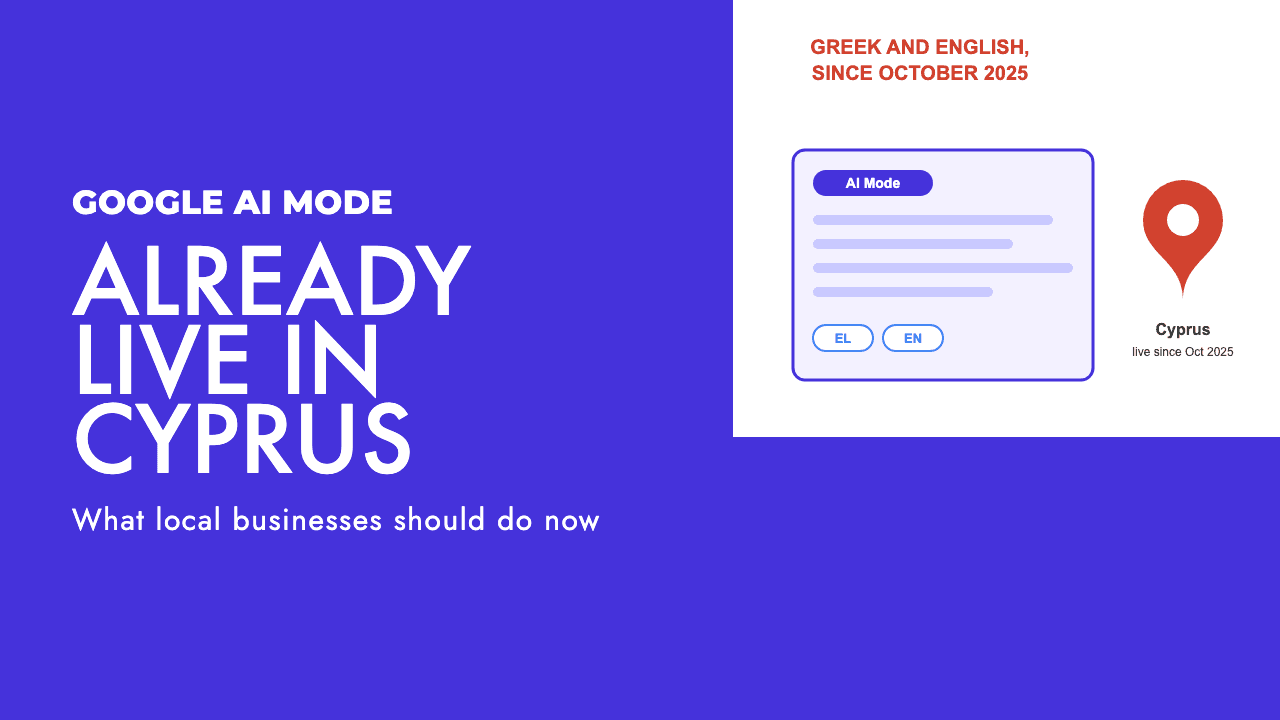
Here is a correction first, because we got it wrong when this was first published: Google AI Mode is not "coming" to Cyprus. It has been live here, in Greek and English, since October 2025, and AI Overviews are live here too. The good news for a Cyprus business is a different kind: almost none of your competitors have noticed.
Google's own help pages list Cyprus among the countries where AI Overviews and AI Mode are available, and Greek among the supported languages. The runway is not the rollout, then. It is the gap between the feature being on your customers' phones and local businesses doing anything about it, and most of them are wasting it by treating AI search as someone else's problem.
We are writing this for two audiences at once. If you are in the US, AI Mode has been live since May 2025, ads are moving into it, and agentic features land there first. If you are in Cyprus or the wider EU, the same surface arrived a few months later and with less fanfare, so you get to watch the US absorb the ad formats and the agentic layer before they reach you. Both of you need the same playbook. One of you has slightly more time to build it.
Where the rollout actually stands
Let me lay out the map, because the panic online rarely matches the facts.
AI Overviews, the summary block that sits above the blue links, entered the EU in March 2025 with Germany, Belgium, Ireland, Italy, Austria, Poland, Portugal, Spain and Switzerland (Search Engine Land). It has kept spreading since. Google's availability page now lists Cyprus and Greece among the supported countries and Greek among the supported languages (Google Search Help).
AI Mode is the bigger shift. It largely replaces the results page with a conversational answer engine: you ask, Google answers with cited sources, you ask a follow-up. It opened to everyone in the US in May 2025, reached the UK on 28 July 2025 (Google), and expanded in English to more than 180 further countries that August (Google). The EU proper followed on 7 October 2025, when Google added more than 35 languages and over 40 countries and territories, "many across Europe", taking AI Mode past 200 countries in total (Google). Greek went live the next day (Google Greece), and Google's AI Mode help page lists Cyprus and Greece among the supported countries (Google Search Help).
Since then the two surfaces have been merging. In January 2026 Gemini 3 became the default model behind AI Overviews worldwide, and a follow-up box let people slide from an Overview straight into an AI Mode conversation (Google). At I/O in May, Google said AI Mode had passed one billion monthly users and made Gemini 3.5 Flash its default model globally (Google I/O 2026), and in June it put AI Overviews at more than 2.5 billion monthly users (Google).
So the honest status for a Cyprus business: both surfaces are on your customers' phones today, in the language they search in. You are not exempt, and you are not early. What you may still be is ahead of your competitors, because most of them have not changed a thing.
What the US is teaching everyone right now
Here is the part worth paying attention to. The US market gets every ad format and agentic feature first, so it is the live experiment, and the results are not comfortable.
The click data points one way. SparkToro's 2026 clickstream study found 68 percent of Google searches now end without a click (Search Engine Land), and Pew found users clicked a link inside an AI summary on just 1 percent of the visits where one appeared (Pew Research). People get their answer inside the interface and stop. This is the pattern we have written about before under a different name, the slow decoupling of impressions from clicks, and AI Mode accelerates it hard.
At the same time Google is monetising the surface. At Google Marketing Live in May it unveiled a set of Gemini-powered formats built to live inside AI answers rather than beside them, including Conversational Discovery ads and Highlighted Answers, all labelled "Sponsored" (Google Ads & Commerce blog). A July 2026 SE Ranking sample found text ads already showing on 29 percent of commercial keywords inside AI Mode, rising above half for keywords with a cost per click over ten dollars (Search Engine Journal).
Put those two facts together and the strategic picture is stark. Fewer clicks are leaving the answer, and the clicks that do leave are increasingly paid. Organic visibility inside the AI answer, being the source Google cites rather than the tenth link nobody scrolls to, is where the durable attention is. That is what US businesses are learning under fire. Cyprus businesses get the same lesson a few months later, with fewer ads in the way for now.
The runway is for building citeworthiness, not waiting
The wrong response to a runway is to sit on it. The right response is to build the one asset that survives every version of this: content a model wants to quote.
Being cited in an AI answer is not a trick you flip on in a week. It compounds over months. Google's systems preferentially pull from sources that are well structured, clearly sourced, and demonstrably trustworthy, and that reputation takes time to establish. The feature is already live here, so every month of waiting is a month a competitor could use to become the source Google reaches for in your niche.
Here is what we would spend the runway on, in order.
Answer real questions, completely, in your own words. Content that only restates what a model can already synthesise has lost its value. Original detail, first-hand experience, specific local knowledge, and genuine expertise are what get pulled into answers. An accountant in Limassol explaining exactly how Cyprus Union OSS VAT works for a small exporter is citeworthy. A generic "what is VAT" page is landfill.
Structure so a machine can extract you. Lead each section with a direct answer, then support it. Use clean headings that match how people actually ask. This is not new SEO hygiene dressed up, but it matters more now because extraction, not just ranking, is the goal. We break down the mechanics in our guide on how to structure content so LLMs cite you.
Build the entity, not just the pages. Models cite brands they can place. Consistent business information, real reviews, coverage on sites that matter in your sector, and a clear sense of who you are and what you are known for all feed the trust signal that decides whose answer gets quoted.
Decide the opt-out question deliberately, not reflexively. Google began testing a Search Console toggle in June 2026 that removes your site from AI Overviews and AI Mode while leaving normal rankings alone, UK first (Google), and it reached every site worldwide on 31 August. For almost every Cyprus or US business this is the wrong lever to pull, and we explained why in detail in our take on the AI Overviews opt-out. Know it exists, then leave it alone unless you have a very specific reason.
What this means for Cyprus specifically
The local angle is not just timing. It is language and competition.
Cyprus SERPs are thinner than US ones, and thinner than what we see doing SEO in the UK. Many local queries, in English and Greek, still return weak, generic results because few local businesses have invested in genuinely useful content. AI Mode is already assembling answers for Cyprus users in both languages, and it pulls from whatever it can find. Right now, in a lot of niches, from restaurant marketing to professional services, that is not much. Language matters here more than most people expect: Google's AI surfaces lean towards answering Greek queries with Greek pages, a pattern we unpacked in our piece on language bias in AI search. The business that publishes the clearest, most genuinely helpful answer in its field has a real shot at becoming the cited source, precisely because the competition has not shown up.
That advantage evaporates the moment your competitors wake up, which will happen the first time one of them sees a rival cited in an answer a customer shows them. The runway is the quiet period before that scramble. We go deeper on the local picture in our Cyprus SEO overview.
Update, September 2026
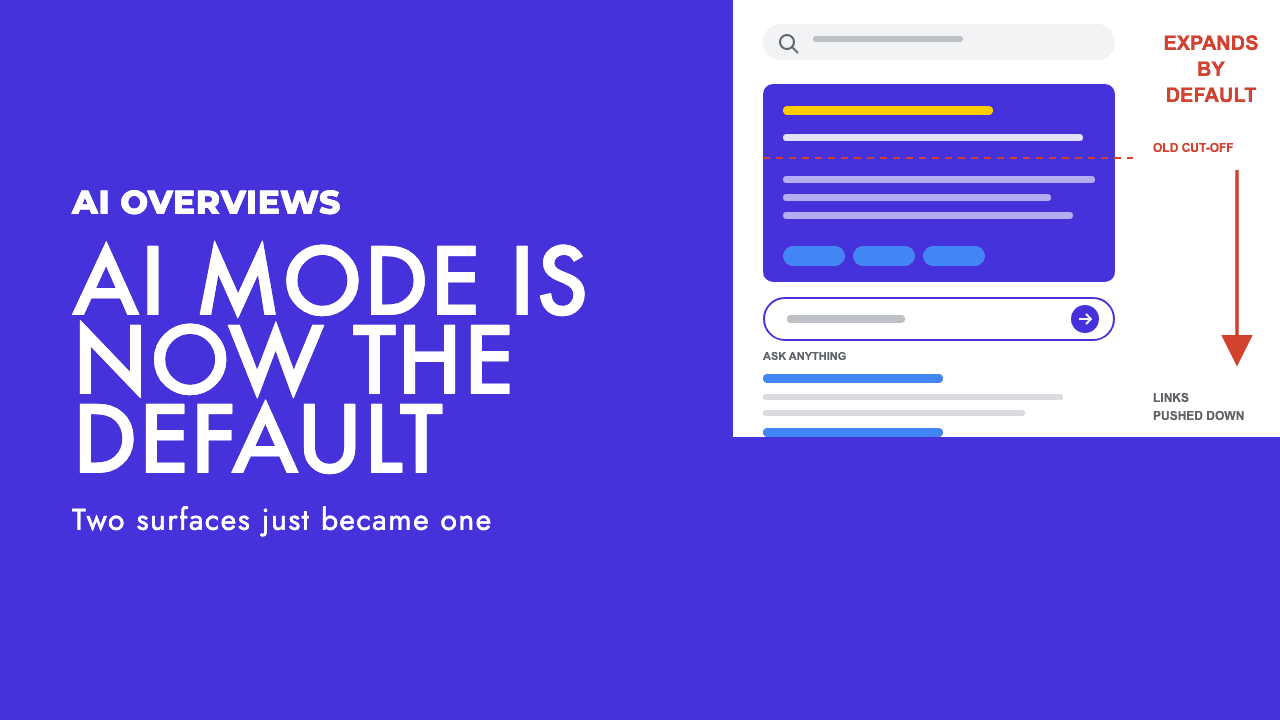
A correction and three developments. The correction: the original version of this post said AI Mode had not reached Cyprus and was expected in Europe by the end of 2026. That was wrong. Google expanded AI Mode across most of Europe on 7 October 2025, added Greek on 8 October, and lists Cyprus on its AI Mode availability page; the body above has been rewritten to match. The developments: on 28 August Google began auto-expanding AI Overviews into full AI Mode answers for some queries, pushing organic results further down without a click (Search Engine Roundtable), which we covered in AI Overviews expanding into AI Mode. The Search Console opt-out toggle went global on 31 August, and Brussels is now asking publishers whether it is any use: the European Commission's questionnaire on the opt-out, and on the merging of AI Overviews with AI Mode, closed on 28 August (PYMNTS). None of that changes the advice: be the source the answer cites.
Our take
AI Mode in Cyprus is a deadline that already passed, and almost nobody noticed. That is the whole opportunity.
The US is showing everyone what the endgame looks like: fewer clicks, more ads, and outsized reward for being the source an answer engine trusts. Cyprus and the wider EU are already living in the first part of that world, with the ads and the agents still a step behind. The advantage is not time. It is a field of competitors who have not moved, and it is wasted entirely if you wait for them to move first.
Spend the gap on the boring, compounding work: genuinely useful content, clean structure, and a brand a model can trust. Do that now and the next AI Mode feature to reach Cyprus lands as an opportunity you are already positioned for, rather than a wave you are trying to catch.
If you want a clear read on where your site stands before it lands, a free SEO review is a sensible place to start, or look at how we approach AI search optimization directly.