
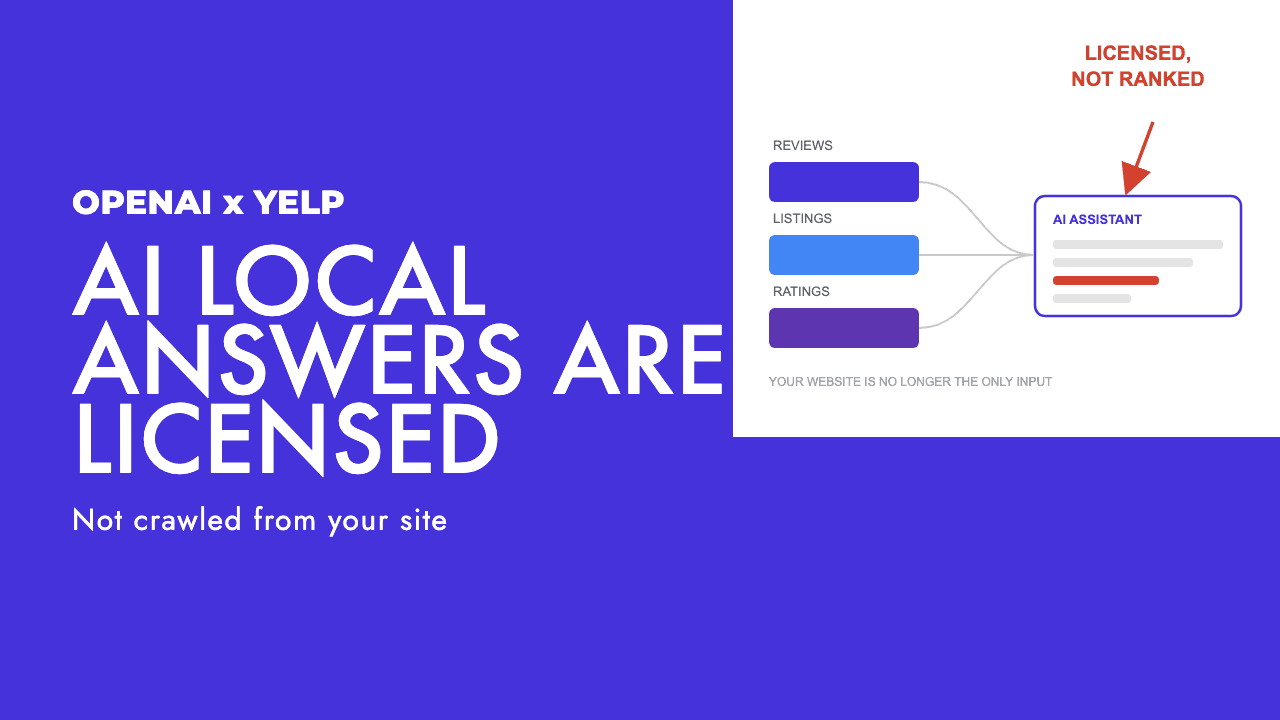
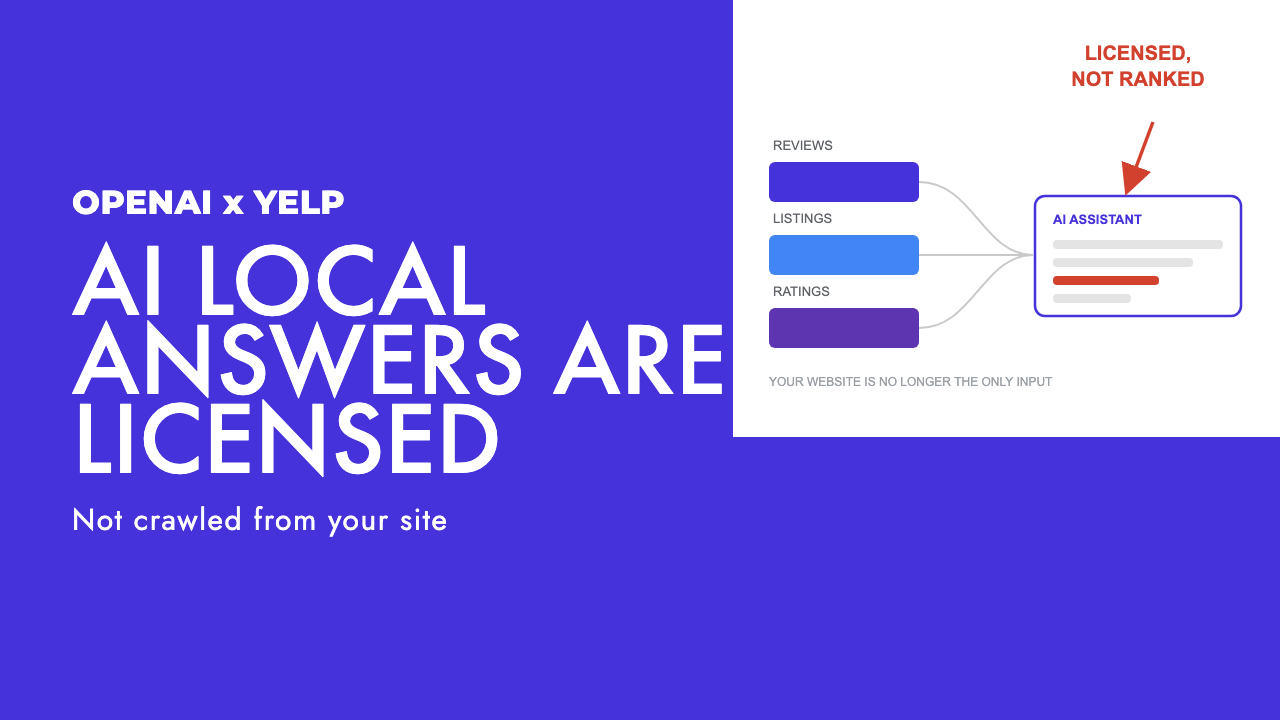
On 23 July, OpenAI signed a licensing deal with Yelp. ChatGPT now has access to hundreds of millions of reviews, ratings, photos and business listings for local queries, with Yelp branding and links carried alongside (Search Engine Land, Axios).
Read that again as a distribution story rather than a news item. ChatGPT had a known weakness on "who should I hire near me" questions. It did not fix that by crawling harder. It bought a corpus.
What actually changed
For local intent, the input that decides whether an AI assistant mentions your business is moving off your website and onto platforms you do not own.
This is not a one-off. Tripadvisor runs an app inside ChatGPT that surfaces its hotel ratings, traveller photos and prices in the conversation, US users only for now (Tripadvisor), and Expedia and Booking.com were doing the same for travel inventory before that. Yelp's agreement is explicitly non-exclusive, and Yelp already feeds Apple Maps and Yahoo. Expect more of these, not fewer.
So there are now two very different ways to end up inside an AI answer about a local business. You can be crawled and cited like a web page. Or your business can exist as a structured record inside a dataset somebody licensed.
The second route does not care how good your homepage is.
Our take: this is the local pack problem again, with worse visibility
Here is the opinion, clearly labelled as one.
We think this is a rerun of what happened when Google put the map pack above the organic results, except the shortlist is shorter and you can no longer see how it was built. With the map pack you could at least inspect the results, count your competitors and reason about proximity and prominence. With a licensed corpus feeding a generated answer, you get a paragraph naming two or three businesses and no visible ranking to reverse engineer.
That matters because AI local answers are short and unstable. When Steady Demand logged 14,472 Gemini citations across 1,487 local service queries, repeating the same query produced overlapping sources only about 40% of the time, against roughly 90% consistency for the top listing in the local pack (Search Engine Land). Getting into one does not get you into the other, and getting in once does not keep you there.
The uncomfortable version of this: for a whole class of queries, your AI visibility is now decided by a commercial agreement between two companies, neither of which you are a customer of.
The honest counterweight: it has always been like this to some degree. Your Google Business Profile has been the primary input for local visibility for a decade, and nobody owned that either. What is new is the number of gatekeepers and the fact that they change quietly.
The geography problem nobody mentions
Every article about this deal is written for a US reader, where Yelp is a real consumer habit. Cyprus is a different market entirely.
Yelp is close to irrelevant here. The corpus that describes a restaurant in Limassol or a law firm in Paphos lives in Google Business Profile reviews, Tripadvisor, Booking.com, Facebook, and a handful of local directories. If you are a Cyprus business, the Yelp headline is not your headline. The lesson underneath it is.
The lesson: whichever platform holds the review corpus for your category in your market is your AI gatekeeper, and it is probably not the one being written about this month. For a hotel or resort that is Booking and Tripadvisor. For a clinic or a trades business it is overwhelmingly Google. For anything B2B it may be an industry directory nobody outside your sector has heard of.
We see the same failure in both markets: a business with a well maintained website and a Google Business Profile that has not been touched since it was created.
What we would actually do about it
None of this is exotic work. It is unglamorous data hygiene that suddenly has a much bigger payoff.
Find out which platforms hold your category's reviews. Ask ChatGPT, Gemini and Google AI Mode a dozen real customer questions for your service and city, and write down which sources get named or linked. That list, not a generic directory checklist, is your priority order.
Make the record consistent everywhere it exists. Name, address, phone, opening hours, categories and service descriptions should match across every profile. Google is explicit that complete and consistent business information is what its own local ranking rests on (Google Business Profile help). Language models are doing something similar when they cross reference platforms to decide whether they can trust a record.
Treat review text as content, not as a star rating. This is the change most businesses miss. A generated answer needs something to say about you, and "great service" gives it nothing. Reviews that mention the specific job, the location, the timeframe and the price band give an assistant a sentence to quote. When you ask a happy customer for a review, ask them what they came to you for.
Do not buy your way in. Incentivised and undisclosed reviews are exactly the thing Google has been tightening up on, and we wrote about the enforcement side of that in Google's move against undisclosed incentivised reviews. Polluting the corpus that AI assistants now read directly is a worse idea than it used to be, not a better one.
Keep your own site answer-shaped anyway. Licensed data covers the "who" questions. It does not cover the "how much does this cost in Cyprus", "do I need planning permission", "what happens if it goes wrong" questions where your pages are still the source. Our notes on structuring content so LLMs cite you cover that side.
The trust angle makes the review text point sharper
There is a second 2026 trend that pushes in the same direction. A Fractl study run with Search Engine Land found consumer confidence in AI search falling hard year over year, even as usage kept climbing, with skepticism rising and a growing share of people saying heavy AI content reduces their trust in a brand (Search Engine Land).
People are using AI assistants more and believing them less. Which means they are increasingly using the AI answer as a shortlist and then verifying somewhere else before they buy.
That is good news if your underlying record holds up. The assistant names you, the customer goes and reads your actual reviews and your actual site, and the second impression confirms the first. It is bad news if the mention was the strongest thing you had.
Update, September 2026
Google is building the same layer inside its own map rather than licensing someone else's. Ask Maps, the Gemini powered question box in Google Maps, expanded in August to more than 150 countries and territories, with restaurant ordering through Square and Toast and hotel booking built in for US users. That is Google's version of the deal route: partner inventory plugged straight into the answer, and the same data hygiene deciding who gets named. The Steady Demand citation study above is also new since this was written and is the best public evidence so far that your own site still carries most of Gemini's local citations, so the "who" questions have not left your website entirely.
Where this leaves things
Local SEO did not become obsolete. It got another distribution layer stacked on top, and this one is assembled through deals rather than crawling.
The practical read for a small business is boring and slightly reassuring. You cannot influence which platform OpenAI signs next. You can make sure that when your category's corpus does get licensed, your business is in it, accurate, and described in language worth repeating.
We covered the map pack and Google Business Profile side of this in local SEO in 2026, and the wider question of how assistants form an opinion about a brand in ChatGPT answering without searching. If you want a second pair of eyes on how your business is currently being described across the platforms that feed these answers, that is what our local SEO work and AI search optimisation are for, and you can start with a free SEO review.