
The email says your Business Profile has been suspended. The listing is gone from Maps, the phone has gone quiet, and the first instinct is to open the appeals form and start explaining.
That is the move that costs most businesses their reinstatement. A suspension is not a punishment you talk your way out of. It is a failed eligibility check, and the appeal is Google re-running that check on whatever the profile looks like at the moment you press submit.
Work out which suspension you have before you do anything
There are two kinds, and most guides treat them as one.
A hard suspension removes the profile from Search and Maps entirely. Customers searching your name get nothing, the reviews disappear with it, and the listing stays gone until Google puts it back (BrightLocal).
A soft suspension leaves the profile visible. Customers can still find it and call it, but it is marked unverified and you lose management access. You cannot edit it, respond to reviews or post updates.
The diagnosis is different for each. A hard suspension usually means Google doubts whether the business is eligible for a profile at all, or whether the address is a real place of business. A soft suspension, in our experience, is more often about the profile's history: a name change, a category swap, a burst of edits, or a new manager being added.
Search the exact business name in Maps from a phone that is not signed into the business account. Still visible publicly but locked and unverified in your dashboard means soft. Gone entirely means hard.
The breaches that actually trigger it
Google's wording is short: "We may suspend or disable Business Profiles that don't follow our guidelines" (Google). The guidelines themselves are long, but in our experience suspensions cluster around five rules, all drawn from Google's guidelines for representing your business.
| Rule | What breaks it in practice | The fix |
|---|---|---|
| Eligibility: the business must have a physical location customers can visit, or travel to serve customers at their locations | Online-only shops, lead generation sites, a "branch" that is really a director's home used for post | If the business does not meet the test, no appeal will succeed. If it does, make the profile reflect the place where customers are actually served |
| Business name: must match the real-world name on the storefront, website and stationery | "Andreou Dental Clinic Limassol Best Dentist", ALL CAPS words, a phone number in the name, taglines, "near Molos", trademark symbols, opening hours | Reduce the name to what is painted on the sign and printed on the invoices. Nothing else |
| Address: no PO boxes, no mailboxes at remote locations, no virtual offices without customer-facing operations | Registered office at the accountant's, a serviced office nobody works from, a mail-forwarding address | Use the premises where staff work and customers come. A co-working space can qualify if it has your signage, receives customers during business hours and your staff work on site. If you travel to customers, hide the address and set a service area |
| Service-area businesses: one profile with a designated service area, not extending beyond roughly two hours' driving distance | A Nicosia plumber claiming the whole island plus Athens, a cleaning company with a profile in every town it serves | One profile per business, service area trimmed to where you actually drive |
| Duplicates: do not create more than one profile per location | An old unclaimed listing from a previous owner sitting next to the new one, a profile per practitioner named after the practice, a second listing "for the new branch" at the same address | Find every listing for the address, claim them, and remove or merge the extras |
Suspensions frequently arrive in algorithmic sweeps rather than as a response to something you did that morning (BrightLocal). A profile that has been quietly non-compliant for two years can be caught on a Tuesday for no reason you will ever be told.
That said, the thing you did that morning can still be the trigger. Repeated edits in short succession to the name, address or category are a known risk, as is setting hours to 24/7 inaccurately. In our experience the "cleanup session" where someone changes five fields in one sitting is the most common thing that precedes a suspension.
If a category change is part of your fix, read why the primary category is doing more work than your homepage first, then change it once.
Fix the violation before you open the appeals tool
Google asks you not to submit multiple appeals for the same issue before you receive a decision (Google). That makes the first appeal the one that counts. If you file it with the keyword still in the name and the accountant's address still on the profile, you are asking a reviewer to approve the exact state that was just rejected.
The reviewer is not weighing how sorry you are or how long you have traded. They are checking whether the profile in front of them meets the guidelines, so make it meet them first.
Go field by field. Does the name match the sign outside and the header on your invoices? Is the address where your staff work and your customers visit? Is the primary category what the business actually is, not what you wish it ranked for? Are the hours true? Is the service area where you drive to?
Then look outside the profile. Your website footer, your Facebook page, your directory listings and your company registration should all say the same thing. Mismatched business information across platforms is one of the common reasons a later video verification fails (Sterling Sky), and it undermines a document appeal for the same reason: the reviewer cannot tell which version is real.
Duplicates need dealing with before the appeal, not after. If the business has grown into several branches, our guide to local SEO for multiple locations covers how to structure that without tripping the one-profile-per-location rule.
In the verticals we work in most, the fix tends to look like this. A dental practice with "Dentist Limassol" bolted onto the name reverts to the name on the door. A law firm whose profile carries its registered office at a corporate services provider moves the address to where clients are actually seen. A property agency running one profile per agent consolidates to one.
Only when every one of those is done do you open the tool.
The 60 minute rule that catches people out
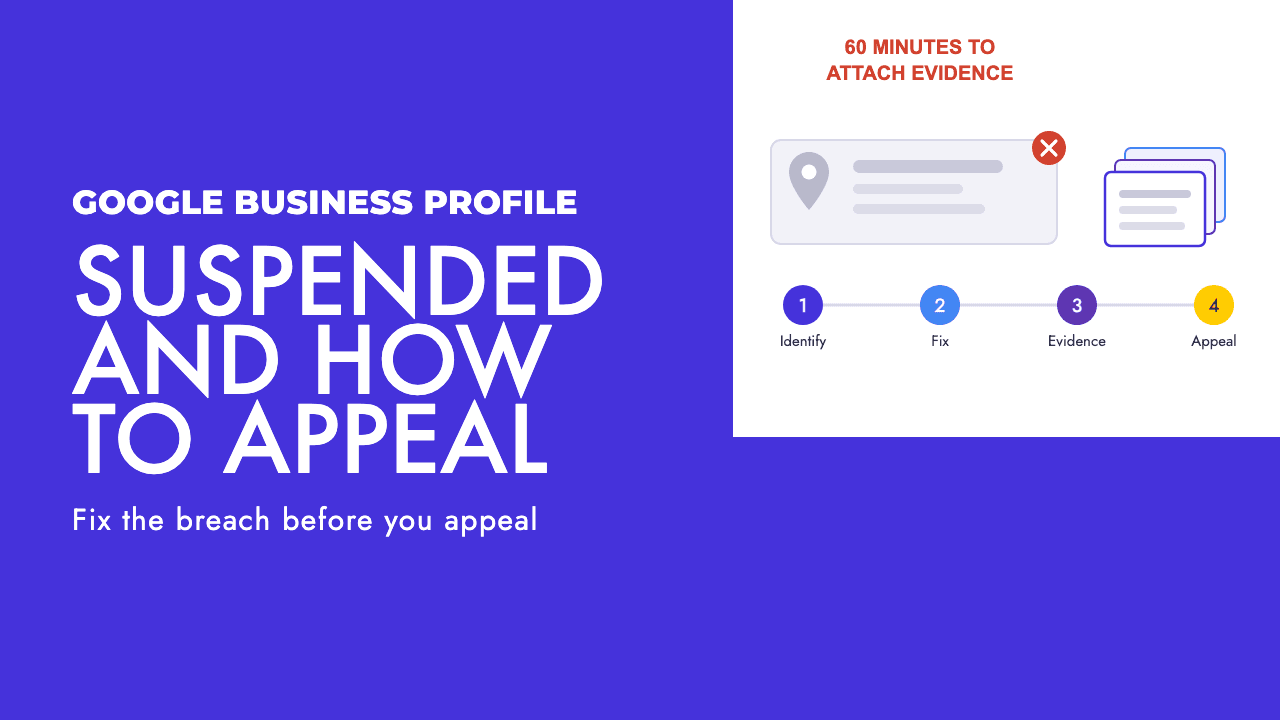
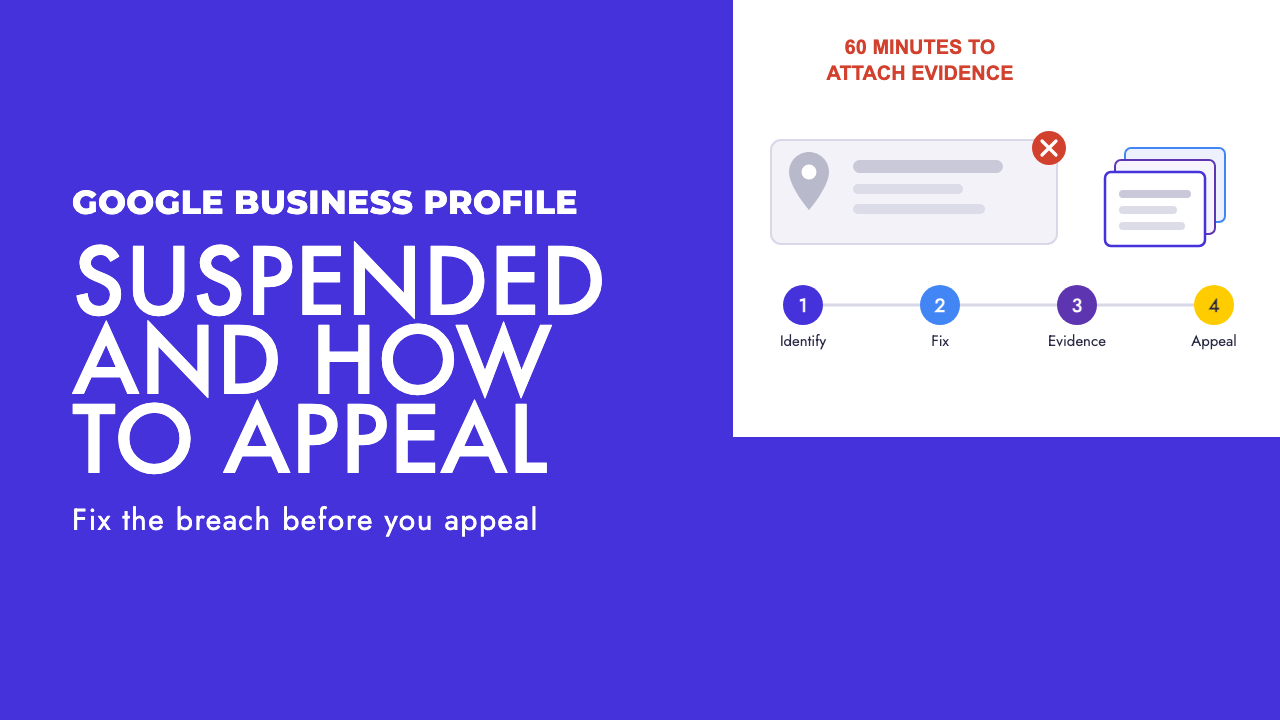
Google's documentation states that once you open the evidence form, you must submit it within 60 minutes or it will not be attached to your appeal (Google).
An hour is not long when you are hunting for a utility bill in a drawer. So assemble the pack before you go anywhere near the form.
Google lists the evidence it accepts: official business registration, business licences, tax certificates and utility bills for electricity, phone, water or internet. The business name and address on every document must match the profile (Google).
In Cyprus that means the certificate of incorporation and the registered office certificate from the Registrar of Companies, the tax or VAT registration certificate, and a recent EAC or Cyta bill in the company name. In the UK it is the Companies House certificate, the VAT certificate, the business rates bill and a utility bill.
The word "match" is doing a lot of work. If the profile says "Andreou Dental" and the certificate says "A. Andreou Dental Clinic Ltd", fix one of them before you appeal. If the utility bill shows the accountant's address, it is not evidence of your premises. It is evidence against them.
Save everything as clear PDFs or photos in one folder, then open the form and upload in one sitting.
Filing the appeal itself
The process Google documents is short (Google). Sign in with the Google account that manages the profile, open the appeals tool, select the suspended profile and submit the appeal. If the tool offers you the evidence form, that is where the pack goes, and that is when the 60 minute clock starts.
Google says appeal reviews and decisions can take up to 5 business days (Google). Practitioners regularly wait longer than that, and we would plan on the basis that you might. Do not file a second appeal while the first is pending.
The status comes back as Approved, Not Approved, or Can't be appealed (Google). Not Approved is where most of the work happens, because it is often followed by a request for evidence or a video verification, which is your second chance to prove the same point. Can't be appealed means the tool has closed the door on that profile, which is when the routes in the Cyprus and UK section below become relevant.
When it comes back as a video verification
Sometimes the price of reinstatement is a video. Google's requirements are specific (Google).
The recording has to be at least 30 seconds long, unedited, unique and complete with no breaks, and it has to be recorded and uploaded from a mobile device through the Business Profile itself. No trimming it on a laptop, no stitching clips together.
For a storefront or hybrid business it has to show three things. Location context such as landmarks and street identifiers. Signage where the business name is clearly printed on a permanent fixture like a signboard, wall or window. And proof you are authorised to manage the business, shown through things only an employee can access, for which Google's examples are opening a cash register, a kitchen or a storage room, or using a point-of-sale system.
For a service-area business, the equivalent three. Street signs or landmarks at the business address. Your professional tools, equipment or branded materials. And proof of management, which can be performing a service or presenting a business permit, invoice or utility bill.
For a dental clinic, that is one continuous take from the street sign to the front door, holding on the signage, then inside to open a treatment room cupboard or log into the practice system. For a plumber working from home, it is the street sign, the van with your name on it, the tool bag and an invoice held up to the camera.
Videos fail for the same reasons appeals fail: mismatched information across platforms, an incomplete address, a keyword-stuffed name, or a recording that never actually shows the location, the signage or your affiliation with it (Sterling Sky). Sort the profile out first and the video is just a walk round the building.
If you have failed repeatedly and the profile offers no further options, Sterling Sky's advice is to use Google's verification troubleshooter to open a support ticket and ask for a manual review. It is slower, but it is a human route.
Cyprus and the UK: the route most guides do not mention
Almost everything written about suspensions is written from the US, and it misses something that matters if you operate here.
UK and EEA businesses have broader access to the appeals tool. It covers suspended or disabled profiles, rejected business information edits and restricted media (Google). If Google has thrown out an edit or hidden your photos, you have a formal route to contest it that businesses in most of the world do not.
For Cyprus and the rest of the EEA there is a second layer. Under the Digital Services Act, a user can refer a decision to a certified out-of-court dispute settlement body, which Google describes as "independent bodies with the means and expertise to consider the issues brought to them." The route applies to users covered by the DSA on Google services designated as online platforms or very large online platforms, and eligible situations include account or content restrictions imposed for alleged policy violations. You also keep the right to go to a national court (Google).
Be clear-eyed about what that buys you. Google states it "is not bound by any decisions made by these out-of-court settlement bodies." So this is not an override switch. What it gives you, in our view, is a paper trail with some weight behind it: a formal, dated record that an independent body examined the decision, sitting alongside the internal appeal history. That is worth having when the profile matters to the business and the internal route has run out.
The UK is not in the EEA, so the DSA route is a Cyprus one. UK businesses get the broader appeals tool access but should not expect the out-of-court body.
Either way, keep everything: the suspension notice, every submission, every status change, every video attempt. The business with the history in a folder is in a different position from the one reconstructing it from memory.
This is the part of the job that reads differently when you work in Cyprus. The market is small, the rules are European, and a profile that has been down for weeks in a town where everyone knows everyone is felt in the appointment book immediately.
Staying reinstated
Reinstatement is the start of a different discipline, not the end of the problem.
Change one field at a time. If the name, the address and the primary category all need updating, do them weeks apart, not in one sitting. The cluster of edits is the pattern that draws attention.
Keep the documentation pack current. When the utility provider changes, when the company moves, when the trading name shifts, update the folder the same week. The next 60 minute window should be a formality.
Keep the name matching the real world. If you rebrand, change the sign, the website and the stationery first, then the profile. If someone suggests adding a service or a town to the name for rankings, that is the one edit that most reliably makes this article relevant to you again.
All of this matters more than it used to, because the profile is now the thing that gets read into AI answers and near me results as much as it is a pin on a map. We covered where that is heading in local SEO in 2026 and how AI search is rewriting near me.
If your profile is down now and you want a second pair of eyes on the fix before you spend the one clean appeal, that is exactly the kind of work our local SEO service exists for, and a free SEO review is the easiest way to start the conversation.
Frequently asked questions
How long does a Google Business Profile reinstatement take?
Google says appeal reviews and decisions can take up to 5 business days. In practice, practitioners often wait longer, particularly when evidence or a video verification is requested after the first decision. Submit one appeal, do not file a second for the same issue while it is pending, and use the waiting time to bring your website and directory listings into line with the profile.
What is the difference between a soft and a hard suspension?
A hard suspension removes the profile from Search and Maps entirely. A soft suspension leaves the listing visible to customers but marks it unverified and strips your management access, so you cannot edit it or respond to reviews. Both go through the same appeals tool. In our experience a hard suspension usually points to an eligibility or address problem, while a soft one is more often about the profile's edit history.
Can I appeal a Google Business Profile suspension more than once?
Google asks you not to submit multiple appeals for the same issue before you receive a decision, so treat the first appeal as the one that counts. Fix the guideline breach, gather registration, licence, tax and utility documents that match the profile name and address exactly, and only then open the appeals tool. If the decision comes back Not Approved, the evidence form or a video verification is your second chance.
Do businesses in Cyprus have any extra options if Google rejects the appeal?
Yes. Cyprus is in the EEA, so alongside Google's own appeals tool you can refer the decision to a certified out-of-court dispute settlement body under the Digital Services Act, and you keep the right to go to a national court. Google states it is not bound by those bodies' decisions, so treat the route as extra pressure and a paper trail rather than a guaranteed reversal. UK businesses get the broader appeals tool access but not the DSA route.