
A year ago, a "plumber near me" search ended in a map, three listings, and a phone call. Today there is a decent chance the person never sees the map. They see an AI Overview that names two or three businesses, summarises the reviews, and answers the follow up question before it is asked. Or they skip Google entirely and ask ChatGPT "who is a good plumber in Limassol" and act on whatever it says.
Local search is not dying. It is moving the goalposts. The query is the same, the intent is the same, but the surface that decides who gets the call has changed, and a lot of local businesses are optimising for a results page that fewer people actually look at.
We work both ends of this market, local service businesses in Cyprus and US clients fighting for the map pack, so we looked at where local clicks are really going, read the public studies, and worked out what still moves the needle. Here is the honest version.
The short answer
Local SEO in 2026 still rewards the same fundamentals, a complete and active Google Business Profile, real reviews, consistent local information, and pages that prove you actually operate where you say you do. What has changed is that ranking well no longer guarantees the click. AI Overviews and AI assistants now sit between the searcher and your listing, and they pick who to mention using the same signals Google has always used for local prominence.
So the work is not new. The reason to do it is. You are no longer just trying to rank in the map pack. You are trying to be the business that both Google and the AI layer trust enough to name.
Near me did not go away, the path to it changed
People still search locally, and the "near me" habit is stronger than ever. What is shifting is what happens after the search.
There are three paths a local query can take now, and they matter because the winner is decided differently on each.
The first is the classic local pack, the map and three listings. This still exists, still drives calls and direction requests, and is still mostly won on Google Business Profile strength and proximity.
The second is the AI Overview. On more and more local and commercial searches, Google now generates a summary at the top that names businesses, pulls in review sentiment, and links out to a handful of sources. We covered how this plays out on informational queries in our piece on getting into Google AI Overviews, and the local version follows the same logic with one twist: the Business Profile and review signals carry more weight than your website copy.
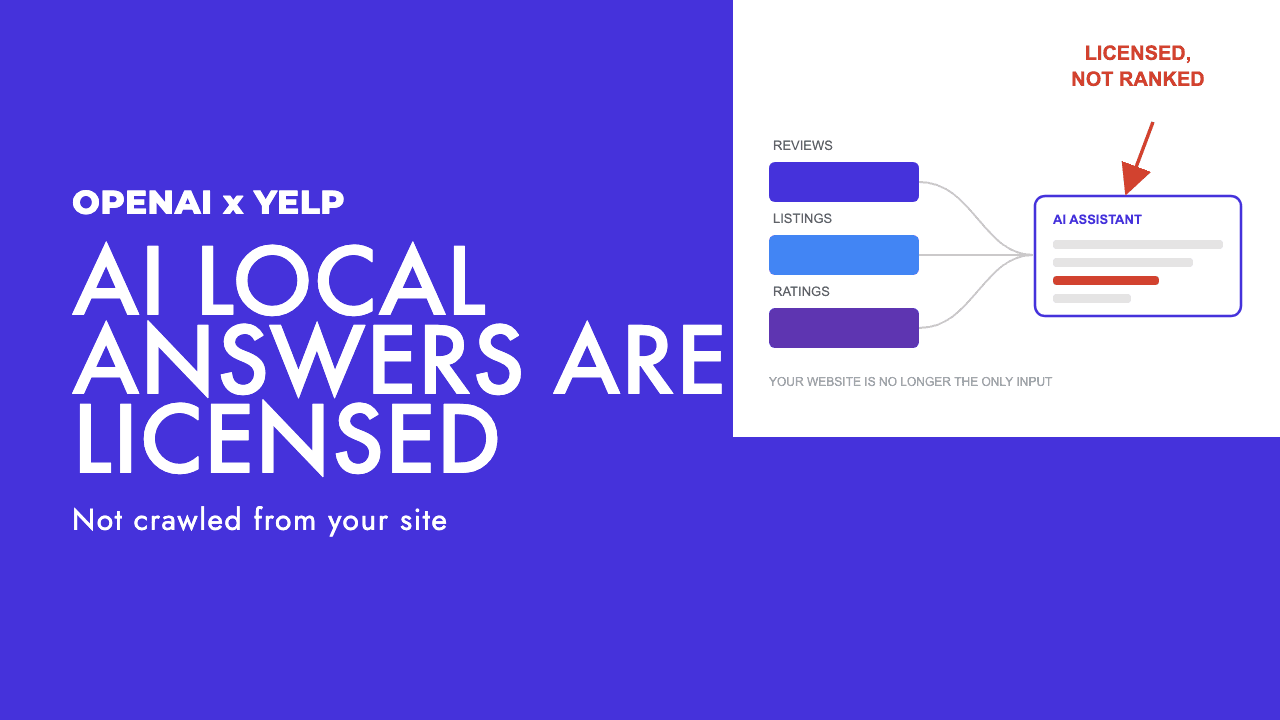
The third path skips Google. Someone opens ChatGPT, Gemini, or Perplexity and asks for a recommendation in plain language. There is no map, no ten blue links, just a named answer, and increasingly that answer is built on licensed review data rather than your website. This is the path nobody has a tidy playbook for yet, and it is growing fast.
What the data shows
Here is the uncomfortable part.
Whitespark ran 540 local business queries across three US cities and found an AI Overview on 68 percent of them, against a local pack on 39 percent. The split by intent is the useful bit. Plain "plumber near me" style searches still showed a local pack 93 percent of the time, while informational and hybrid searches ("how much does a boiler service cost in Denver") triggered an AI Overview on 92 to 97 percent of them.
Read that carefully, because it is the whole story in miniature. The searches where a local business used to earn a click by ranking for an answer are now answered on the page. Your position can improve while the visit never arrives, because the SERP absorbed the value.
This is the local face of what we called the great decoupling, and on commercial searches it bites harder than on informational ones. When the results page answers the question or hands the user a shortlist, climbing from page five to page three changes how often you are seen far more than how often you are clicked. Visibility and traffic have come apart, and for local businesses that have spent years chasing rankings, that is a genuinely different game.
We are not pointing at this to scare anyone. We are pointing at it because the response most people have, push harder on rankings, is aimed at the wrong target.
The SERP is more crowded than your ranking suggests
Even when you do everything right, the head terms are stacked against a small local business. Look at who actually owns the top of a query like "google business profile optimization" in the US. Google's own support pages sit at position one, with the rest of the visible results taken by large platforms like Semrush and national agencies. A single independent business is not outranking Google's help docs on that term, and it does not need to.
That is the mindset shift. Stop fighting for the broad, tool driven head terms and the generic "best X" queries where big brands and Google's own properties live. Win the searches that actually convert, the ones tied to your service plus your town, plus the AI mentions that increasingly decide them.
What still works in 2026
The fundamentals did not change. Their purpose did. Every item below now does double duty, it helps you rank in the map pack and it feeds the AI layer the signals it uses to decide who to name.
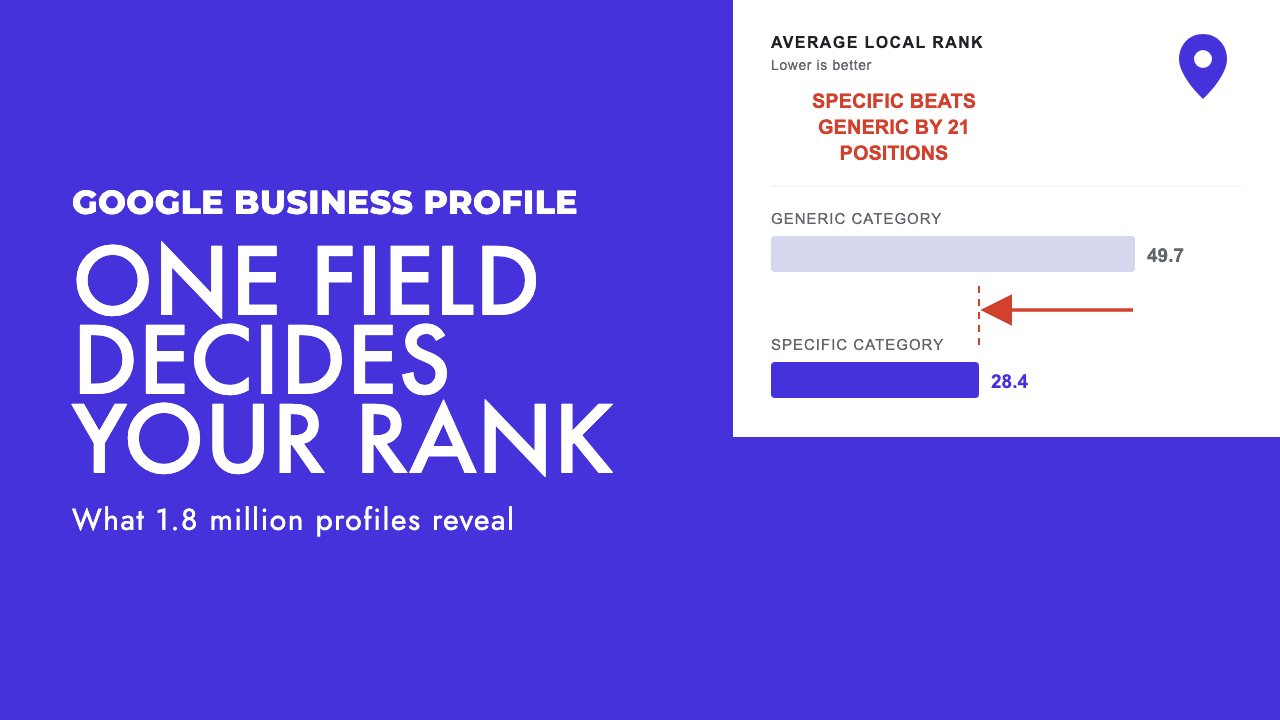
Make your Google Business Profile genuinely complete and active. Google has been clear for years that local ranking comes down to relevance, distance, and prominence, and it spells this out in its own local ranking help docs. Prominence is the lever you control. Fill every field, pick precise categories (we covered how much the primary category moves local rankings), post regularly, add real photos, answer questions, and keep your hours honest. A thin or stale profile is invisible to both the map pack and the AI summary that reads from it.
Treat reviews as ranking content, not vanity metrics. Reviews were always a local signal. Now they are also the raw material AI Overviews summarise when they describe a business. BrightLocal's long running local consumer research has tracked for years how heavily buyers lean on reviews (the 2026 edition has 97 percent of consumers reading reviews for local businesses, and 82 percent reading AI generated review summaries), and the AI layer leans the same way. Ask for reviews consistently, respond to them, and the language customers use in them becomes the language the AI uses about you.
Keep your name, address, and phone identical everywhere. Consistency across your site, your profile, and the directories that matter is unglamorous and still works. AI systems cross reference sources, and contradictory information makes you a riskier business to recommend. Clean data is trust.
Build location pages that prove you operate there. Not doorway pages, real ones, with local detail a national competitor cannot fake. This is where multi location businesses still win, and we go deeper on the structure in our guide to local SEO for multiple locations.
Write the way people ask. Conversational, question shaped content earns citations in both AI Overviews and assistant answers. "How much does a house clean cost in Nicosia" is a real query a real person types into an AI. Answer it plainly on your site and you become a quotable source.
The new layer: getting recommended by AI assistants
Here is our take, and it is opinion, so weigh it as one. Optimising to be named by ChatGPT, Gemini, and Perplexity for local queries is the fastest growing part of local SEO and the least understood. Nobody has a clean attribution model for it yet, which is exactly why most businesses are ignoring it, which is exactly why there is room.
The good news is that the inputs overlap almost entirely with classic local SEO. AI assistants build their picture of you from the same places, your Business Profile, your reviews, mentions on local sites and directories, and your own pages. There is no separate AI checklist that replaces the work. There is the same work, done well, plus a bit of attention to being mentioned in the kind of third party content these models trust, local press, roundups, reputable directories.
We would not bet a whole budget on AI assistant visibility today, the volume is real but still smaller than the map pack. We would absolutely make sure that every signal you are already building for Google also reads cleanly to a model, because that costs almost nothing extra and the trend line only points one way. If you want to go deeper on the discipline itself, that is what our AI search optimization work is about.
Cyprus and the US, same shift, different pace
The mechanics are identical in both markets. The timing is not.
In the US, AI Overviews and assistant recommendations are already common on local commercial searches, so the decoupling we showed above is in full swing. The businesses pulling ahead are the ones treating their Business Profile and reviews as their primary local asset, not their homepage.
In Cyprus and similar smaller markets, the AI layer is a step behind, which is a gift. The map pack still carries more of the weight here, competition on it is lighter, and you have a window to build the profile, review, and citation base now, before the AI surfaces mature and the same squeeze arrives. We work with local businesses on exactly this through our local SEO service and from our Cyprus home base, and the advice right now is simple: use the head start. That holds whether you run a clinic, a garage or a restaurant in Cyprus.
What to actually do this quarter
If you take one thing from this, make it this list, and grab our local SEO and GBP audit worksheet if you would rather work through it in a document.
- Audit your Google Business Profile end to end and fix every incomplete or stale field.
- Build a real review engine, ask every happy customer, respond to all of them.
- Lock your name, address, and phone consistency across every place you appear.
- Add or rewrite location pages with detail only a genuine local could provide.
- Answer your top customer questions in plain language on your site.
- Check what ChatGPT and Gemini say when asked to recommend a business like yours locally, and fix the gaps that answer reveals.
Update, September 2026
Three things moved since June. Google's Gemini powered Ask Maps, which launched in the US and India in March, expanded in August to more than 150 countries and territories in English, with restaurant ordering and hotel booking built in for US users. That is the third path arriving inside Google's own map, drawing on the same reviews and listing data as the map pack.
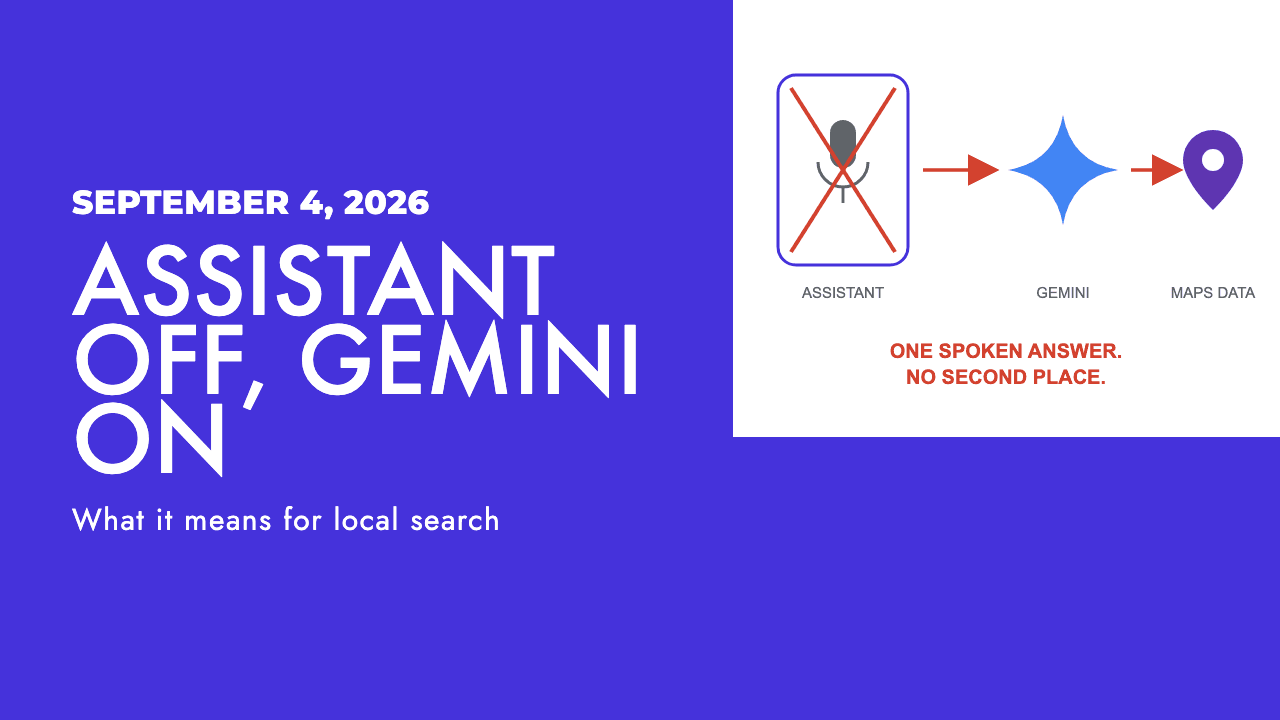
Google also connected Gemini to Business Profiles in June, so owners can draft review replies and find profile gaps from the assistant, and Google Assistant itself is being retired in favour of Gemini, which we covered in what the Assistant shutdown means for local search. The head start we described for Cyprus is shorter than it was in June.
Local SEO in 2026 is about as hard as it was, just pointed at a different target. The businesses that understand the click is no longer the only prize, that being trusted and named matters as much as ranking, are the ones that will still be getting the call when the map pack is just one option among several. If you want a clear read on where you stand, our free SEO review is a good place to start.