
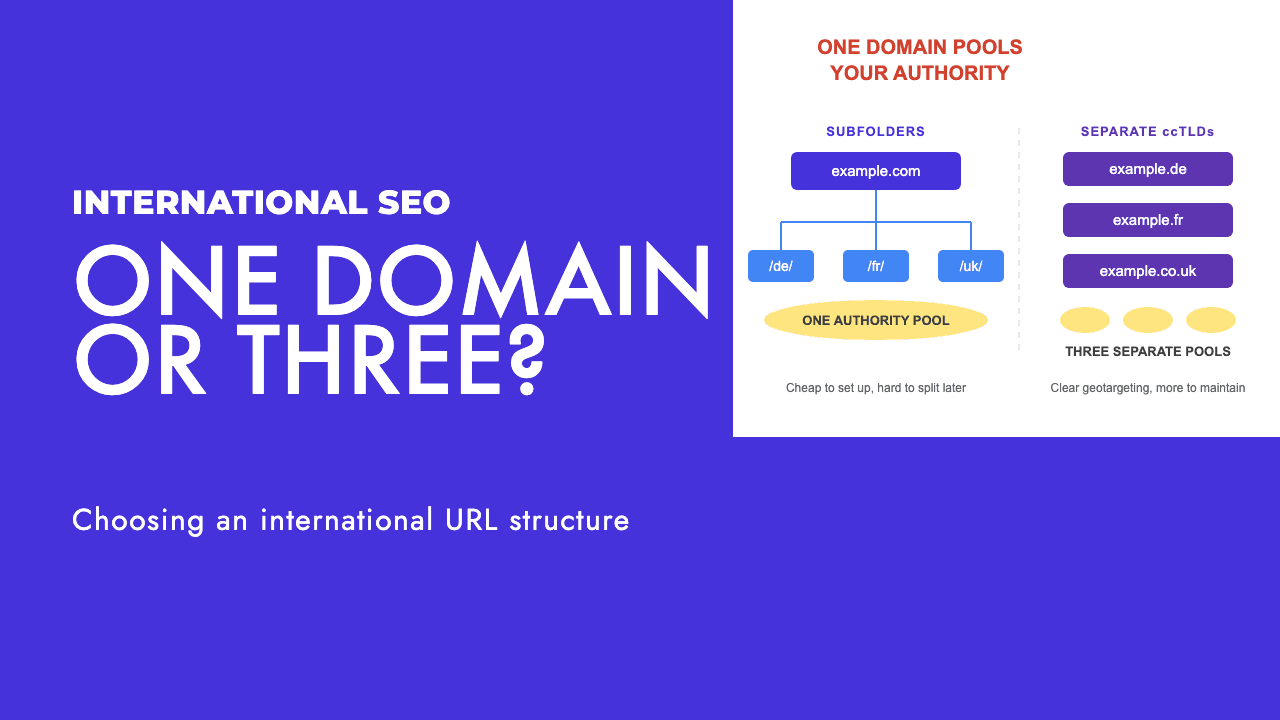
Picking a URL structure for a second market takes one meeting. Reversing it takes a site migration, a redirect map for every URL you own, and about a year of keeping the old addresses alive.
That gap is why this is the one decision in international SEO worth slowing down for. Most businesses we speak to have been pointed at the expensive option, a country domain per market, when a subfolder on the domain they already own would have done the job better.
The four structures Google documents, and the one it tells you to skip
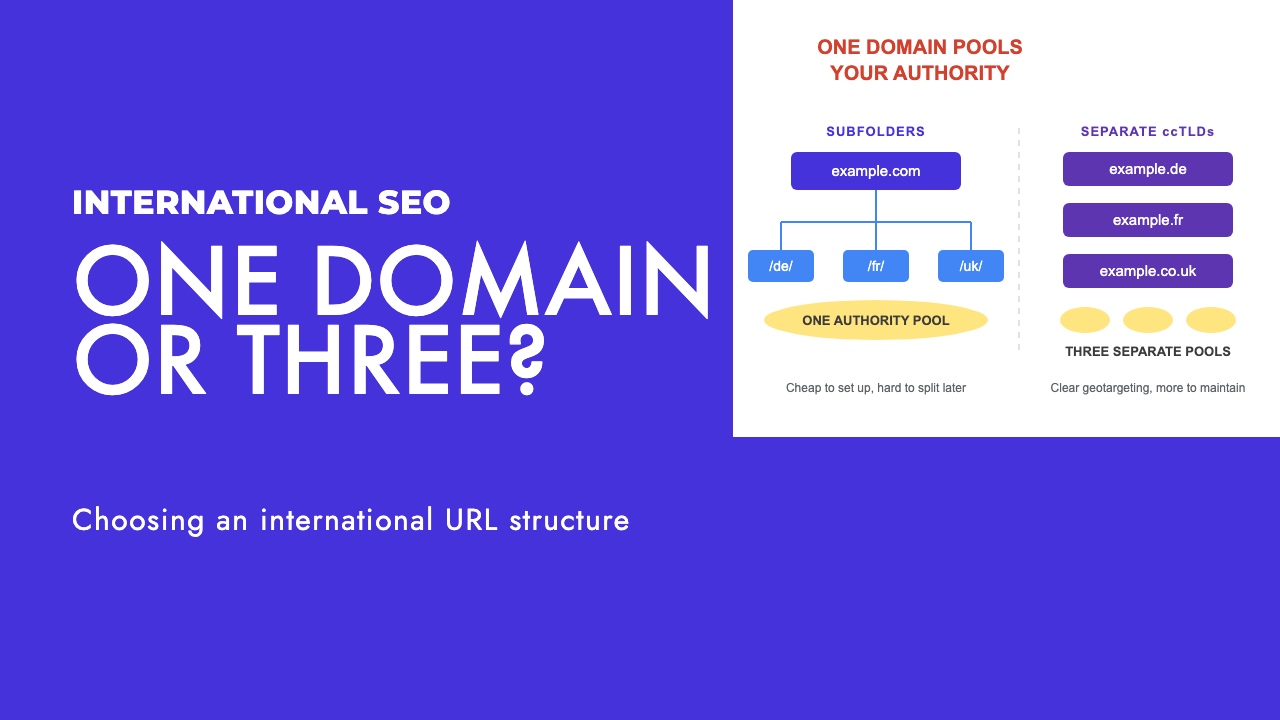
Google's guide to managing multi-regional sites lists four ways to give each market its own URLs. The pros and cons below are Google's own, lightly condensed.
| Structure | Example | What Google lists in favour | What Google lists against |
|---|---|---|---|
| Country-specific domain (ccTLD) | example.de | Clear geotargeting. Server location irrelevant. Easy separation of sites. | Expensive, with limited availability in some cases. Requires more infrastructure. Strict ccTLD requirements (sometimes). Can only target a single country. |
| Subdomain on a generic TLD | de.example.com | Easy to set up. Allows different server locations. Easy separation of sites. | Users might not recognise the targeting from the URL alone. Is "de" a language or a country? |
| Subdirectory on a generic TLD | example.com/de/ | Easy to set up. Low maintenance (same host). | Users might not recognise the targeting from the URL alone. Single server location. Separation of sites harder. |
| URL parameters | site.com?loc=de | Nothing. Google marks this one "Not recommended". | URL-based segmentation is difficult. Users might not recognise the targeting from the URL alone. |
Nowhere in that table does Google say one structure ranks better than another. Every item is about cost, infrastructure, clarity for users or how cleanly the sites separate.
That matches how Google describes its own process on the same page. It works out a target locale from the ccTLD if there is one, hreflang, server location and other signals such as local addresses and phone numbers, local language and currency, links from local sites and Business Profile data.
Server location is a signal but not a definitive one, because CDNs and hosting choices blur it. And Google ignores locational meta tags like geo.position and distribution, so nobody needs to spend a sprint adding them.
The country dial in Search Console is gone
There used to be a setting in Search Console where you could point a site or a folder at a country. Google has deprecated the International Targeting report, and its explanation is blunt: country targeting "was determined to have little value for the ecosystem, and is no longer supported".
Older guides still recommend subfolders "and then set the target country in Search Console". That step no longer exists. The same notice confirms Google will keep supporting and using hreflang, so what you have left is your structure, your hreflang and the ordinary local signals listed above.
Our reading: this makes the ccTLD look more attractive than it should, because it is the only explicit country flag left. But Google removed the dial because it did little, which is a strange basis for paying extra to get the same flag another way.
ccTLD registration rules: the thing nobody checks until the project is approved
Google's guide tells you in one line to research registration restrictions before choosing a country domain. In our experience that research tends to happen after the budget is signed off, which is the wrong way round.
The .eu domain is open to EU citizens wherever they live, and to undertakings and organisations established within the Union, under Regulation (EU) 2019/517. Registration for citizens living outside the EU has applied since 19 October 2019, according to the European Commission. For a company the test is establishment in the Union, so a UK business with no EU entity should confirm it qualifies before a .eu goes anywhere near the plan.
France works on residence and location. Afnic's FAQ says a private individual can register a .fr if they live in an EU member state, Switzerland, Liechtenstein, Norway or Iceland. An organisation needs its registered office or main place of business in one of those territories. Work out which entity in your group would actually hold the name before you assume it qualifies.
Closer to home, Registry .cy is the official administrator of all .cy domain names and is managed by the University of Cyprus. If a .cy is part of your plan, read the registry's own terms before you budget for it.
Multiply that homework by every market on the roadmap. A subfolder needs none of it.
The generic ccTLD trap: .io, .co, .me and friends
Some country code domains do nothing for geotargeting at all. Google treats a list of them as generic, because users and site owners mostly see them that way. The current list in Google's documentation is:
.ad, .ai, .as, .bz, .cc, .cd, .co, .dj, .fm, .io, .la, .me, .ms, .nu, .sc, .sr, .su, .tv, .tk, .ws
Google notes the list may change, so check the live page first.
The good news: a software company on a .io or a .ai has not accidentally told Google it only serves one small territory. The domain behaves like a .com for targeting purposes.
The trap is the reverse assumption. A brand on a .co that expects some local pull in the country that code belongs to gets none from the domain. Any targeting has to come from subfolders, hreflang and local signals, the same as on a .com.
Why subfolders are the right default for most businesses
If you are a Cyprus or UK business adding a second or third market, start from subfolders on your existing domain and make every other structure argue its way in.
The reason is authority, and we are stating it as a practitioner view, not as something Google has published. A site earns its standing through links and reputation, and most small businesses do not have much of either to spare. A new country domain starts from nothing. A new folder on your main domain starts on a site Google already crawls and already has reasons to trust.
John Mueller made a related point about subdomains and subdirectories in 2018, as reported by Search Engine Journal: "In general, we see these the same. I would personally try to keep things together as much as possible." He added that subdomains suit cases "where things are really kind of slightly different".
If the search engine sees the structures much the same, the choice comes down to what is cheaper to build, link to and maintain. For a small team that is one site: one host, one CMS, one set of templates, and every link earned in any market pointing at the same domain.
Google's listed downsides for subfolders are real but small for most readers of this blog. "Single server location" matters less once you remember Google itself says server location is not a definitive signal, and a CDN covers the speed side. "Separation of sites harder" only hurts if you needed separation in the first place.
This is the structure we recommend first in most of our international SEO work, whether the starting point is a business in Cyprus looking outward or a UK company adding its first EU market.
When a separate domain or subdomain is the right call
There are good reasons to go the other way, and they are narrower than a domain reseller will tell you.
A regulatory or licensing boundary. If your licence, your regulator or your payment setup requires a market to be operated by a specific entity on its own domain, the decision is made for you. It comes up most with iGaming operators and financial services firms, where the legal structure comes first and the SEO has to fit around it.
A separate brand or legal entity. If the business in the new market trades under a different name, sells a different range or belongs to a different company, it is a different site. Forcing it into a folder on someone else's brand helps nobody.
A market where the local domain is a trust requirement. In some countries and sectors, buyers expect the national domain and hesitate without it. That is a conversion argument, and it can be a good one. Test the assumption with people in the market before paying for it.
A local team that needs its own stack. If the German office runs its own platform, its own release cycle and its own content team, a subdomain lets them host and ship independently.
None of these is "because it ranks better". If that is the only reason on the table, you are back to subfolders.
Structure does not replace hreflang
Whichever structure you pick, Google still needs to be told which page is the equivalent of which. That is hreflang's job, and it works across all three structures. Google's documentation on localised versions of your pages states that alternate URLs do not need to be on the same domain.
The rules that decide whether the tags get honoured are short:
| Rule | What Google says |
|---|---|
| Pick one method | HTML link tags, HTTP headers and XML sitemaps are "equivalent from Google's perspective". Using all three gives no extra benefit. |
| Include yourself | Each language version must list itself as well as every other version. |
| Make it mutual | If two pages do not both point to each other, the tags are ignored. |
| Use full URLs | Alternate URLs must be fully qualified, including http or https. |
| Set a fallback | x-default is used when no other language or region matches the user's browser setting. |
In our experience the mutual rule is the one that breaks on ccTLD setups. When each country site has its own CMS and its own team, one side updates a URL and the other never hears about it. On a single domain with one CMS, the return tags come from the same database.
We go through the implementation detail, including the failure modes that only appear on geo-restricted sites, in our hreflang guide for multilingual casino sites.
What each structure costs you in reporting
Reporting is the cost people forget, and it comes down to how Search Console property types work.
A Domain property covers the root domain, every subdomain and every protocol. It can only be verified with a DNS record, unless the site is hosted on a Google product. A URL-prefix property covers only URLs that start with the exact prefix, protocol included, so a property for https://example.com/pets/ includes /pets/cats but excludes the http version and m.example.com.
| Structure | What you get by default | How to get the market view back |
|---|---|---|
| Subfolders | One Domain property with every market in it | Add a URL-prefix property per folder, such as https://example.com/de/ |
| Subdomains | One Domain property that includes every subdomain | Add a URL-prefix property per subdomain and protocol |
| ccTLDs | A separate property per domain, with no combined view | Export each property and join the data yourself |
Subfolders give you both views cheaply: the whole business in one property and each market in its own. With country domains, the combined picture only exists in a spreadsheet or dashboard that somebody has to maintain every month.
If you already picked the wrong structure
Google's guidance on site moves with URL changes says a small to medium-sized site can take a few weeks for most pages to move, and larger sites take longer. Googlebot has to visit every URL on the old and new site at least once before the move counts as complete. Expect visibility to fluctuate while that happens.
The Change of Address tool helps in one direction. It can move a domain to a path within another domain, which is exactly the ccTLD to subfolder case: example.de into example.com/de/.
Its limits:
- It only works on domain-level properties, not on a path such as example.com/petstore/.
- It does not move subdomains below the domain you specify, www included. Each one is its own job.
- It is not for HTTP to HTTPS changes, www to non-www changes, or moves within the same site. Reshuffling folders on one domain relies on redirects alone.
- Its signals last 180 days. Google says to keep redirects for at least that long, and longer if the old URLs still get Search traffic.
Google's site move guidance goes further and recommends keeping redirects for at least a year. That means renewing every old country domain long after the project is declared finished, because a lapsed domain takes its redirects with it.
Everything in our website redesign SEO checklist applies here too: map every URL, redirect page to page instead of everything to the homepage, and update hreflang on the same day the redirects go live.
A consolidation is weeks of careful technical SEO and a year of upkeep. Choosing the right structure at the start is one meeting. If you are about to have that meeting, or you suspect you had it years ago and got the wrong answer, send us the site through a free SEO review and we will tell you which structure we would pick and what changing would cost.
Frequently asked questions
Is a ccTLD better than a subfolder for international SEO?
Not by default. Google documents country domains, subdomains and subfolders as workable options and lists trade-offs for each without ranking them. A ccTLD gives clear geotargeting but costs more, needs more infrastructure and can only target one country. For a business without much authority to spare, we think subfolders on one domain are the better starting point, because every market builds on the same site.
Does Google treat .io, .co and .ai as country domains?
No. Google treats a list of country code domains as generic, including .io, .co, .ai, .me and .tv, because site owners and users mostly see them that way. A domain on one of those endings tells Google nothing about which country you serve. It behaves like a .com for geotargeting, so you still need subfolders, hreflang and local signals to target specific markets.
Can I still set a target country in Google Search Console?
No. Google deprecated the International Targeting report and no longer supports country targeting through Search Console, saying the feature had little value for the ecosystem. Hreflang tags are still supported and used. In practice your URL structure, your hreflang annotations and ordinary local signals such as addresses, currency and links from local sites are the only ways left to tell Google which market a section serves.
How long does it take to move from country domains to subfolders?
Google says a small to medium-sized site can take a few weeks for most pages to move, with larger sites taking longer, and that visibility may fluctuate during the move. The Change of Address tool can move a whole domain into a path on another domain, and its signals last 180 days. Plan to keep the redirects for at least a year.