
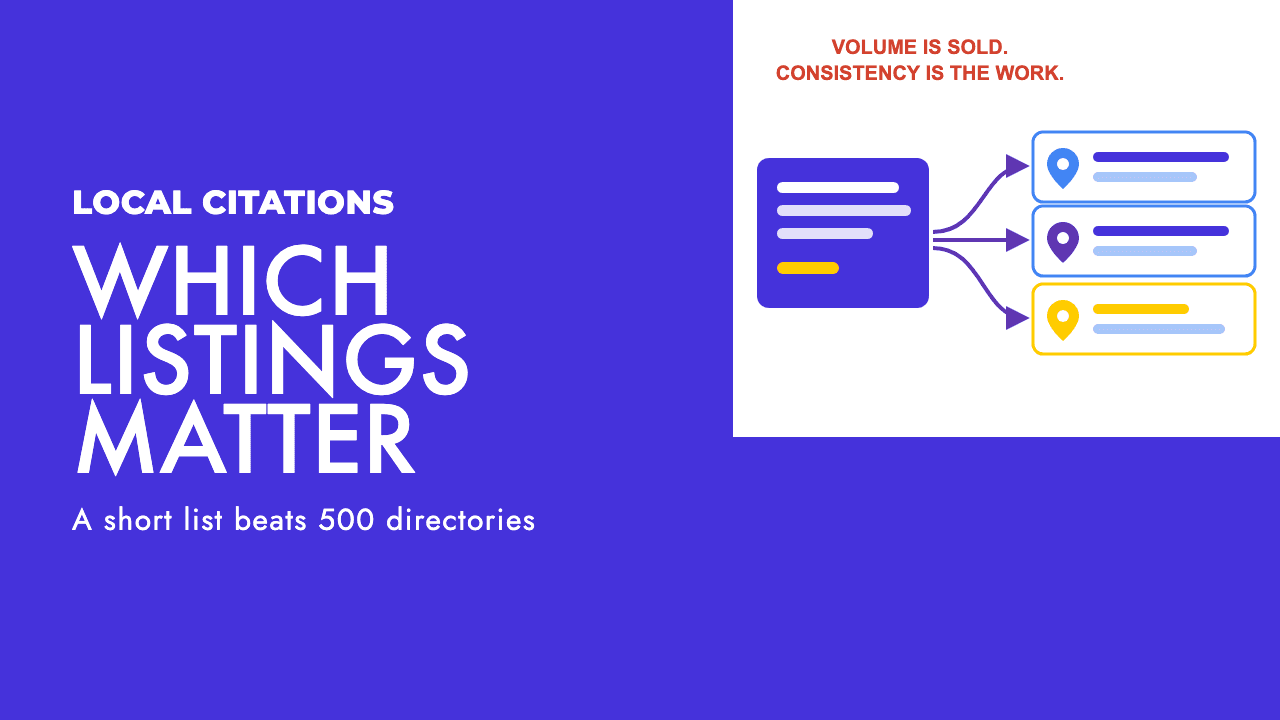
If you run a local business, somebody has tried to sell you a citation package: a few hundred directory submissions, a monthly fee, and a report full of green ticks. Google's own page on local ranking never uses the word "citation" at all.
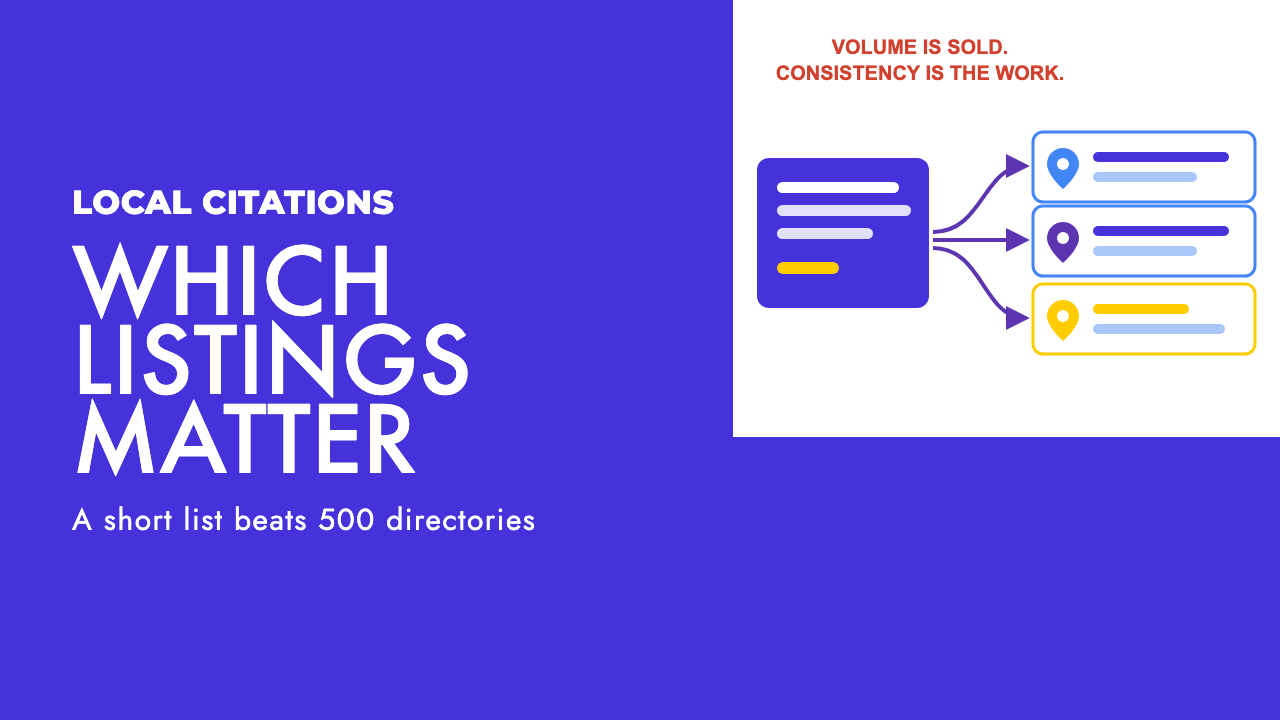
Local citations still matter, in a much narrower way than the packages imply. The work is making sure a short list of platforms carries the same correct details about your business. For most firms in Cyprus or the UK that is an afternoon, plus a check once a quarter.
What a citation is, and what Google's documentation actually says
A local citation is a mention of your business's name, address and phone number on a site you do not own: a maps listing, a directory, a regulator's register, a chamber of commerce page. The industry shorthand for those three fields is NAP, and "NAP consistency" means they match wherever they appear.
Now read Google's page on how to improve your local ranking. It says local results are "mainly based on relevance, distance, and popularity", and under the heading of prominence it explains the third factor as how well known a business is, "based on info like how many websites link to your business and how many reviews you have".
The same page says "Businesses with complete and accurate info are more likely to show up in local search results", and that there is no way to request or pay for a better local ranking. The words "citation", "NAP" and "consistency" do not appear on it.
The industry's own survey treats them as a category of their own. Whitespark's Local Search Ranking Factors asks local search practitioners to score what moves rankings, and it files "location data, NAP consistency, citation volume" together as citation signals, kept apart from Google Business Profile signals, reviews and links. Our experience is that this is the group with the smallest gains left in it.
So our position is simple. Treat citations as a data-integrity job. As links they are worth next to nothing. What a good citation does is confirm, to machines and to people, that your business exists where you say it does and under the name you say it has.
The one consistency rule Google does publish
There is exactly one place where Google tells you to be consistent, and it is about your name. The guidelines for representing your business on Google say: "Your name should reflect your business's real-world name, as used consistently on your storefront, website, stationery, and as known to customers."
Look at what the consistency is anchored to. It is the physical world: the sign above the door, the letterhead, what customers call you. Google is asking whether your profile matches reality, and forty directories agreeing with each other proves nothing about that.
The same guidelines give everything else its own home: address, service area, hours and category are entered in other sections of your business information. Whatever is painted on the sign is what goes in the name field, with no "Best Dentist in Limassol" bolted on the end.
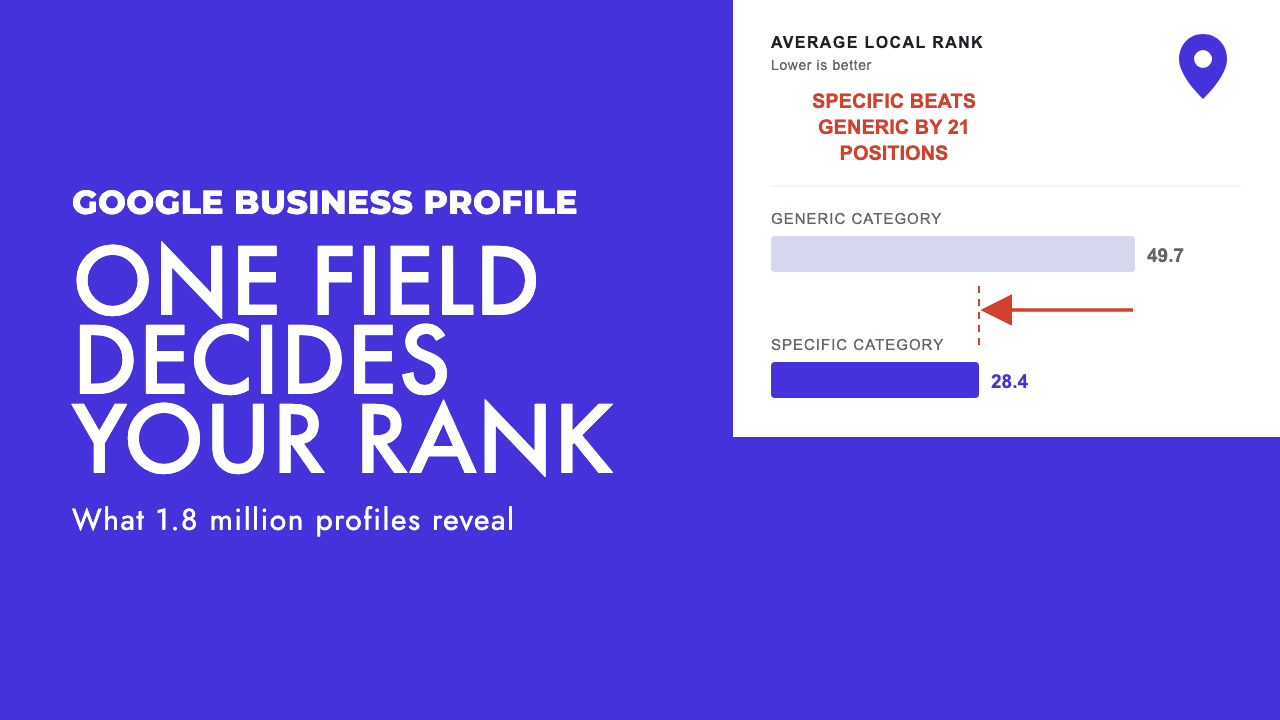
In practice, decide the name once, exactly as it appears on your signage, and use that string everywhere. If you want Google to understand what you do, that is the job of the category field, and we have covered how the primary category affects local rankings separately.
The listings that earn their place
Here is the whole list, in the order we would do them.
| Platform | Who consumes the data | What to do |
|---|---|---|
| Google Business Profile | Google Search and Google Maps | Claim and verify it. Real-world name, correct primary category, every field filled in. |
| Apple Business (formerly Apple Business Connect) | Apple Maps and the place card shown across Apple's apps | Claim the place card. Check the pin position, hours and phone, then set the action buttons. |
| Bing Places for Business | Bing and Bing Maps, with Copilot integration on Microsoft's roadmap | Sign in at bing.com/forbusiness and check the listing that was migrated or imported for you. |
| Facebook Page | People checking that you are real, open and reachable | Match the name, phone, address and hours to your canonical record. |
| One or two sector platforms | Customers comparing options in your vertical (TripAdvisor for hospitality, the marketplace or booking site your trade runs on) | Claim the profile, correct the details, keep hours and photos current. Stop at two. |
| Regulator or association register | Customers doing due diligence, and anything looking for an authoritative record of who you are | Check that your entry matches. Fix it through the body's own process. |
Two of these have changed recently, and most citation guides have not caught up.
Apple's listing product has a new name. Apple's user guide now states that "Apple Business Connect is now Apple Business", which folds Apple Business Manager, Apple Business Essentials and Apple Business Connect into a single offering.
The thing you are managing there is the place card, which Apple's partner guide describes as "the digital representation of every brand on Maps and across Apple". The default action buttons are directions, call and website, and Apple says place cards are viewed billions of times a month. If your customers carry iPhones, a wrong pin on Apple Maps sends them to the wrong street.
Bing Places has moved house. On 3 October 2025 Microsoft announced that the owner experience had moved from www.bingplaces.com to www.bing.com/forbusiness, with existing listings migrated automatically.
Microsoft also says the import from Google is now "better at preserving key attributes like business name, hours, and contact details", and that it is continuing to invest in "deeper integrations with Bing Maps and Copilot". That last part is the reason to spend ten minutes here. A Bing listing that was imported years ago and never opened since is a likely home for an old phone number.
That is six rows, and most businesses will end up with six to eight listings in total.
Why the citation ecosystem maps do not apply outside the United States
Every citation guide reproduces some version of the same diagram: data aggregators at the top, directories in the middle, maps and search engines at the bottom, with arrows showing data flowing down. The canonical version is Whitespark's, and its title is The U.S. Local Search Ecosystem.
The logic of the diagram is that you correct your details with a few aggregators upstream and the fix spreads to everyone they supply. In the United States that is a sound way to work.
Cyprus has no aggregator layer. Nobody compiles Cypriot business data and licenses it down to a hundred directories, so there is nothing to seed. When a package sold to a business in Cyprus lists "aggregator submission" as a line item, ask which aggregators, and which of them hold data here.
UK businesses should ask the same question. The decks used to sell citation work in the UK are, in our experience, the American diagram with the flag changed.
The practical consequence is that outside the US each listing gets corrected at source, by hand, by someone who has the login. With a list this short, that is manageable.
Registers and associations: the citations that do real work
Our view is that the highest-value citations for a Cyprus or UK business are free and cannot be bought from an agency. They are the official registers.
In the UK the starting point is Companies House, the public register of company names and registered office addresses. It is your address of record. Plenty of firms use their accountant's address as the registered office, which is fine. What matters is that you know what the register says and that your website makes the link between the registered company and the trading name plain.
In Cyprus, regulated sectors have their own registers. The CySEC register of Cypriot investment firms is one example: a public list of regulated firms, maintained by the regulator. Most regulated professions have an equivalent, kept by a regulator or a professional association.
These entries pull double duty. People read them: an investor checking a broker or a client choosing a law firm goes to the register before the contact form. A wrong address or a lapsed trading name there costs you the enquiry.
They are also the hardest listings to fake, which is the property any system needs when it is deciding whose details to believe. We have written about how AI local answers run on licensed data, and our opinion is that a register entry matching your website is the cheapest trust signal you can give an AI assistant asked whether a firm is legitimate.
How to audit what is already out there in an afternoon
Do this in order, and do not skip the first step.
- Write the canonical record in a spreadsheet before you touch anything: legal name, trading name as it appears on your signage, address in one format, main phone number in international format, website URL, opening hours and primary category.
- Run the searches in the table below and log every result: the URL, what it shows, whether it matches, and whether you hold the login.
- Open the six core platforms while signed in and compare each field against the canonical record.
- Sort the mismatches into two piles: wrong and visible (anything on page one for your name, plus the core six) and wrong and obscure.
| Search for | What it surfaces |
|---|---|
| Your business name in quotation marks | Listings you forgot about and ones you never created |
| Your phone number in quotation marks, in both local and international format | Directories that scraped you, and listings under a different name |
| Every previous address | Stale listings and duplicate map pins from before a move |
| Old phone numbers and former trading names | Records that are still sending customers to a dead line |
Fix the visible pile. For the obscure pile, correct what takes two minutes and leave the rest.
Then make your own website agree with the record. The contact page and footer should carry the same name, address and phone, and you can state it in LocalBusiness structured data with our schema markup generator.
Fixing inconsistency: what to worry about and what to ignore
If we had to rank the fields, name comes first. It is the only one with a published consistency rule, and a name that breaks the guidelines puts the whole profile at risk. Phone comes second, because a wrong number loses the customer outright. Address and hours follow.
Do not lose sleep over "Street" against "St". Google's guidelines say "Google determines how best to display your business address based on your business information and information from other sources." Google normalises the formatting itself. The mention of other sources is also the closest its documentation comes to saying third-party listings feed in.
What does matter is that every listing points at the same building and the same unit. The guidelines allow suite and floor numbers, so if you share a building, include the suite the same way everywhere. PO boxes and remote mailboxes are not acceptable.
Service-area businesses are a special case. Google says that if you are one, you should hide your business address from customers. Our advice is to keep it off directories too, so your consistent record becomes name, phone, website and service area. There is more on this in our guide to service area business SEO.
Duplicates need removing, because "There should only be one profile per business". The usual culprits are a listing from a previous address and one created by a former employee. A business with several branches gets one profile per branch, each with its own record, which we cover in local SEO for multiple locations.
Finally, your Google listing is not only yours to edit. Any signed-in user can suggest changes to a place, and Google says this feedback "helps Google Maps decide whether to change a place's information". Edits that try to significantly change a business may be rejected, but smaller ones can go through without you noticing.
That is the reason for the quarterly check. If an edit or a name problem ever tips the profile into suspension, we have a suspended Google Business Profile appeal guide for that.
What to skip, and why
Skip citation packages and 500-directory submissions. Customers do not read those directories, Google's documentation does not ask for them, and outside the US there is no aggregator network to justify them. You also inherit 500 records that will all be wrong the day you change your phone number.
Skip perpetual listing-management subscriptions if you have one location. The data on six listings is static until you move. Brands with dozens of branches have a real maintenance problem and tooling is reasonable there. For everyone else, ask the vendor what happens to the listings when you stop paying.
Skip keyword-stuffed names. They break the one rule Google has written down, and anyone can suggest an edit to them.
Skip anything that promises a ranking in exchange for a fee. Google's own page says there is no way to request or pay for a better local ranking.
What is left is small: one correct record, six to eight listings that match it, and a calendar reminder every three months. If you would rather hand that over, it is part of our local SEO service, and a free SEO review will tell you what your listings currently say.
Frequently asked questions
What are local citations?
A local citation is a mention of your business name, address and phone number on a site you do not own, such as a maps listing, a directory or a regulator's register. Their job is to confirm that the business exists where it says it does. We treat them as a data accuracy task: a handful of correct listings does more than hundreds of unread ones.
Does NAP consistency affect Google rankings?
Google's local ranking documentation does not mention NAP or citations. It says businesses with complete and accurate info are more likely to show up, and its guidelines ask for a name that matches the one on your storefront, website and stationery. Our view is that consistency protects you from wrong data reaching customers and Google, and that it is hygiene, with little ranking upside beyond that.
How many local citations does a business need?
For most single-location businesses in Cyprus or the UK, six to eight: Google Business Profile, Apple Business, Bing Places, a Facebook Page, one or two platforms specific to your sector, and whichever regulator or professional association register covers you. Beyond that, each extra listing is another record to correct when your phone number or address changes, with nobody reading it in the meantime.
Are business listing management tools worth paying for?
For one location, rarely. The data on six listings changes when you move or change your number, and checking it takes under an hour a quarter. A subscription makes more sense for brands with dozens of branches, where hours and phone numbers change constantly. Before signing, ask the vendor which platforms it covers in your country and what happens to the listings if you cancel.