
Ask most business owners how they are doing in AI search and they will tell you about AI Overviews and ChatGPT. Ask them when they last logged into Bing Webmaster Tools and you get a blank look.
That gap is the point of this post. There is a second distribution network for AI answers, it runs on Microsoft's index, and checking your position in it costs an afternoon.
Yahoo Scout is the reminder that this network exists
In January 2026 Yahoo launched Scout, an AI answer engine built on Anthropic's Claude and grounded in Yahoo's own data ecosystem, with Microsoft's Bing grounding API supplying the web search layer (Yahoo Inc, Search Engine Land).
What makes Scout worth noticing is not the model choice. It is the link behaviour. Scout puts sources front and centre, with hoverable citations through the answer and a featured source block, rather than burying attribution behind a chevron.
That is the opposite of the pattern everyone has been complaining about for two years. An answer engine that is trying to send traffic out is one you want to be visible in.
The map most people have never drawn
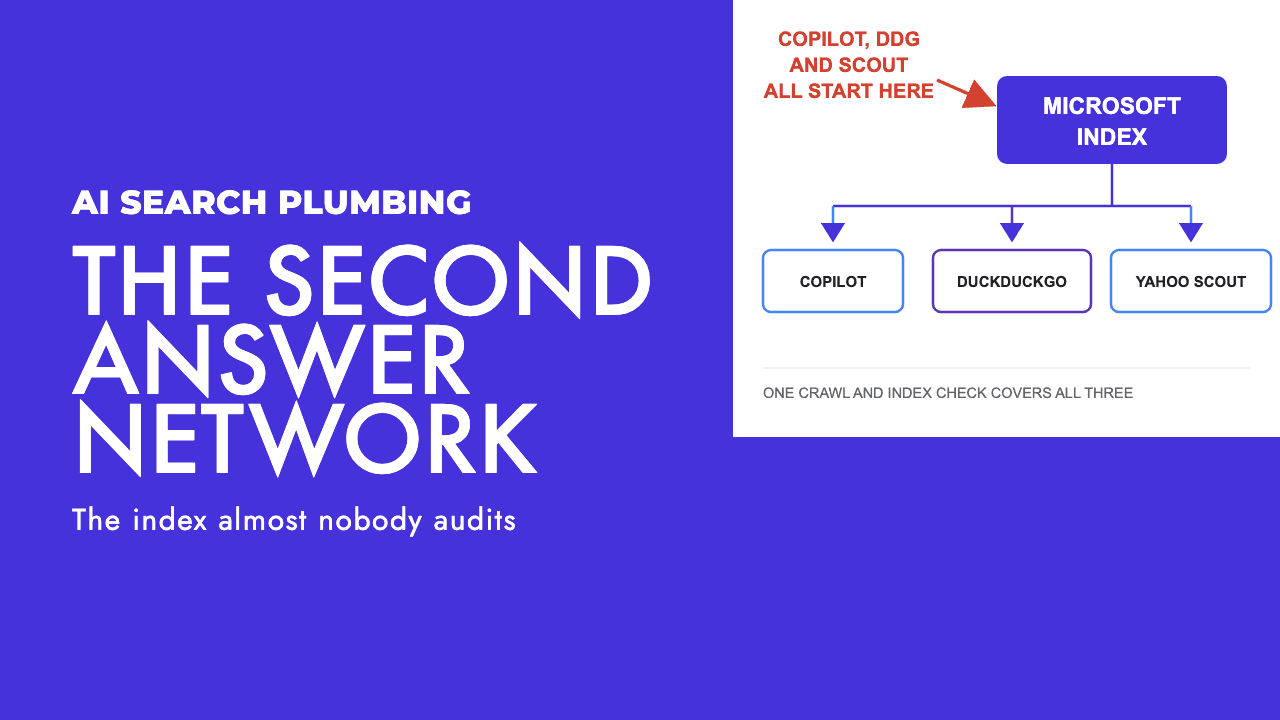
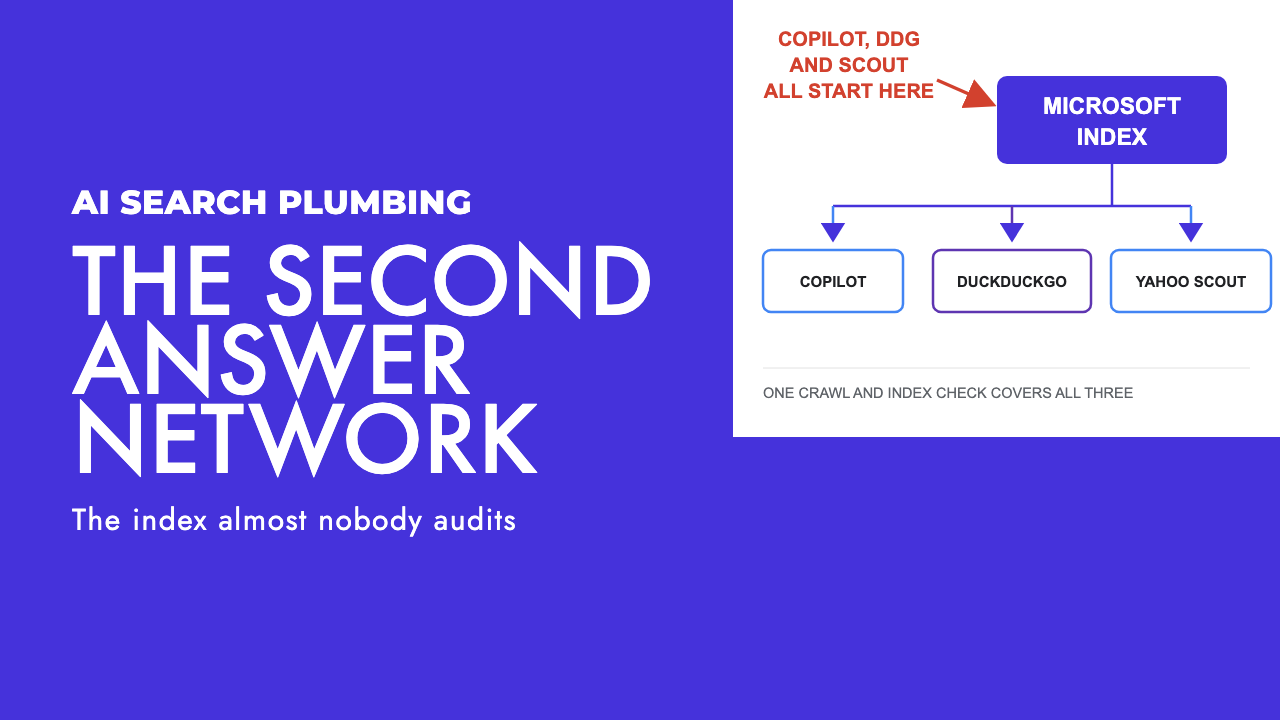
Here is the part that surprises clients. A single index sits underneath several places people are getting answers.
- Microsoft Copilot, inside Windows, Edge and Microsoft 365.
- DuckDuckGo, which sources its traditional web links and images from Bing and layers its own crawler, Instant Answers and AI features on top (DuckDuckGo help pages).
- Yahoo, including Scout.
- The Windows search box and Edge's default experience.
None of those are Google. All of them are downstream of how well Microsoft has crawled, rendered and understood your site.
If you have never verified your domain in Bing Webmaster Tools, you have no idea what any of them can see. We run into this constantly with new client sites: strong Google presence, and a Microsoft index footprint that is stale, partial, or missing entire sections.
Our take: this is not a "Bing strategy"
We want to be careful here, because the SEO industry has a habit of turning every observation into a new discipline with a new acronym.
This is not that. We are not telling you to build a Bing content plan, or to write differently for Copilot, or to buy a rank tracker for DuckDuckGo. Microsoft's share of classic search is what it has always been, and chasing it as a traffic channel has never made sense for most businesses.
What changed is that the index stopped being a search engine and started being plumbing. It now feeds answer surfaces that reach people who never type a query into bing.com. Being absent from plumbing is a different kind of problem from ranking eighth.
So the correct response is proportionate: a one-off hygiene check, not a strategy. Half a day, mostly free tools, then move on.
The audit, in the order we run it
1. Verify the domain in Bing Webmaster Tools. It is free, and if you already have Search Console you can import the property rather than re-verifying from scratch (Bing Webmaster blog). Most sites we look at have simply never done this step. Once you are in, open the AI Performance report, in public preview since February 2026, which lists the URLs cited in Copilot and in Bing's AI-generated summaries and the grounding queries that pulled them in (Bing Webmaster blog).
2. Compare indexed page counts against Google. Not for vanity. You are looking for a gap that points at a structural problem: a section that never got crawled, a sitemap that was never submitted, a template that renders empty.
3. Check robots.txt for accidental blocks. Bingbot is the obvious one, but plenty of sites have picked up copy-paste blocks over the years, and AI crawler blocking has made robots.txt files messier than they used to be. Take two minutes to test Bingbot against a few real URLs rather than reading the file by eye. If you are unsure what you are actually allowing, our guide to AI crawlers and robots.txt walks through it.
4. Test rendering, not just fetching. If your content only exists after JavaScript executes, treat that as a risk on every index that is not Google's. This is where we find the ugliest problems, and it is the same class of issue covered in our JavaScript SEO troubleshooting notes. For a quick per-page look, our Chrome extension that audits a single page covers the on-page basics in one click.
5. Wire up IndexNow. It is an open protocol supported by Bing, Yandex, Naver, Seznam and Yep that lets you push changed URLs instead of waiting to be crawled (IndexNow). Most modern stacks and CMS plugins support it, and it is a genuinely small piece of work.
6. Read the crawl diagnostics once. Not weekly. Once, properly, and fix whatever it flags.
That is the whole thing. If your site is healthy, you will find nothing and you will have bought certainty cheaply. If it is not, you have just found visibility that was sitting there unclaimed.
Where the simple story breaks down
One correction, because it gets repeated as gospel: "ChatGPT runs on Bing, so fix Bing and you fix ChatGPT" is out of date.
OpenAI operates its own crawler, OAI-SearchBot, to surface sites in ChatGPT search (OpenAI), and its retrieval now blends multiple sources rather than passing through a single index. The overlap between what ranks in Bing and what ChatGPT cites is looser than it was in 2024. We went through what ChatGPT actually reads, and how rarely it opens the live page, in ChatGPT almost never opens your page.
We would treat Microsoft's index as necessary but not sufficient. It is a hard prerequisite for Copilot, DuckDuckGo and Yahoo Scout. It is one contributing input for ChatGPT. Neither of those is a reason to skip the check, and neither is a reason to expect the check alone to earn you citations. For that side of the work, structure and source quality still do the heavy lifting, which we covered in how to structure content so LLMs cite you.
Why this matters more in Cyprus and small US markets
Two reasons, and they are practical rather than philosophical.
First, in smaller markets the competitive set is thin. On a query where three local businesses could plausibly be cited, being one of the two that an answer engine can actually read is decisive in a way it never is in a crowded national vertical.
Second, Microsoft's index skews toward desktop and workplace contexts. Copilot inside Microsoft 365 and Edge is a business-hours surface. If you sell B2B services, professional services, or anything bought from an office desk, that audience composition is worth more to you than its raw share suggests.
None of this displaces Google. Google is still where the volume is, and the broader AI search market picture has not been rewritten by a Yahoo launch. It just means the cost of ignoring the second network went up while the cost of fixing it stayed at roughly zero.
The bottom line
Answer engines are consolidating onto a small number of indexes. Google runs one. Microsoft runs the other. OpenAI is building a third, and Apple quietly tripled its crawl capacity for a fourth in July.
Everyone is spending their AI search energy on the first and the third. The second is unglamorous, free to check, and quietly feeding answers to people using Windows, Edge, DuckDuckGo and now Yahoo Scout.
Verify the domain. Compare the index counts. Check what robots.txt is really doing. Turn on IndexNow. Then go back to the work that actually needs your attention.
If you would rather someone else ran the check, that is part of what we do in a technical SEO engagement, and it is one of the things we look at in a free SEO review.