
For twenty years the job was to rank a page. Someone typed a query, scanned ten blue links, and clicked one. Win the ranking and you won the visit.
That is no longer the whole job. When someone asks ChatGPT, Perplexity, Gemini or Google's AI Overviews a question, nobody clicks ten links. The model reads across a few sources, lifts the passages it can use, and writes a single answer. The unit of victory has moved from the ranked page to the quoted passage.
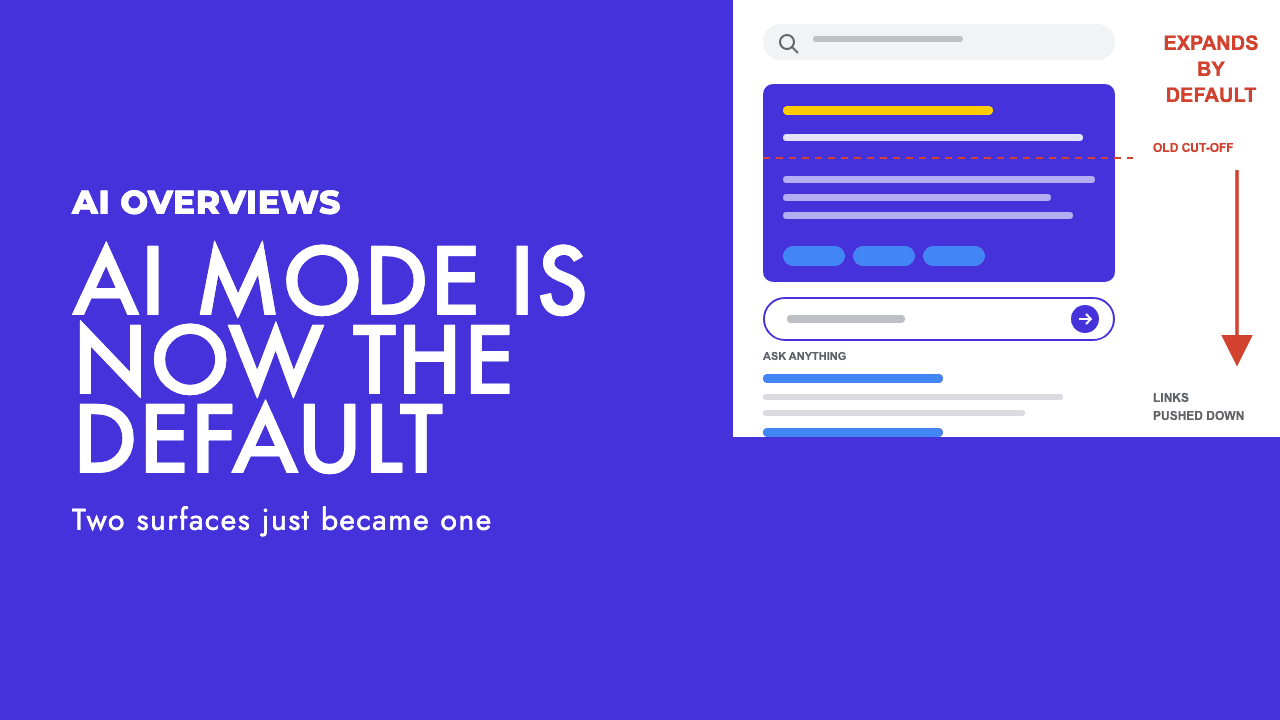
This is already the default for a large slice of search. Pew Research tracked nearly 69,000 real Google searches in 2025 and found that when an AI summary appeared, people clicked a normal result in just 8 percent of visits, against 15 percent when there was no summary (Pew Research Center). By early 2026, SparkToro put the share of US Google searches ending without any click at 68 percent (via Search Engine Land). AI Overviews on its own now reaches more than two billion people a month, on Google's own numbers. The answer has become the destination.
So the question clients in Cyprus and the US ask us constantly is the practical one. How do you structure a page so the machine picks you as the source? Here is the honest, tested version, and it is not the checklist most people are selling.
The short version
LLMs do not rank your page. They retrieve and quote fragments of it. So you are not optimising a page to be ranked, you are writing passages to be extracted and trusted. In practice that means:
- Answer the question in the first two sentences of each section, before any wind-up.
- Write headings as the questions people actually ask.
- Make every section make sense on its own, with no "as we saw above".
- Use formats a machine can lift cleanly: short paragraphs, lists, comparison tables, plain definitions.
- Put the evidence in the visible text. Quotes, statistics and named sources are what the research shows earns citations.
- Earn the authority underneath it all. Structure gets you read. Reputation gets you chosen.
The rest of this guide is the why and the how. And yes, this article is built the way it tells you to build yours. That is the point.
What "getting cited" actually requires
Three things have to be true before an AI surface will quote you. Your passage has to be retrievable, extractable, and trustworthy. Miss any one and you are invisible to the answer.
Most AI answers are built with some form of retrieval augmented generation. Amazon's plain definition is that the model "references an authoritative knowledge base outside of its training data sources before generating a response" (AWS). To do that, systems break documents into chunks, turn each chunk into a vector that captures its meaning, and pull back the chunks whose meaning sits closest to the question. Google's AI Overviews and AI Mode add a step on top, a "query fan-out" technique that issues multiple related searches across subtopics before composing the answer (Google Search Central). We unpack that mechanic in our guide to query fan-out.
The implication is the whole game. The unit the machine works with is the passage, not the page. A chunk that reads cleanly on its own gets retrieved and quoted. A chunk that leans on the sentence above it does not, because the model has nothing to resolve "it", "this" or "as mentioned" against once the surrounding text is gone. Engineers building these systems already know this. Anthropic's write-up on contextual retrieval uses the example of a chunk saying a company's revenue grew 3 percent, with no mention of which company or which quarter, which makes it hard to retrieve or use (Anthropic). You are not writing for a reader who starts at the top. You are writing for a machine that may only ever see one paragraph of yours, ripped out of order.
This is the heart of answer engine optimisation, and it is why the same passage can win across ChatGPT, Perplexity and Google at once. Now the moves.
Answer the question in the first two sentences
Lead with the answer, then explain. A web page is not a novel, and there is no payoff for building suspense. The model is scanning for a clean, self-contained statement it can present as the response, so give it one before you give it anything else.
Open each section with one or two sentences that would stand as a complete answer if nobody read another word. Then add the nuance, the caveats and the worked example underneath. This is the old inverted pyramid from journalism, and it maps almost perfectly onto how retrieval works. The sentence that answers the heading is the sentence most likely to be lifted.
Write headings as the questions people actually ask
People query AI tools in questions, so your headings should look like the questions, not like chapter titles. "How do I structure content for LLMs" is a heading a model can match to a real query. "Content structure considerations" is not.
A quick test. If a heading could sit comfortably in a frequently asked questions list, it is doing its job. If it reads like a line in a table of contents, rewrite it. Match the phrasing to how a person would actually ask, and you give the retrieval step an obvious hook. This is also how you earn a place across the Google AI Mode playbook, where one question fans out into many.
Make every section survive being copied out on its own
Take any section of your page, paste it into a blank document with no heading and no surrounding text, and read it cold. If it still makes sense and delivers the answer, it is built for extraction. If you need the paragraph above it for context, it is not, and the model will likely skip it.
Kill the connective tissue that only works in sequence. Phrases like "as we covered earlier", "building on the above" and "as mentioned" are quietly toxic, because they signal to the machine that this fragment cannot be cleanly separated from its neighbours. Repeat the subject instead of leaning on a pronoun. Name the thing again rather than calling it "it". A little repetition reads slightly heavier to a human and dramatically better to a retrieval system.
Give machines formats they can lift cleanly
Some formats are far easier for a model to reuse than others, because they package one idea per unit with no ambiguity. The more of your content sits in these shapes, the more there is to quote.
| Format | Why an LLM can use it |
|---|---|
| A one or two sentence direct answer under the heading | Lifted whole as the response, no editing needed |
| Numbered list | Reused verbatim for "how to" and "steps" answers |
| Bulleted list | Pulled as discrete points for "what are the" answers |
| Comparison table | Read row by row to answer "X versus Y" questions |
| A defined term, written as "X is..." | Quoted directly as a clean definition |
Keep paragraphs short, ideally one to three sentences. Long blocks blur several points together, so the machine cannot cite one without dragging in the rest. Break sequential instructions into numbered lists and unordered points into bullets. When you are weighing two options, build the table. You are not dumbing the content down, you are making each idea independently quotable.
Put the evidence in the visible text
This is the finding that should change how you write, and it is the part most "AI content" advice skips. The strongest controlled study we have on what makes generative engines cite a page comes from researchers at Princeton, Georgia Tech and the Allen Institute for AI, published at KDD 2024. They tested content edits across thousands of queries and measured what moved visibility in AI answers. The headline: their methods boosted a source's visibility "by up to 40% in generative engine responses" (GEO, Aggarwal et al.).
The tactics that won were not technical. The three best performers were citing your sources, adding direct quotations, and adding statistics. None of them touch the markup. All of them enrich the words a reader actually sees. And the tactic that failed? Keyword stuffing, the oldest reflex in SEO, performed worse than doing nothing at all.
A 2026 analysis pointed the same way from the other direction. Citera looked at around 350,000 articles and found that the ones AI tools actually cited carried far more evidence on the page: expert quotes appeared in 52 percent of cited articles versus 21 percent overall, and cited articles averaged roughly 2.7 times as many external source citations as the rest (Citera).
The lesson is blunt. You cannot tag your way into an AI answer. You earn it by putting quotable substance on the page, a specific number where a vague claim used to be, a named source, a real quote, a date. If a sentence could be tightened into a citable fact, tighten it. Hedging language and rounded-off generalities give the model nothing to lift.
Use plain, consistent language for the things that matter
Name things the same way every time and define your terms once, clearly. Models match meaning, and inconsistent or jargon-heavy phrasing makes your content harder to retrieve for the query a real person would type. If a term is not widely understood, define it in a plain "X is..." sentence the first time it appears.
This is also where entities matter. The machine needs to know who you are, what you do, and what your key terms mean without guessing. Consistent naming of your product, your service and your core concepts across the page, and across your site, gives the model a stable thing to attach trust to. Clever synonyms scattered around for "freshness" work against you here.
Where schema actually fits now
Schema markup helps machines parse your content. It does not buy you a citation, and Google has now said so in about as many words as it ever will. Its generative AI guidance states plainly that "structured data isn't required for generative AI search, and there's no special schema.org markup you need to add." Its AI features documentation repeats it: "you don't need to create new machine readable files, AI text files, or markup to appear in these features."
The point was underlined in May 2026 when Google retired FAQ rich results entirely. The FAQPage markup is still valid and harmless, but the visible reward in the results is gone. We wrote about what that tells you about schema, and the short version is that markup was never a growth hack and the era of treating it like one is closing.
So keep the structured data that earns you real rich results and helps machines understand your entities, your articles and your products. If you are starting from nothing, our schema markup generator writes valid Article, Product and Local Business JSON-LD. Drop the magical thinking that a bit of JSON-LD will talk an LLM into quoting a page that has nothing quotable on it.
The llms.txt question, settled with data
You will be pitched llms.txt as the new must-have file. Skip it for now and spend the time on the page itself. The evidence is not close.
Ahrefs looked at 137,210 domains and found that 97 percent of llms.txt files received zero traffic in May 2026 (Ahrefs). SE Ranking studied close to 300,000 domains and found no correlation between having an llms.txt file and being cited. And Google's Gary Illyes said outright in July 2025 that Google does not support llms.txt and is not planning to (Search Engine Land), a position Google's own AI guide has since put in writing. We covered the full case for and against llms.txt, and nothing in 2026 has moved it from theory to results. If you want the file anyway, generate a spec-compliant llms.txt in a couple of minutes and get back to the page itself. If you want a file that actually controls AI access, your robots.txt and crawler directives do real work today.
Structure earns the citation, authority keeps it
Structure gets your content read by the machine. Authority is what makes the machine choose you over the other clean, well-structured page answering the same question. Without genuine expertise underneath it, perfect formatting just makes thin content easier to skip.
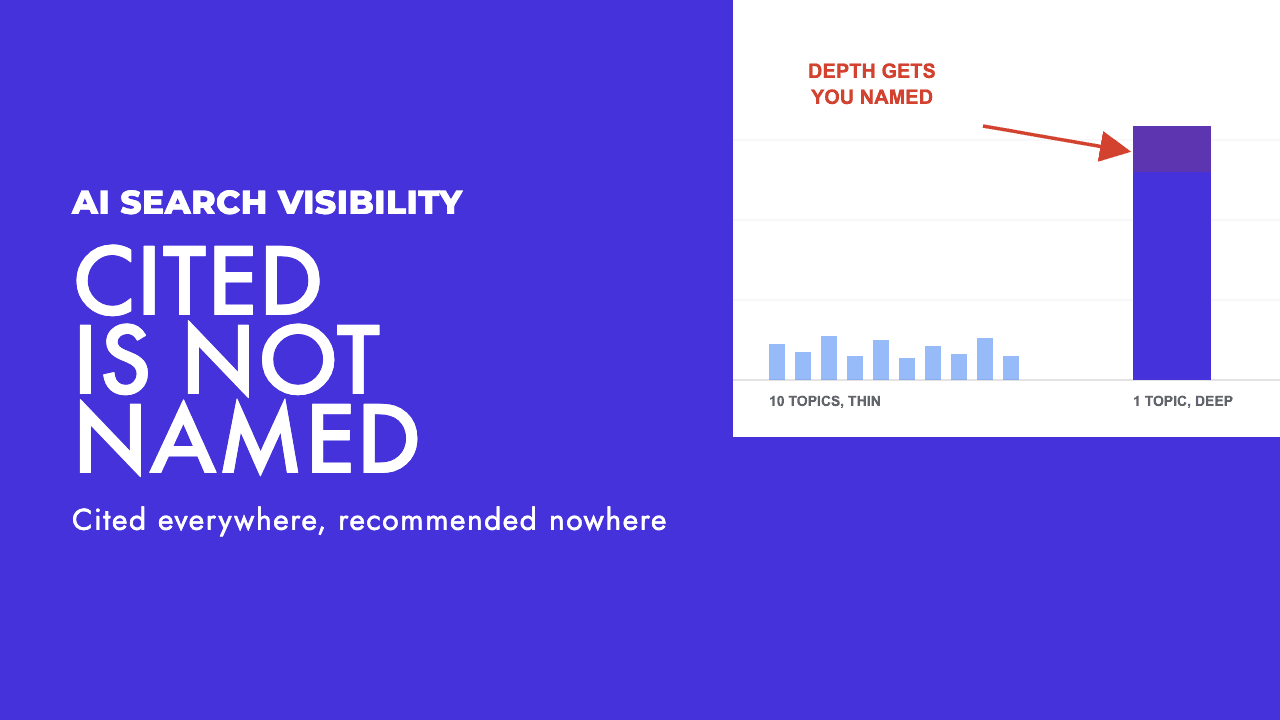
The data here is striking. Ahrefs analysed around 75,000 brands and found that branded mentions across the web were the single strongest correlate of AI visibility, far ahead of classic link metrics like Domain Rating (Ahrefs). Semrush's "ghost citations" study found that in almost 62 percent of cases an AI platform used a page as a source link without ever naming the brand in the answer (Semrush). We looked at what to do about that in our post on ghost citations, and at why being cited and being recommended run on different signals in AI citations vs recommendations. The models are drawing on what the web says about you, not just what your own page says about itself.
That means the work that builds AI citations is the work that has always built durable visibility. Cover your topics in real depth rather than one thin page each, so you read as an authority on the subject and not a tourist. Link your own pages together so the machine can see how they fit into a theme. Put real, named authors and verifiable expertise on the page. And earn mentions because you are worth quoting, not because you bought them, which is a line Google has now drawn hard in its spam policy on manufactured AI citations. The same logic that separates good backlinks from bought ones now applies to mentions, and it is the standard we hold our own backlink building work to.
How to tell if it is working
You no longer have to guess whether AI is citing you. Google Search Console now reports impressions inside AI Overviews and AI Mode, rolled out to every site worldwide on 31 August 2026, though it shows impressions only and no clicks or queries (Search Engine Journal). We walk through it in our look at the new generative AI reports. For the surfaces Google does not measure, there are tools that track whether you appear in ChatGPT and Perplexity answers, covered in our guide to tracking AI visibility and our wider piece on AI search visibility.
Watch the right metric while you are at it. Impressions can climb while clicks stay flat, the pattern we call the great decoupling. In an AI answer world, being the cited source is often the win even when the click never lands.
Why good pages still don't get cited
If your domain is strong and your topic is relevant but you are still missing from AI answers, the cause is usually one of these, and all of them are structural:
- A long introduction that warms up for three paragraphs before answering anything.
- The actual answer buried near the bottom, after the context.
- Walls of unbroken text with no lists, tables or short paragraphs to lift.
- Headings written as labels instead of as the questions people ask.
- Sections that only make sense if you have read the ones before them.
- Vague, hedged language where a specific number or named source belongs.
- A page with nothing genuinely expert to say, which no amount of formatting can rescue.
Update, September 2026
Google has since drawn a line under one reading of this advice. On Search Off the Record in January, Danny Sullivan said of cutting content into bite-sized pieces for LLMs, "I was talking to some engineers about that. We don't want you to do that" (Search Engine Roundtable), and at Search Central Live Milan in June the message was that forcing paragraph "chunking" for AI is useless and organisation should follow human readability (Search Engine Roundtable). That is consistent with everything above. Self-contained sections, answers up front and evidence in the visible text are how good writing for people has always worked. Slicing a page into 40-word fragments for a parser is the thing to avoid, and we covered the difference in what Google actually said about content chunking.
The bottom line
Writing for LLMs is not a separate discipline with secret files and special markup. It is clear, well-evidenced, well-structured content, written so a machine can pull one passage out of order and still trust it. Answer first. Break the content into self-contained, quotable pieces. Put real evidence in the visible text. Then earn the authority that makes the model pick you.
The businesses that win the AI search era will be the ones that are genuinely worth quoting and easy to extract, in that order. If you want an honest read on whether your content is built to be cited or just built to rank, a free SEO review is the place to start. We work with companies through our Cyprus SEO agency and across the US on AI search optimisation that gets you into the answer, not just onto the page.