
Two facts are doing the rounds this year and they are used to argue opposite things. Google's share of search engine referrals is still above 91%. ChatGPT has 900 million weekly users.
Both are true. Neither measures what most people think it measures, and the gap between them is where the useful answer lives. This post pulls the 2026 figures into one place, dates each one, and then explains why "AI search market share" is a phrase that needs unpacking before you spend a budget on it.
The 2026 numbers in one table
Every figure below comes from a source we opened this week. Where a company has not published an update, the table says so rather than guessing.
| Figure | Value | As of | Source |
|---|---|---|---|
| Google share of search engine referrals, worldwide (Bing 4.5%) | 91.1% | August 2026 | StatCounter |
| ChatGPT weekly active users | 900 million | 27 February 2026 | OpenAI via Search Engine Land |
| ChatGPT share of generative AI web traffic | 52.7%, down from 76.4% a year earlier | May 2026 | Similarweb via PPC Land |
| Gemini share of generative AI web traffic | 27.3%, up from 8.9% | May 2026 | Same Similarweb data |
| Gemini app monthly active users | 1 billion | 11 August 2026 | |
| AI Mode monthly active users | over 1 billion | Q2 2026 call, 22 July 2026 | Alphabet |
| AI Overviews monthly users | 2.5 billion | June 2026 investor presentation | Motley Fool reporting Pichai |
| Generative AI platforms, combined monthly web visits | 9.5 billion (655 million unique visitors) | June 2025 to May 2026 | Similarweb via Search Engine Journal |
| Google Search monthly unique visitors vs ChatGPT | 3.3 billion vs 494 million, with 95% of ChatGPT users also using Google | March to May 2026 | Same Similarweb data |
| ChatGPT answers containing an external link (US) | 6.8%, up from about 1% a year earlier | May 2026 | Same Similarweb data |
| Perplexity monthly queries (last company-stated figure) | 780 million | May 2025 | Search Engine Land |
| Perplexity share of generative AI web traffic | 1.3% | May 2026 | Similarweb via PPC Land, as above |
| AI platforms' share of all website traffic (101,574 sites) | 0.32%, from 0.02% in 2024 | January 2025 to April 2026 | SE Ranking |
| ChatGPT share of AI referral traffic | 74.8% (Gemini 11.6%, Perplexity 7.2%) | 2026 | SE Ranking, as above |
| Google searches ending without a click (US) | 68.0%, from 60.5% in 2024 | January to April 2026 | SparkToro via Search Engine Land |
A note on Perplexity. Its CEO gave the 780 million figure at a Bloomberg event in June 2025 and said volume was growing 20% a month. We could not find a comparable company-stated number for 2026, and the third-party estimates floating around vary too much to print. Similarweb's traffic share is the cleanest thing to cite.
Three different denominators, so the numbers do not stack
The reason this topic produces so many confident, contradictory headlines is that the sources above are counting different things.
StatCounter counts referrals to the sites in its tracking network and attributes them to a search engine. AI Overviews and AI Mode live on google.com, so every click out of them is a Google referral. ChatGPT is not a search engine in that method at all. The 91.1% figure tells you Google-shaped search has not been displaced. It says nothing about how often a Google search ends in a click.
Similarweb's "share of generative AI traffic" is a chatbot-versus-chatbot number. ChatGPT's 52.7% is a share of visits to AI assistant domains, a category that was 9.5 billion monthly visits in the year to May 2026. Google Search alone had 3.3 billion unique visitors a month in the same window. The two shares are not on the same axis.
Google's own numbers are reach, not choice. AI Overviews appear by default. Their 2.5 billion monthly users are people who saw one, and AI Mode's billion includes anyone who tapped the tab. Compare that with ChatGPT's 900 million weekly actives, who opened an app on purpose, and you are comparing exposure with intent.
So when someone tells you ChatGPT is "eating Google" or that AI search is "only 0.3% of traffic", ask which denominator they are using. Both statements can be sourced. Neither is the number that decides your quarter.
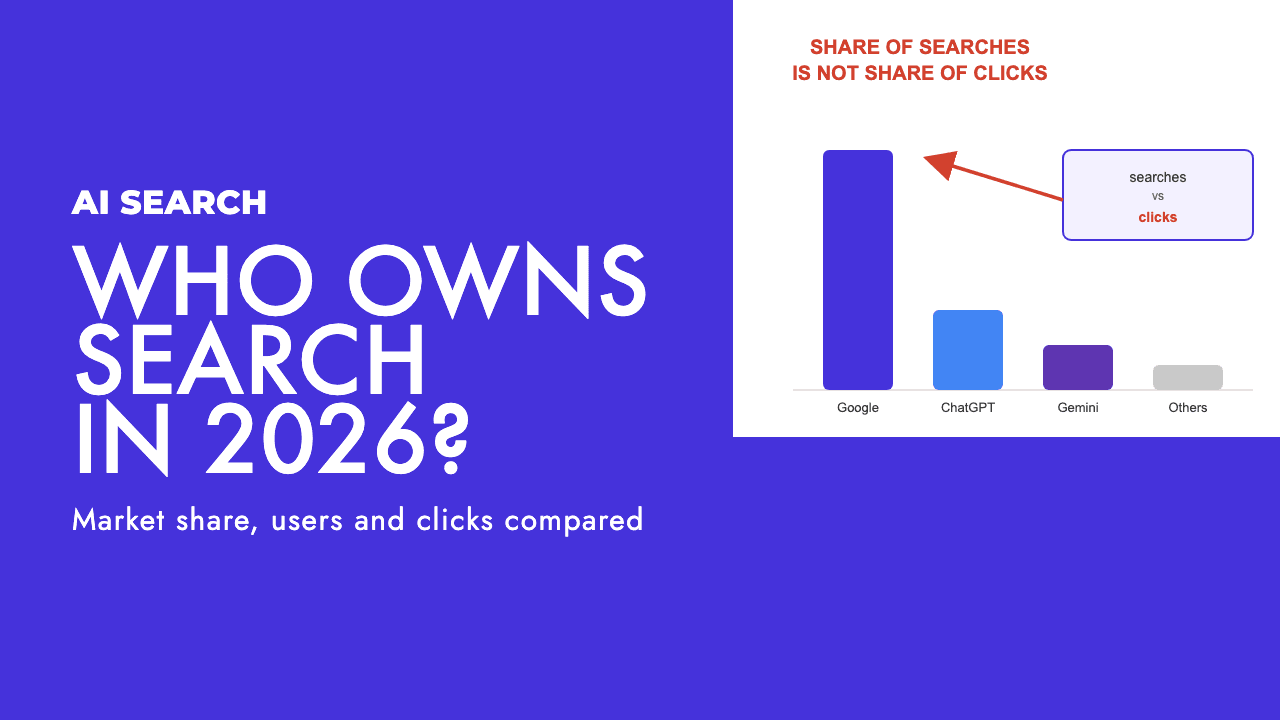
Share of searches is not share of clicks
Here is the metric we think matters, and it is not in most market share articles.
In the first four months of 2026, 68% of US Google searches ended without a click to any website, up from 60.5% in 2024. The same study found AI Overviews on more than 20% of searches, with click-through down close to 60% on the queries that trigger one. AI Mode itself was only 0.34% of searches in that period, which is how a feature can have a billion monthly users and still be a rounding error in query volume.
Meanwhile AI assistants send websites 0.32% of their traffic, and only 6.8% of ChatGPT answers in the US include a link at all.
Put those together and the picture is not "Google versus ChatGPT". It is a search market where more of the answering happens on the platform, whichever platform, and fewer of the sessions leave. Google's share of searches is intact. Its share of clicks handed to websites is shrinking, and ChatGPT's clicks are too small to replace them. We wrote about the mechanics of this in the great decoupling, and it is the same story a year on with bigger numbers.
That is the thing to track. Not who has share, but where the click went, and whether your brand was named when it did not go anywhere.
The real contest is Gemini versus ChatGPT, not ChatGPT versus Google
The most interesting movement in the table is inside the AI column.
ChatGPT's share of AI traffic fell 23.7 points in a year, not because it shrank but because Gemini tripled its share and Claude went from 1.6% to 8.9%. The Gemini app hit a billion monthly users in August 2026, up from 950 million at the July earnings call. Different units to ChatGPT's weekly figure, so do not read it as a lead, but the direction is clear.
Our read is that distribution is winning. Google can put Gemini in Android, Chrome, Workspace, and the search box itself. OpenAI has to be chosen every time. In a market where 95% of ChatGPT users also use Google, the default wins on volume even if the challenger wins on affection.
For a business, the practical consequence is that optimising for "ChatGPT" and optimising for "Google" are no longer separate projects. Gemini reads the same web Google ranks. Our guide to how to rank in ChatGPT still holds, but the work overlaps more with mainstream SEO than it did in 2025, and Perplexity has settled into a smaller, research-heavy niche rather than the Google replacement it was pitched as.
Cyprus, the UK and the EU are on different clocks
This is where a global market share number stops being useful, because rollout timing is doing more to your traffic than share is.
The UK got AI Mode on 29 July 2025, a couple of months after the US and well ahead of the EU. UK businesses have had a full year of AI Mode in their SERPs and, unlike the EU, ads in the AI surfaces.
The EU wave came on 8 October 2025, when Google switched AI Mode on in 38 new languages and more than 40 countries, and Greek was one of the languages.
The other EU difference is money. Google's ads VP said at the European launch that ads are not available inside AI Overviews or AI Mode in the EU while the format is still being tested. So an EU SERP with an AI answer is currently an ad-free zone at the top, which is one reason click behaviour in Cyprus does not match what UK and US studies report.
For Cyprus specifically, the market runs in English and Greek, and in our experience the English queries behave like a lagged version of the UK. AI answers arrived later, ads inside them have not arrived at all, and search volume in a country this size means brand recall still moves faster than any feature rollout. We covered the local angle in what AI Mode in Europe means for Cyprus businesses.
What a business should do with these numbers
Direct answer: stop asking which engine is winning and start measuring the two things that pay you.
| What to measure | Why it matters in 2026 | Where to see it |
|---|---|---|
| Clicks from Google, split by AI and non-AI surfaces | Google's share is stable, its clicks are not | Search Console now reports AI Mode data, see our AI Mode in Search Console walkthrough |
| Citations and mentions in AI answers | 93% of ChatGPT answers link to nothing, so being named is the win | Brand monitoring in Ahrefs or Semrush, or manual prompts |
| AI referral sessions | Small (0.32%) but growing and higher intent | GA4 with a regex on chatgpt.com, gemini.google.com, perplexity.ai |
| Branded search volume | The proxy for whether AI answers are creating demand you cannot see | Search Console, filtered to your brand terms |
A few opinions from doing this for clients over the past year.
Do not move budget off Google to chase ChatGPT. With 95% of ChatGPT users still on Google, you are not reaching a different audience, you are reaching the same one in a second place. The work that gets you cited in an AI Overview is the same work that gets you cited in Gemini, and most of it is ordinary SEO done properly.
Do fix the specific pages that answer questions. Similarweb's citation rate is much higher in some sectors than others (travel and automotive above 20%, professional services below 4%), so the value of a well-structured answer page depends heavily on what you sell. If you are in insurance or recruitment, the answer box is doing more of your prospect's research than it is for a plumber.
Do build something that carries your name. The single biggest change in the last twelve months is that assistants answer from memory before they search, and a brand that is never mentioned is invisible in exactly the sessions that do not click. That is not a technical fix.
And do read your own country's data, not the global average. If you are in Cyprus, a US zero-click study describes a SERP with ads in the AI answer and a year more AI Mode usage than yours. Useful as a forecast, wrong as a diagnosis.
If you want the two numbers above worked out for your own site, that is what our AI search optimisation service does, and a free SEO review is the quickest way to find out which surface is actually costing you clicks.