
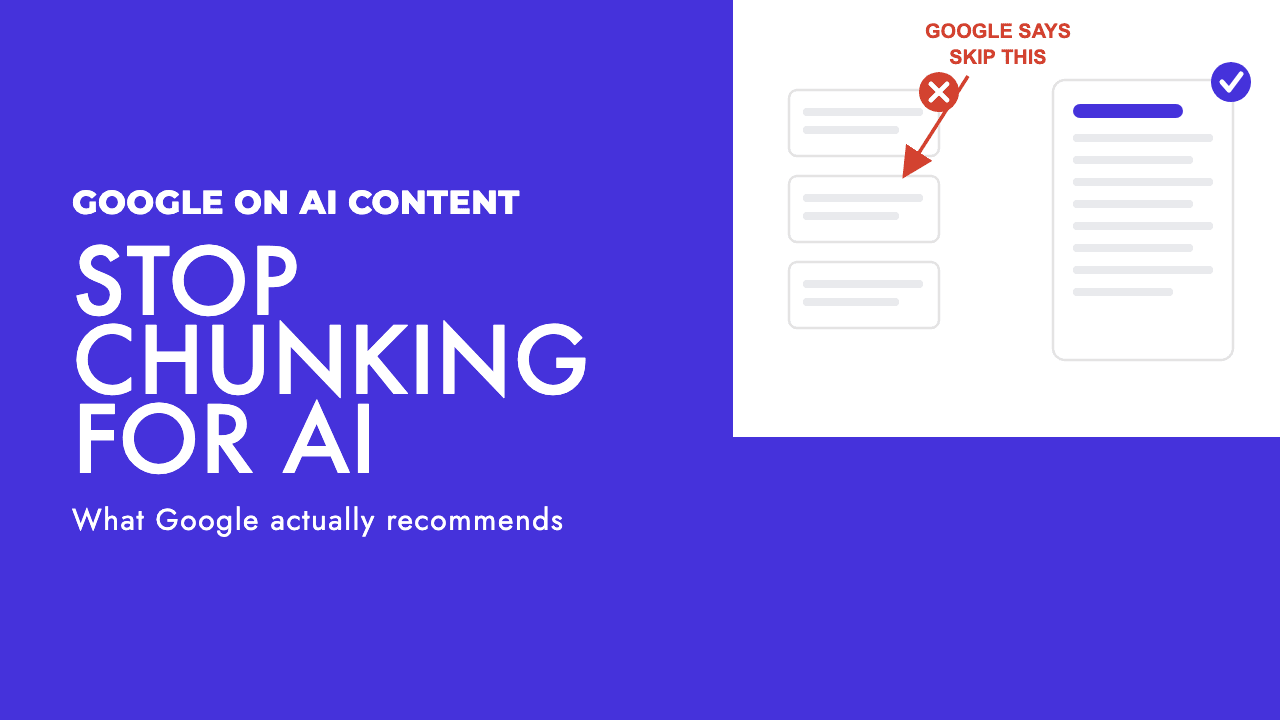
There is a piece of advice going around that you should break your pages into tidy little chunks so AI can read them. Short self-contained paragraphs, one idea each, formatted for the machine. Sell it hard enough and it sounds like the secret to getting quoted by ChatGPT and Google's AI Overviews.
Google just told everyone to stop. At Search Central Live in Milan in June, the message from the stage, as relayed in attendee notes rounded up by Search Engine Roundtable, was about as plain as Google ever gets: forcing paragraph chunking for AI is useless, and content organisation should follow human readability, not machine formatting (Search Engine Roundtable). Danny Sullivan had already said it on the Search Off the Record podcast in January: "I was talking to some engineers about that. We don't want you to do that" (Search Engine Roundtable). Google's own AI guide says the same thing in calmer language (Google Search Central).
So who is right, the tool vendors or Google? Here is our read, and it is not the fence-sitting answer.
What "chunking" actually means, and where it went wrong
Chunking is not a made-up term. It comes from how retrieval systems work. When an AI answer engine wants to use your page, it does not swallow the whole thing. It splits your content into passages, embeds them, and pulls the specific passage that answers the question. That much is real, and we have written before about how AI answers quote passages rather than rank pages.
The problem is what the GEO industry did with that fact. It turned a description of how machines read into a demand that you write like a machine. Cut everything into 40-word blocks. One idea per paragraph, no exceptions. Front-load a keyword-shaped answer into every section whether the topic needs it or not.
That is the part Google called useless. The retrieval system already knows how to find the relevant passage inside a normal, well-written page. It does not need you to pre-slice the page for it. When you chop good writing into robotic fragments, you usually make it worse for the human reader and no better for the machine.
The thing the chunking debate distracts from
Here is what actually decides whether an AI system cites you, and it is not paragraph length.
At the same Milan event, Google spent more time on something the chunking crowd tends to skip: site-level quality. URLs are not isolated entities, weak site quality drags on rankings, and the content that gets rewarded is unique, specific and authentic rather than a rewrite of what already ranks (Search Engine Roundtable). Google's AI guide adds that its generative features are "rooted in our core Search ranking and quality systems" (Google Search Central). Put those together and AI Overviews do not judge one page in a vacuum. The trust and quality picture of your whole site feeds the decision about whether any single page of yours is worth quoting.
Read that again, because it reframes the whole game. You can chunk a page to perfection and still never get cited, because the AI system does not consider your site a source worth pulling from. Formatting is a page-level lever. Citation is a site-level decision. Being recommended, rather than merely cited, sits a level above that again, and we covered the difference in AI citations vs recommendations.
This is the same message Google keeps repeating and the industry keeps not wanting to hear. Its AI guide is blunt about it: there is no special markup, no llms.txt requirement, no AI-only rewrite that unlocks visibility. What moves the needle is content people find unique, compelling and useful, built on a site that is technically sound and genuinely trusted (Google Search Central). We said much the same when we argued that AEO and GEO are still just SEO, and Milan did nothing to change that view.
Our honest take
Chunking-as-a-tactic is mostly a way to sell a simple deliverable for a hard problem.
Site-level trust is slow and hard to build. Reformatting paragraphs is fast and easy to invoice. So the market drifted toward the easy thing and dressed it up as an AI breakthrough. We see this pattern every time search shifts. Remember when everyone was reformatting pages for FAQ schema or shipping an llms.txt file as if it were a magic key. Same shape, new label.
That does not mean structure is worthless. It absolutely is not. A page that answers a clear question in a clear place, with a real heading and a direct opening line, is easier for both a human and a retrieval system to use. The difference is intent. Structure your content because it helps a reader find the answer fast, and the machine benefits as a side effect. Structure it to game a retrieval algorithm, and you get brittle writing that ages badly the moment Google's systems change.
The signal to optimise for is not "can a machine parse this paragraph." It is "would a person reading this consider it the best, most trustworthy answer on the page." Google's systems are built to approximate that judgement. Write for the judgement, not the parser.
What to actually do instead
If you were about to pay someone to chunk your content for AI, redirect the effort here.
Answer the question where the question is asked. Lead each section with the direct answer, then support it. This is good writing and good retrieval at the same time. You do not need 40-word cages to do it, just clear structure and a willingness to say the answer plainly before you elaborate. This is the core of solid content strategy, not an AI hack.
Make the content genuinely non-commodity. Google explicitly rewards a unique point of view and first-hand experience over content anyone could have written. If your page is a rephrased version of the top three results, no amount of formatting saves it. If you are not sure how much of your library reads like everyone else's, our free AI content detector will score a page for the patterns that give generated text away. The unreplicable stuff, real client patterns, specific numbers you actually have, opinions you will defend, is what earns a citation.
Fix the site-level trust picture, because that is the real gate. Clean technical foundations, a coherent topic focus, consistent quality across the site, and the authority signals that tell Google you are a source and not a scraper. This is unglamorous technical SEO and reputation work, and it is exactly the ground the chunking conversation skips over. A full website audit is usually how you find out which part of that picture is letting you down.
Stop writing for the parser. No llms.txt ritual, no mechanical paragraph slicing, no rewriting a good page into fragments because a tool told you to. Google has now said it three times, on a podcast in January, in its guide in May and on stage in Milan in June: none of it is required.
The bottom line
Chunking your content for AI is not a strategy. It is a formatting tic that got promoted to a strategy because it was easy to sell.
The businesses getting cited by AI search are not the ones with the tidiest paragraphs. They are the ones Google trusts at the site level, publishing content distinctive enough to be worth quoting. That is slower to build and impossible to fake, which is precisely why it works.
If you want a straight read on whether AI systems actually trust your site, and what is holding that back, that is what a free SEO review is for.