
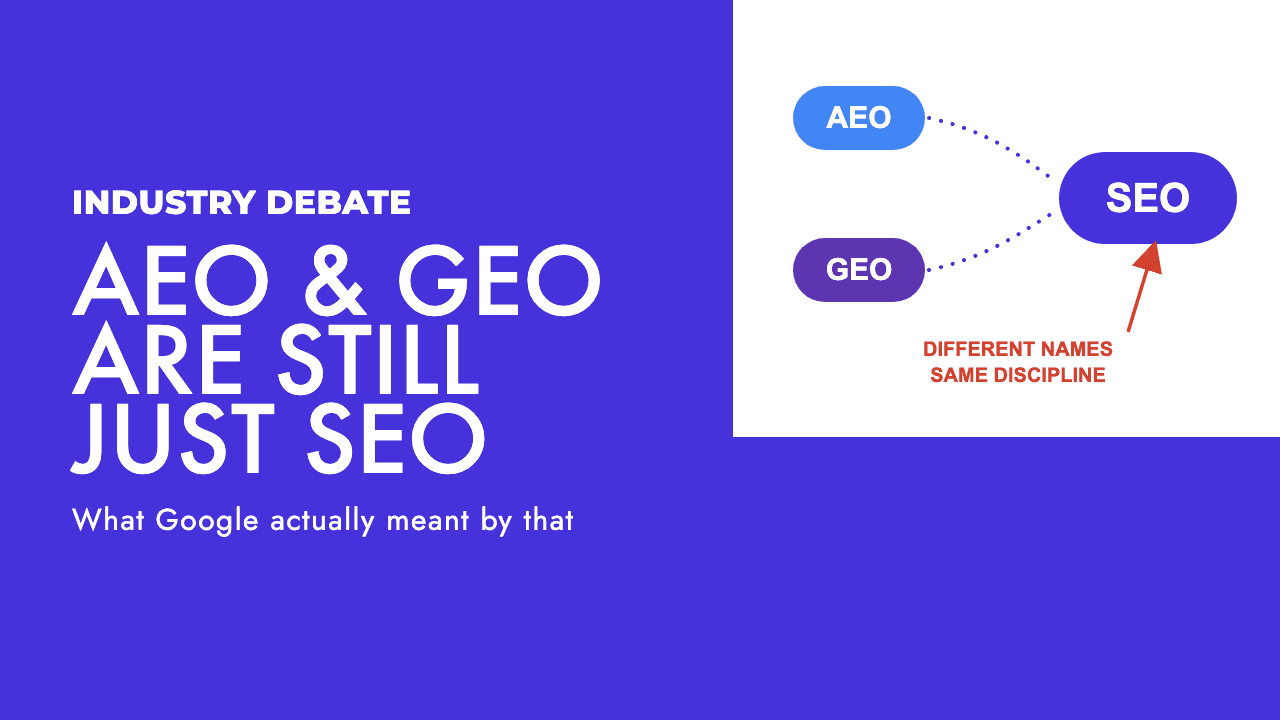
Google has now said the quiet part out loud. In the guidance on optimizing for generative AI features it published on 15 May 2026, Google states plainly that "optimizing for generative AI search is optimizing for the search experience, and thus still SEO." Answer engine optimization, generative engine optimization, whatever acronym you saw on LinkedIn this week: from Google's side of the fence, it is all the same job.
That single line has been read two ways. One camp calls it validation. The other calls it Google protecting its turf. Both are a little right. Here is the practitioner version, minus the ego.
What the guide actually kills
The useful part of Google's guidance is not the "still SEO" headline. It is the list of tactics Google explicitly says you do not need. If you have been paying for any of these as a separate AI service, read this closely.
- llms.txt and AI-specific files. Google says you "don't need to create new machine readable files, AI text files, markup, or Markdown," and that these files will "neither harm nor help." We ran llms.txt across client sites for six months and reached the same conclusion. Our full findings are in our llms.txt verdict. If you want one regardless, our llms.txt generator will build a spec-compliant file for free.
- Special schema for AI. "Structured data isn't required for generative AI search, and there's no special schema.org markup you need to add." Schema still helps you win rich results in classic search. It is not a secret AI ranking lever.
- Content chunking. There is "no requirement to break your content into tiny pieces for AI to better understand it." Google's systems handle multiple topics on one page. Danny Sullivan said much the same on the Search Off the Record podcast in January: "I was talking to some engineers about that. We don't want you to do that" (Search Engine Roundtable). We took the chunking argument apart properly in what Google actually said about content chunking.
- Rewriting everything for robots. "You don't need to write in a specific way just for generative AI search." The systems understand synonyms and meaning without you contorting every sentence.
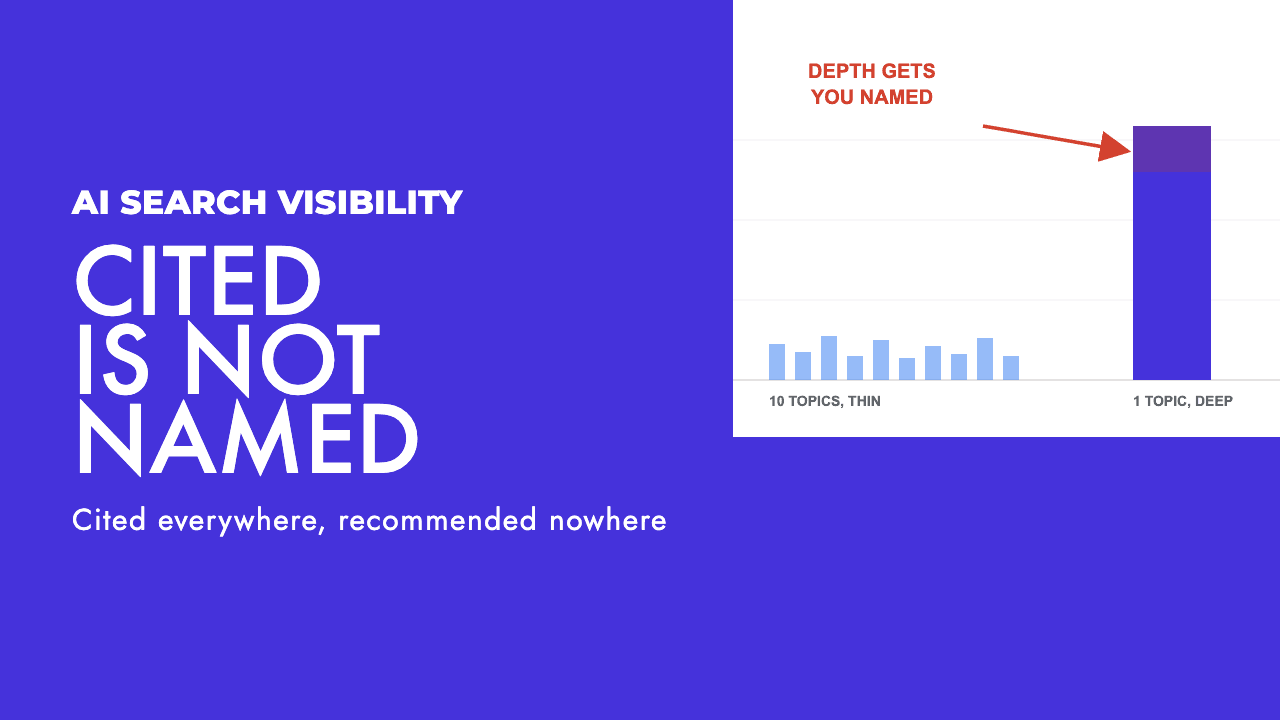
- Buying mentions. Google notes that chasing inauthentic brand references "isn't as helpful as it might seem." We wrote about why paid AI citations are a trap in our piece on buying AI citations.
Roughly half of what the "AEO specialist" crowd has been invoicing for just got waved off by the platform they claim to optimize for. That is not nothing.
What Google says to do instead
Strip the guide back and the positive advice is almost boringly familiar. Publish content with "unique expert or experienced takes that go beyond common knowledge and the ordinary." Make sure Google can crawl and index the page. Use clean semantic HTML. Keep the page experience solid.
In other words, the moat is non-commodity content. Not a file, not a markup trick, not a rewrite. The thing that is hard to fake and hard to copy: a genuine point of view backed by first-hand experience. This is the same reason we keep telling clients that structuring real expertise well beats gaming extraction. We went deep on the mechanics in how to structure content so LLMs cite you.
If your reaction is "that is just good SEO," yes. That is Google's entire point.
The part Google leaves out
Here is where we push back. Google's guide is honest, but it is honest about Google. The document speaks for Google Search, its AI Overviews, and its AI Mode. It does not speak for ChatGPT, Perplexity, or Claude, and those are a fast-growing slice of how people find things now.
That distinction matters because the off-Google engines do not all behave like Google. Some lean heavily on their own model memory rather than a live crawl, so a brand that is well represented across the wider web can get surfaced without the query ever touching a search index. We dug into that behaviour in our piece on ChatGPT answering from brand memory. Optimizing for "the search experience," as Google frames it, is not automatically the same as being the answer an assistant reaches for.
So treat Google's guide as authoritative for Google surfaces and directional for everything else. It closes the debate on gimmicks. It does not close the debate on whether the wider answer-engine field is one job or several. We laid out our own split in GEO vs SEO, the honest version.
Why "still SEO" is also convenient for Google
We can hold two ideas at once. The guidance is broadly correct, and it is also useful to Google that the whole field stays filed under "SEO."
Google's documentation, tools, and its entire ecosystem of practitioners are organized around SEO as the canonical category. A world where GEO and AEO harden into separate disciplines with their own vocabulary is a world where Google is one engine among several rather than the gravitational center. Keeping the label steady keeps the attention pointed at Google. That is not a conspiracy. It is just incentives, and it is worth naming.
None of that makes the tactical advice wrong. It just means you should take the "it is all still SEO" framing as Google's preferred map, not the whole territory.
What a Cyprus or US business should do this quarter
Skip the acronym war. Here is the short list we are actually giving clients right now.
Stop paying for the killed tactics. If a proposal leads with llms.txt, AI schema, or a "chunking" retrofit as its headline deliverable, that is a red flag. Google just told you those do not move its AI features. Redirect the budget.
Fund non-commodity content. One genuinely expert page beats ten thin ones rewritten for robots. That is what a non-commodity content strategy is for. If you serve a specific market, say Cyprus SMEs, write the thing only someone operating there could write. That is the asset both Google and the assistants reward. Our own Cyprus SEO work is built on exactly that reasoning.
Get the boring fundamentals clean. Crawlability, indexation, semantic HTML, fast pages. Google's guide is a reminder that these technical SEO fundamentals still gate everything. Most sites we audit are leaking on the basics before AI ever enters the picture.
Watch the off-Google engines separately. Track how you show up in ChatGPT and Perplexity as their own thing, because Google's guide does not govern them. This is the part that is genuinely new, and it is where our AI search optimization work focuses.
The takeaway is not "AI changed nothing." It is that Google just drew a clean line between the fundamentals that matter and the gimmicks that do not, and a lot of the AI-optimization market was selling on the wrong side of that line. Fundamentals are unglamorous. They also keep working.
Update, September 2026
Google has kept adding to the picture without changing the message. Its documentation changelog shows a 15 June clarification that llms.txt files "aren't needed for Google Search" and neither help nor hurt visibility, and a 20 August addition to the Preferred Sources docs describing a custom button publishers can use to ask readers to star them (Google Search Central updates). Read those together and the direction is clear: no new files for machines, more effort on getting real people to choose you. We covered the second half in Google turning user choice into a ranking signal. The argument over the label carried on regardless, and we added our view to GEO vs SEO.
Want a straight read on where your site actually stands before you spend on any of this? Grab a free SEO review and we will tell you what to fix first.
Sources: Google Search Central, Optimizing your website for generative AI features; Search Engine Journal, Google's New AI Search Guide Calls AEO And GEO 'Still SEO'; Search Engine Roundtable, July 2026 Google Webmaster Report.