

If you went looking for a Perplexity rank tracker in early 2025, you found maybe three options and a lot of hand-waving. Run the same search today and Google returns ten paid landing pages on the first SERP before you scroll, half of them launched in the last six months. That sudden density is the clearest sign yet that AI search visibility has become a budget line, not a side project.
We have been tracking Perplexity rankings for clients across Cyprus and the United States since the citation data became reliable enough to act on. Eighteen months of prompt logging, three full tool migrations, and a lot of arguments about what "rank" even means inside an answer engine. Here is the practitioner take on where the category actually is, written in May 2026 and updated in September. If you just want the tool shortlist, we compare the best Perplexity rank trackers side by side in a separate piece, with every price re-checked on 1 September 2026; this one is about the methodology underneath.
Why search demand for this tool category has exploded
A quick orientation, because this is the part most vendor blogs skip.
You do not need a keyword tool to see the demand. Look at the SERP itself: eighteen tracking tools now claiming Perplexity coverage, where a year ago there were three, and a long tail of phrasings ("perplexity seo checker", "perplexity rank tracking software", "how to rank on perplexity") that each now has its own set of pages competing for it. Nobody builds eighteen landing pages for a query nobody types.
What that supply curve tells you is simple. Marketing teams have decided they need a number to put in a Monday status update for AI visibility, the same way they need a number for Google rankings. The supply side has rushed to meet that demand. Whether the number is meaningful is a different question.
What "ranking" even means in Perplexity
Before any tool comparison, a small but important detour into how Perplexity actually works.
Perplexity is not a ten-blue-links search engine. The user types a question, Perplexity runs it through a retrieval pipeline that pulls candidate sources from the open web, an LLM synthesises an answer, and the cited sources appear as footnotes underneath. Position in the answer text matters less than whether you are cited at all. There is no rank one. There is "cited" or "not cited".
That means a Perplexity rank tracker is really doing one or both of two things.
Citation tracking. For a given prompt, does Perplexity cite your domain in its answer? If yes, in which position among the citations? How does that change over time and across geographies?
Mention tracking. Even if not cited as a source, is your brand or product named inside the answer text? This is closer to share-of-voice than to a ranking number, but it is often what executives actually want to know. The reverse case matters too: Perplexity links a page without naming the brand more than any other engine, which we covered in ghost citations.
Some tools track only one. Some track both. Almost all of them re-prompt the actual Perplexity API or web interface on a schedule and parse the result. There is no Search Console for Perplexity. Everyone is scraping the same surface, which is a useful thing to keep in mind when a vendor claims proprietary access.
A useful piece of background reading here is Search Engine Land's writeup of Metehan Yesilyurt's Perplexity ranking research, which broke down the system into a retrieval stage, an entity-aware reranker, and a set of manually boosted authoritative domains. The ranker discards entire result sets when too few candidates clear a quality threshold, which is partly why brand mentions on third-party authority sites move the needle so much. If you only read one external source on Perplexity ranking signals this quarter, read that one.
The tools we have actually run for clients
We have rotated through a working set of about a dozen tools over the last eighteen months. Here is the honest breakdown.
Brand and citation trackers
These are the tools built specifically for AI search visibility. They prompt Perplexity, ChatGPT, Google AI Mode, and Claude on a schedule, then store citations and mentions. SE Ranking, Rankability, AthenaHQ, Otterly.ai, Peec AI, Scrunch, Profound, and Brandlight all live in this category. When we re-read every vendor's pricing page on 1 September 2026, published entry prices ran from about $19 a month for small-business tools to $399 and up for plans with real prompt volume, and several enterprise platforms publish no price at all. The catch that costs people most is which plan includes Perplexity: Profound puts it on Growth rather than Starter, Rankability on Core, and Peec makes it one of three model slots you choose. Read the plan comparison table, not the logo strip.
What they get right is the basics. You give them a list of prompts, they run them daily or weekly, and you get a chart of citation share over time, plus a competitor comparison. The dashboards are mostly fine.
What they get wrong is methodology disclosure. We have asked five different vendors how their "ranking" number is calculated and received five different answers, three of which were not really answers. One vendor counted any citation as a tied first place. Another weighted by citation position but did not disclose the weighting. A third aggregated across prompts in a way that buried any single-prompt regression. If you are spending more than $200 a month on one of these, ask for the formula. If they cannot tell you in one paragraph, that is your answer.
Classic SEO tools that bolted on AI tracking
Advanced Web Ranking, SE Ranking, and Keyword.com have all added Perplexity tracking on top of their existing platforms in the last twelve months. The advantage here is that you already have the keyword list and the comparison logic from your traditional rank tracking, and now you get an AI visibility column next to it.
Our take is that this works well for established SEO teams that already pay for the underlying platform. The data quality is comparable to the dedicated tools for citation tracking. The dashboards are not as polished for AI-specific metrics, but the integration with normal keyword data is genuinely useful when you are trying to attribute traffic shifts to a specific cause.
Free and freemium options
There are now several free Perplexity rank checkers, geoptie.com being the most polished we have seen. Useful for a quick check on three or four keywords. Not built for the kind of monitoring you would do across a 200-prompt portfolio.
For one-off audits, the free tools are fine. For ongoing tracking, you will outgrow them inside a month.
DIY prompting
The thing nobody selling a tool will tell you is that the data is not actually hard to collect. Perplexity's Search API is priced at $5 per 1,000 requests, and its Sonar endpoints, the ones most DIY collectors were written against, are being replaced by the Agent API, with Sonar supported until 27 September 2026 (Perplexity). A monitoring set of 100 prompts run daily is a few tens of dollars a month in API spend, plus a few hours of script-writing.
We run our own collector for the clients where the budget makes the off-the-shelf tools awkward. It is a small Python script that posts to the Perplexity API, parses the citations field out of the JSON response, and writes to a SQLite database. We added a thin dashboard layer on top with a few lines of HTMX. The whole thing took an afternoon. If you built something similar against Sonar, put the migration on the calendar before 27 September and re-test whatever parses the citations field.
The point is not that everyone should build their own. The point is that you should know that what you are paying for in a tool is the dashboard and the prompt design help, not access to magic data.
What we have learned from the tracking data
A few things have surfaced from running this monitoring across client portfolios that we think are worth knowing.
Geography matters more than people expect
Perplexity does take location into account, lightly, when retrieving sources. The same prompt run from a US IP and a Cyprus IP returns overlapping but distinct citation sets, particularly on commercial queries where local intent is plausible. If you are tracking Perplexity citations for a Cyprus client and your tool is only sampling from US data centres, you are reading a slightly different reality than your customers see.
Most of the dedicated trackers now let you set a location for each prompt set. Most of the classic SEO tools that bolted on AI tracking still do not, or do not let you choose more than two or three locations. This is the single biggest hidden methodology issue we have seen in the category.
Citation share is volatile day to day
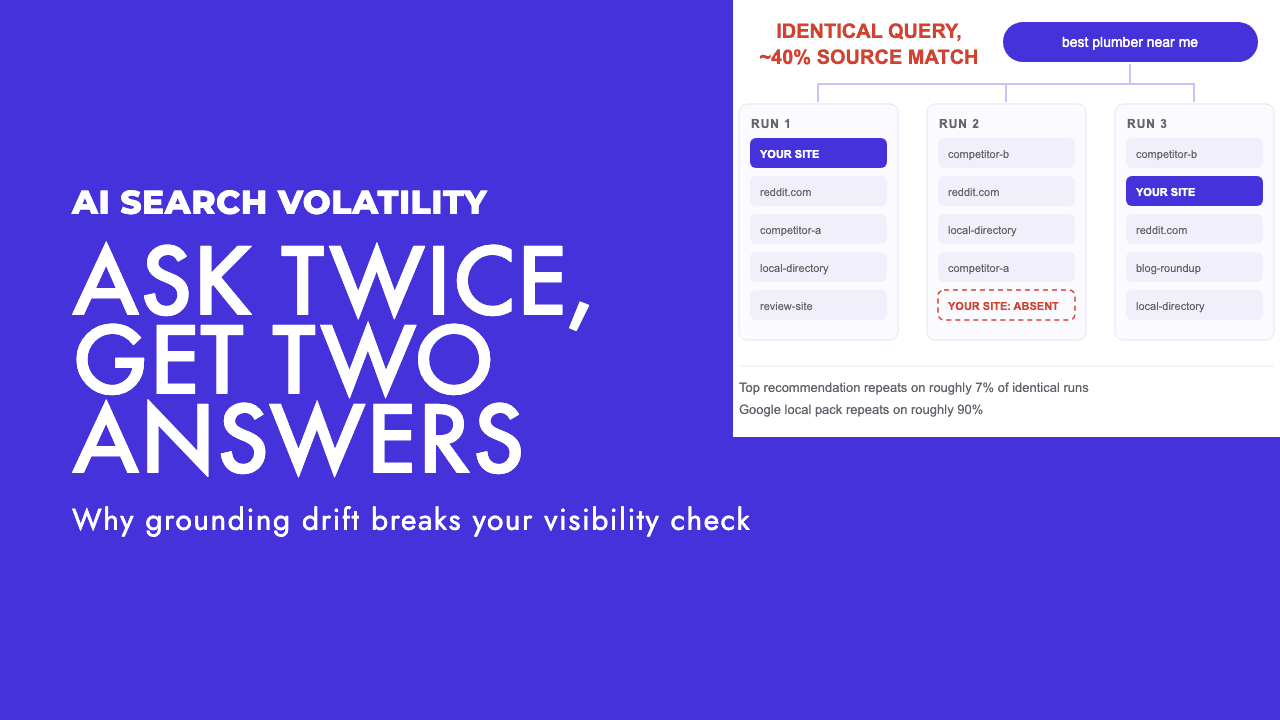
If you check citation share daily, you will see double-digit swings that resolve themselves within a week. Perplexity's retrieval set is not deterministic, and the reranker has enough randomness in it that two near-identical prompts an hour apart can return different source sets. We wrote up the general version of this problem in grounding drift. We learned to look at seven-day or fourteen-day rolling averages, not single-day snapshots, before drawing any conclusion. Treat any tool that pings clients about a 12 percent single-day drop with caution.
Authority sites dominate the citation pool, but not totally
Across the prompts we monitor, the top three cited domains for any given topic almost always include at least one Wikipedia page, one large news outlet, and one industry-specific authority site. That tracks with the manual domain boosts described in the Search Engine Land research. What is more interesting is the long tail. The fourth and fifth citation slots are where smaller, more specialised sites consistently appear, including a meaningful number of our clients' product and resource pages. The opportunity is not displacing Wikipedia from slot one. It is being one of the niche sources that shows up in slots three through six.
Newly published content gets cited surprisingly fast
For evergreen topics, Perplexity tends to lean on older authority. For topics with any recency, the bar to entry is much lower. We published our Google AI Mode GEO playbook on May 26 and started seeing it cited in Perplexity answers to GEO-related queries within 48 hours. Same pattern with our llms.txt analysis piece earlier this week. If you are publishing original takes on emerging topics, you are competing with a much shallower pool of candidate sources than you are on legacy SEO topics.
Ranking factors are not what some vendors are selling
If you read enough Perplexity tracking blogs, you will eventually be told that you need to optimise for some specific "Perplexity ranking factor" that the vendor has identified, often one that requires their tool. We have not seen the data hold up. The factors that move citation share, in our testing, are mostly the same ones that have always moved organic SEO: entity clarity, original information, strong internal linking, brand presence on third-party sites, and crawl access for the AI bots that actually fetch your pages. We covered the practical version of this in our AI crawlers and robots.txt guide. The Perplexity-specific work, in practice, is mostly about whether ClaudeBot, PerplexityBot, and OAI-SearchBot can actually reach your content. You can test ClaudeBot and PerplexityBot against your robots.txt in under a minute.
For a deeper look at how the bots work, Google's Search Central documentation on Googlebot and other crawlers is still the cleanest reference for crawler behaviour generally, even if it does not cover the AI-specific user agents.
Our methodology for client tracking
For anyone who wants the short version of how we structure this work in practice.
Prompts, not keywords. We brief clients to write 30 to 100 prompts that real users would type into Perplexity to find a solution like theirs. Not keywords. Full questions, in natural language, with as much specificity as a real user would include. "Best igaming SEO agency for Cyprus operators" beats "igaming seo cyprus" by a wide margin as a tracking input. The same holds in regulated niches such as igaming SEO, where the useful prompt names the market as well as the service.
Two locations minimum. For most of our clients we track at minimum a US sample and either a Cyprus or UK sample. The geographic split surfaces issues that an aggregate global number hides.
Weekly cadence, not daily. We pull weekly averages and report on a 28-day rolling basis. Daily charts look impressive in dashboards and tell you almost nothing because the noise floor is too high.
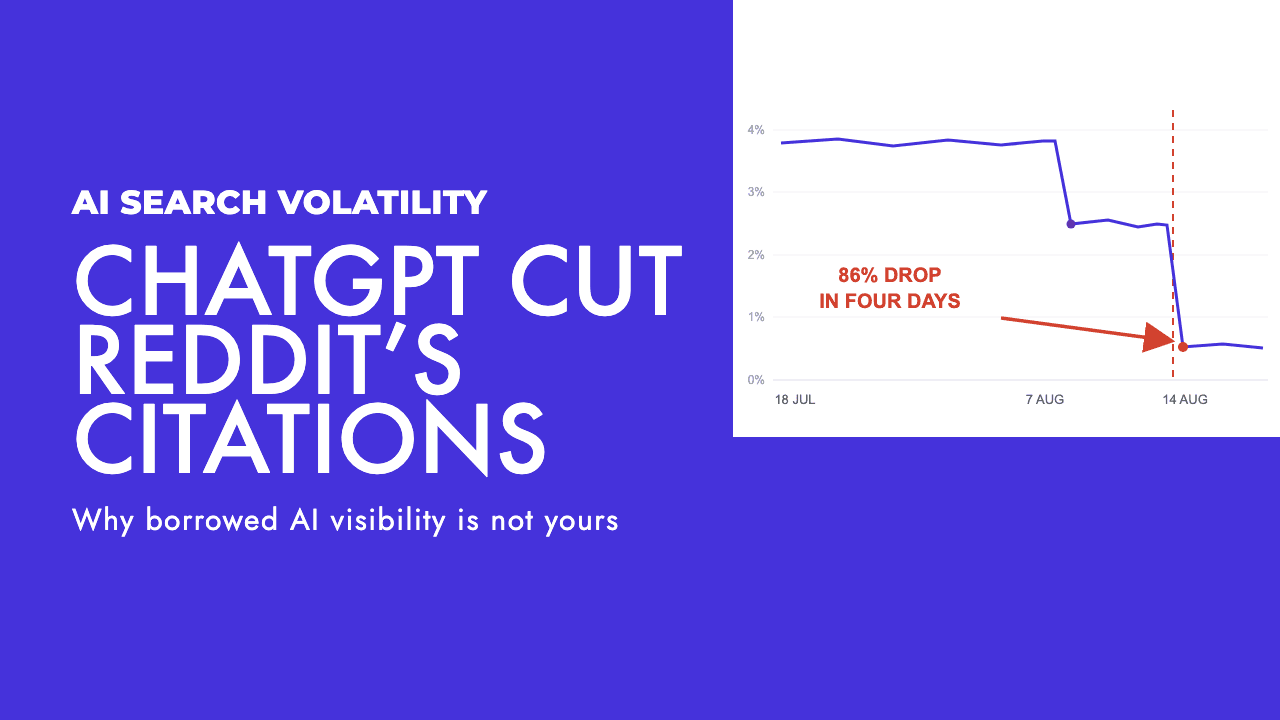
Cross-engine, not Perplexity alone. Perplexity is one of four engines we monitor for any client serious about AI visibility, alongside ChatGPT search, Google AI Mode, and Claude. The relative share between them shifts often, and one engine can change its mind about a whole domain overnight, as Reddit's ChatGPT citation collapse showed in August. Track each engine as its own line. We covered the broader picture in our AI search engine market share analysis.
Attribution back to content. When citation share moves up or down for a given prompt, we trace which of our content changes or third-party mentions plausibly drove it. More often than not we can attribute the move to a specific cause. The rest stays in the "noise or unknown" bucket. We resist the temptation to invent a story for the unknowns.
Our opinion on where the category is heading
Three predictions, with the usual caveat that nobody who tells you they know exactly what AI search will look like in twelve months is being honest.
The tool category is going to consolidate hard in the next twelve months. There are too many vendors, the underlying data source is the same scraped surface, and the dashboards are converging. We expect three or four winners by mid-2027, with the rest acquired or quietly shut down.
Tracking will move from "are we cited" to "what is said about us". Citation tracking is the obvious first step because it is the easiest to measure. The harder, more valuable layer is sentiment and framing inside the answer text itself. The tools that get good at parsing the natural-language description of your brand, not just the footnote, will be the ones that survive.
Methodology disclosure is going to become a buying criterion. It is not one today. Most procurement teams buy on price and dashboard polish. We expect that to shift as the discipline matures and a few high-profile cases of misleading metrics get aired publicly. Vendors that publish their methodology in plain English will end up with a structural advantage.
Update, September 2026
Two things moved between May and September. The tool market repriced: when we re-checked all 18 vendors for the companion comparison, entry prices had moved in both directions, two vendors had stopped publishing prices at all, and three of the most shortlisted tools turned out to gate Perplexity behind a higher plan. And Perplexity's own API changed underneath the DIY route: Sonar is being replaced by the Agent API and is supported until 27 September 2026 (Perplexity). Neither changes the methodology above. Both change what you should check before you pay for, or build, anything.
The bottom line
Perplexity rank tracking is real, it matters, and you should be doing it if AI search is anywhere in your channel mix. The tools are mostly fine for the basics. The category is also full of marketing language designed to make the data sound more proprietary than it is, and you should ask hard methodology questions before you sign a longer contract.
The metrics that actually move are entity clarity, original information, third-party brand presence, and crawl access. Our guide to ranking in Perplexity walks through how to improve each of those. The dashboard is downstream of those. If you spend twenty hours a month tuning your tracker setup and zero hours improving the content the tracker is measuring, you have the priorities reversed.
If you want a second pair of eyes on your AI search tracking, including whether the tool you currently pay for is giving you defensible numbers, our AI search optimisation team does this work for clients across Cyprus and the United States, and through our UK SEO team for brands in the United Kingdom. We will tell you straight whether the dashboard you are looking at matches the reality your customers are seeing in Perplexity.