
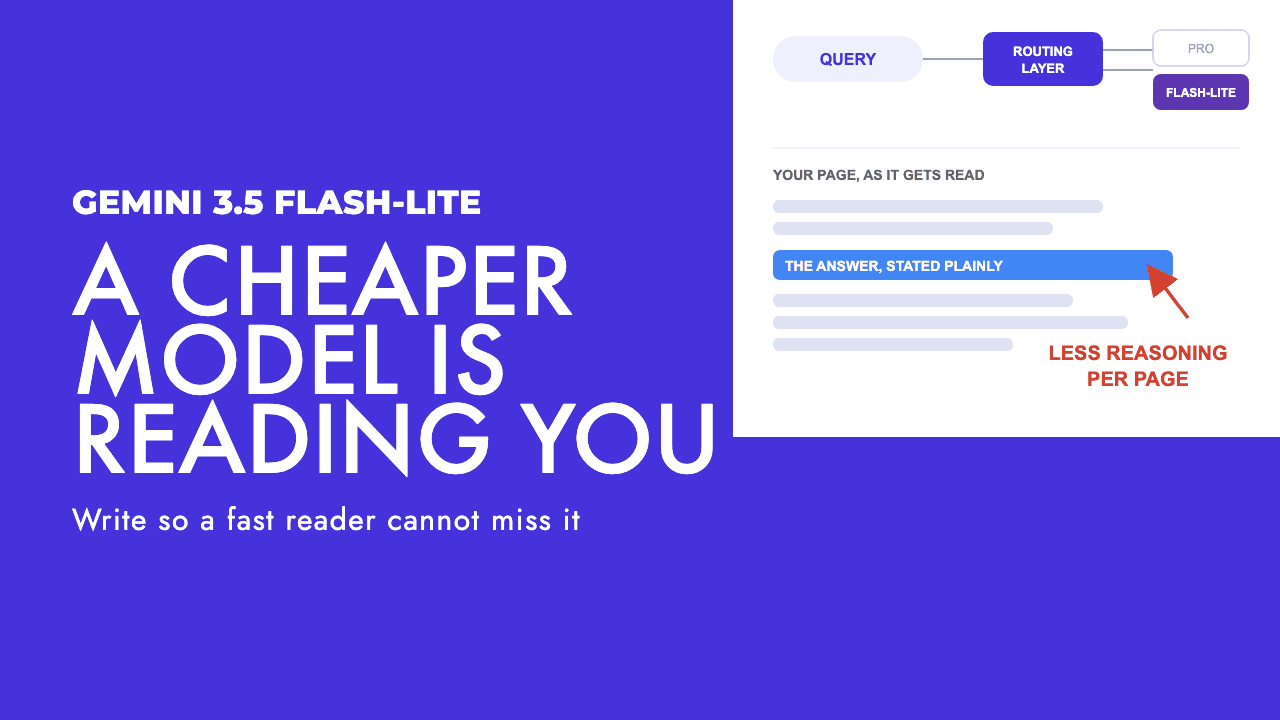
Most of the GEO advice written in the last year rests on a quiet assumption: that the AI reading your pages keeps getting smarter. Write with nuance, the thinking goes, and a more capable model will eventually reward you for it.
The models Google is actually putting in front of your content are going the other way.
What Google actually shipped
Two moves, three months apart, tell the story.
In May, Google made Gemini 3.5 Flash the default model behind AI Mode globally, announced at I/O (Search Engine Land). Flash, not Pro. The fast tier, not the frontier tier.
Then on 21 July, Google confirmed Gemini 3.5 Flash-Lite is rolling out in Google Search, describing it as its fastest and most cost-effective 3.5-class model, pushing 350 output tokens a second and aimed at agentic workflows.
Read Google's own developer documentation on where the Flash-Lite tier belongs and the picture sharpens. For the 3.5 family, Google recommends Flash-Lite (the API docs still name 3.1 Flash-Lite in that line) for low cost, high-volume tasks that, in its words, do not require the advanced reasoning depth of 3.5 Flash (Gemini API docs).
That is Google describing the model it is putting into Search.
This is economics, not a temporary compromise
Google is not going to reverse this. The direction is baked into the unit economics.
A traditional blue-link result costs Google almost nothing to serve. An AI answer costs real money every single time, because a model has to read retrieved documents and generate text. Multiply that by Google's query volume and the cost per query becomes the constraint that shapes everything else.
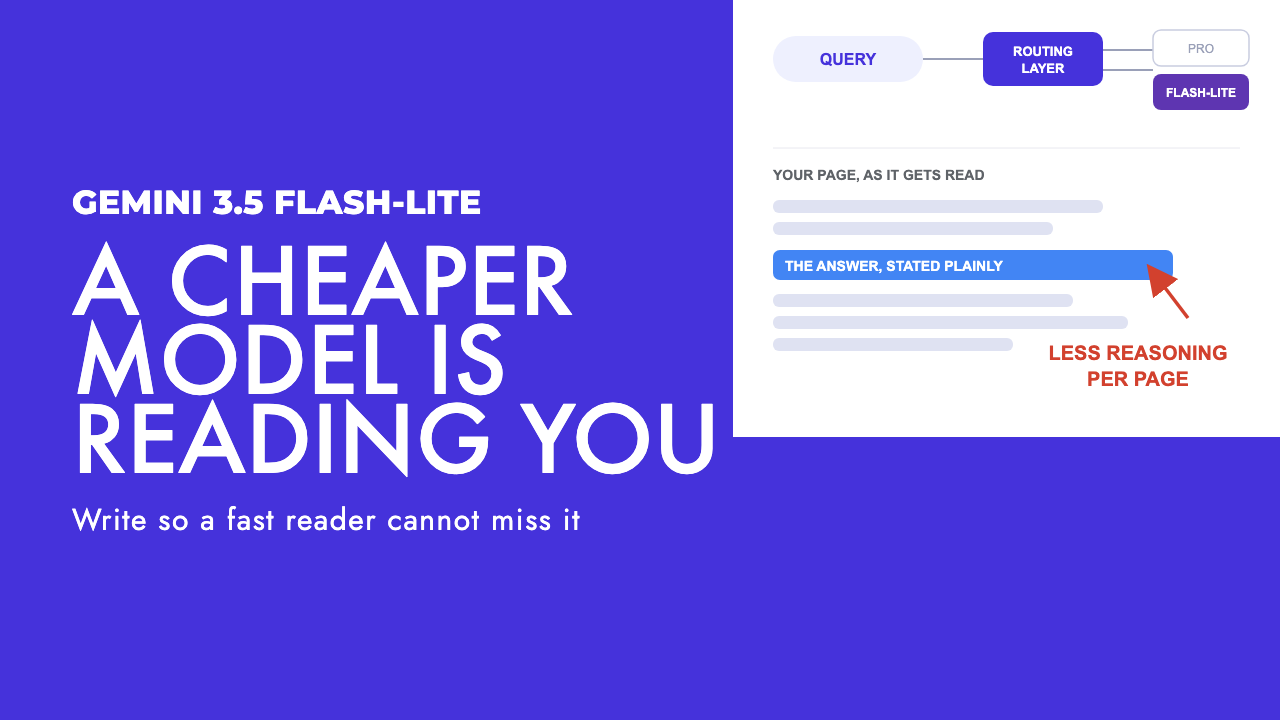
So Search runs a routing layer. Queries get classified, and most of them go to the cheapest model that can handle them. The expensive models are held back for the queries that genuinely need them.
The rational thing for Google to do is push the cheap tier's share up over time, not down. Every efficiency gain gets spent on serving more AI answers rather than on reading your page more carefully.
Our take: the inference ceiling is the real story
Here is where we will plant a flag, clearly framed as opinion.
The interesting variable in AI search is not whether the model can reason. It is how much reasoning budget the model gets to spend on your specific page, in the moment it decides whether to use you.
That budget is small and shrinking. And it is spent on a page that arrived alongside a dozen others, in a pipeline where one user question has already fanned out into many sub-queries.
A lighter model under time pressure does not read your page the way an editor does. It extracts. It does not hold your argument in mind across eight paragraphs and synthesise the conclusion you were building toward. If the answer is not sitting somewhere it can be lifted, you do not get used.
This is why we keep telling clients that the fashionable advice to "write with depth and let the AI figure it out" is backwards for the surfaces that matter right now. Depth is good for humans and good for the trust signals that get you into the candidate set at all. It is not what gets you into the answer.
The four ways content loses to a lighter reader
We see the same failure modes constantly on client sites, and they have nothing to do with content quality in the human sense.
The answer is implied, not stated. The page walks through why something works, and the actual claim only exists in the reader's head at the end. A human gets it. An extraction pass finds nothing to extract.
The qualifiers are orphaned. The price is in paragraph two, who it applies to is in paragraph nine, and the geographic limit is in the footer. A model with reasoning budget stitches those together. A model without it either takes the price out of context or drops you for being ambiguous.
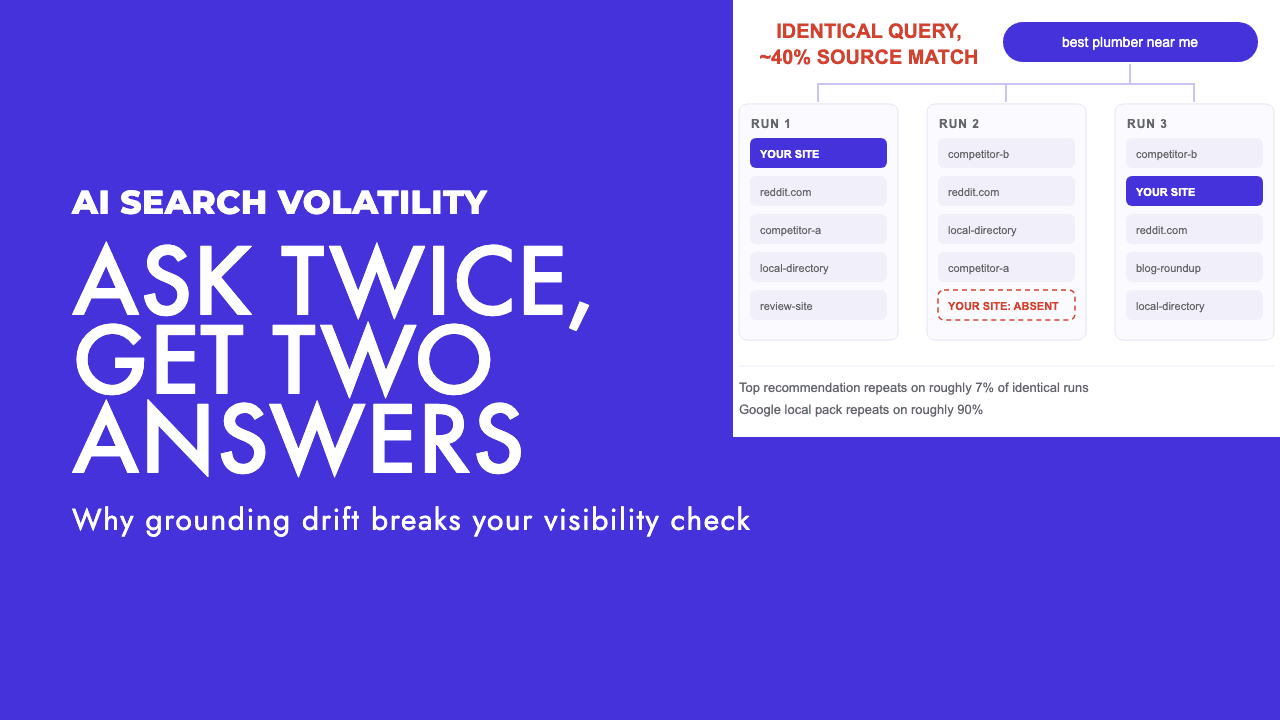
The page contradicts your other pages. Your service page says one thing, your FAQ says something slightly different, an old post says a third thing. A capable model reasons about which is current. A cheap one picks one, effectively at random, or treats the site as unreliable and moves on. That randomness is part of why the same question gives a different answer every time.
The specifics live in an image or a table graphic. Anything the text layer does not say plainly is, for practical purposes, not on your page.
None of these are new problems. What changed is the penalty. These used to cost you a bit of precision. Now they cost you the citation outright.
What to change
The fix is making the content you already have survive a shallow read, rather than adding more of it.
State the answer in the first two sentences under every heading. Not a preamble about why the question matters. The answer, then the reasoning. We have written the longer version of this structural argument separately and it holds up better than ever.
Keep each claim and its qualifiers in the same place. If a price depends on location, business size, or timeframe, those conditions belong in the same sentence or the one immediately after. Do not make anything walk across the page to find its own context.
Audit your site for self-contradiction. Pick your ten most important facts, the things a customer actually needs (what you do, where you do it, what it costs, how fast, who for) and check that every page saying them says them identically. This is boring work and it is currently one of the best returns on an afternoon you will find. It is also one of the first things we check in a website audit.
Put every number, name and condition in the visible text. Charts and images are fine as reinforcement. They cannot be the only place a fact exists.
Write headings as the question, not the topic. "How much does an SEO audit cost in Cyprus" beats "Pricing". The routing layer is matching sub-queries, and a heading phrased as a question is a much cleaner match target.
What we are explicitly not telling you to do is mechanically chop your content into bite-sized chunks. Google has already said that on the record, and we agree with them. Explicitness is not the same thing as fragmentation.
What this means in Cyprus and the US
For Cyprus businesses, the entity facts are where this bites. Service area, languages spoken, whether you cover Limassol as well as Nicosia, whether prices include VAT. Those are local SEO fundamentals, and a shallow reader will not infer any of them. These are exactly the details that tend to be implied by context on a local site, because every local customer already knows them. A model working at speed does not.
For US businesses, the pressure point is usually multi-location and multi-service consistency. The more pages you have, the more chances your own site has to disagree with itself, and the more a shallow reader has to guess.
In both markets the same thing is true: the businesses winning citations right now are frequently not the ones with the best content. They are the ones whose content is hardest to misread. That gap is why pages outside the top ten keep showing up in AI answers.
Where we could be wrong
Two honest caveats.
Google has not confirmed exactly which surfaces Flash-Lite serves. The rollout was announced for Search and framed around agentic experiences. Whether it is handling a given AI Overview on a given day is something we are inferring, not something Google has stated.
And the cheap tier will keep improving. A Flash-Lite model in two years will read a page better than a flagship model did in 2024. We are not arguing that AI search stays dumb. We are arguing that the gap between the best available model and the one that actually reads your page will persist, because that gap is where Google's margin lives.
If we are wrong about that, the advice here still costs you nothing. Clear, explicit, internally consistent pages have never been a bad bet.
One dated note, September 2026: the gap has not closed. Google's Gemini API changelog for 1 September lists 3.7 Flash and 3.6 Flash alongside 3.5 Flash-Lite (Gemini API changelog), and 3.5 Flash-Lite remains the most recent model Google has publicly tied to a Search rollout that we can find. The frontier moved two versions. The reader of your page did not.
The bottom line
Google is optimising Search for cost per query, and that means lighter models doing the reading. Write for a reader that will not connect dots you left unconnected. Say the thing, keep its conditions next to it, and make sure your site never contradicts itself.
If you want a second pair of eyes on how your pages read to a machine in a hurry, that is what our AI search optimisation work is for, and a free SEO review is a reasonable place to start.