
In May, Google published its own numbers on how people use AI Mode. Most of the coverage picked up the headline figure, a billion monthly users. The more useful line sat further down: planning queries grew roughly 80 percent faster than AI Mode queries overall in six months, and brainstorming queries grew about 30 percent faster since launch.
That is Google telling you which way search behaviour is moving, in its own words, using its own data. And the query type it is pointing at is the one almost no business has a page for.
What Google actually said
The AI Mode insights post (19 May 2026) reports three things worth holding on to.
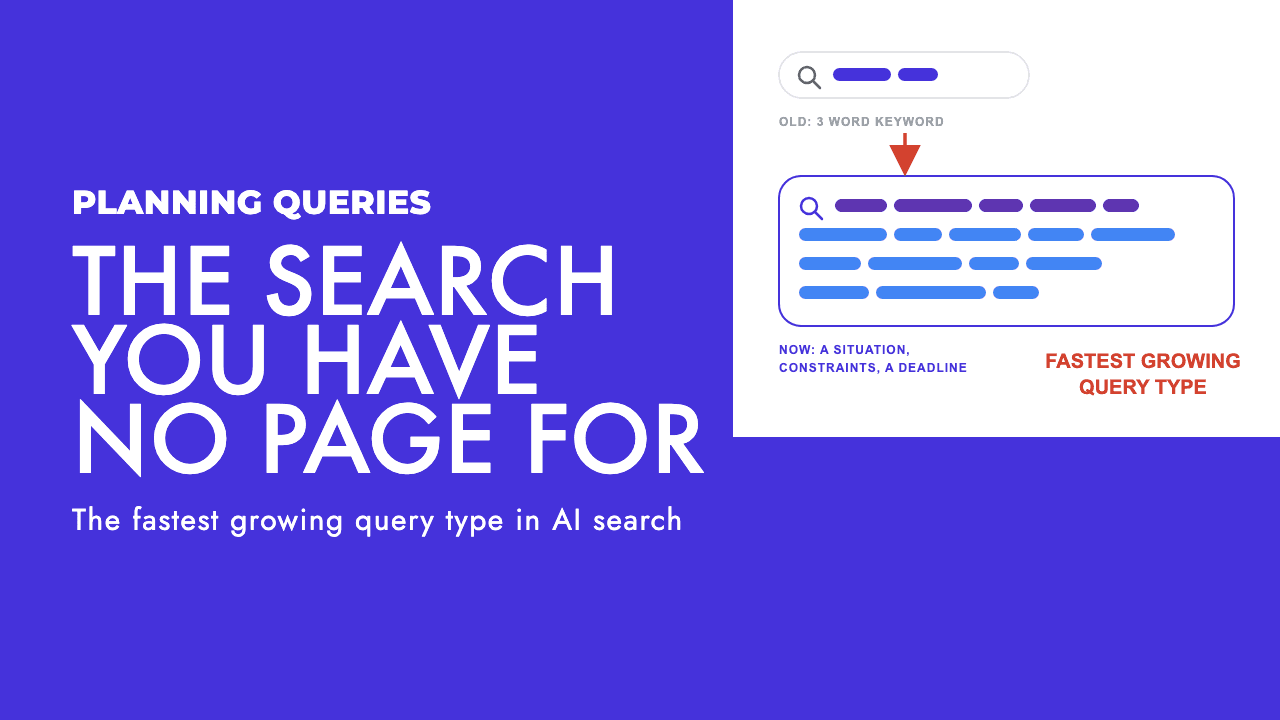
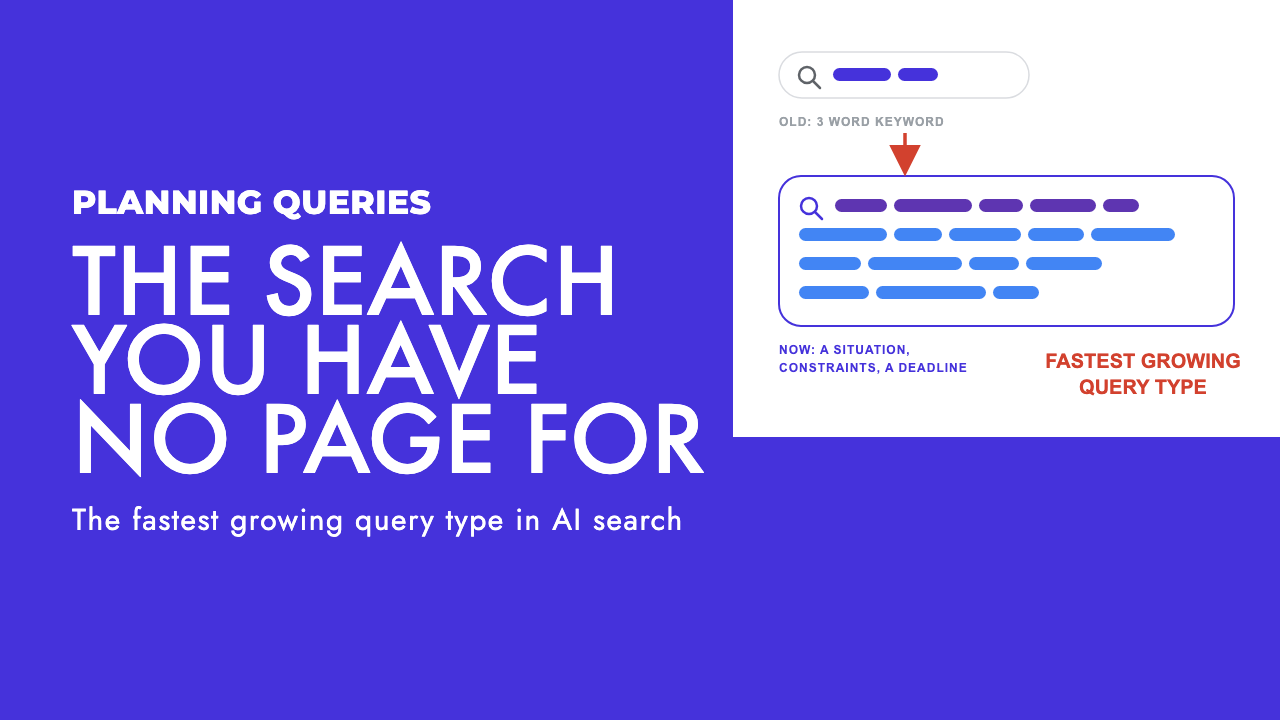
The average AI Mode search is about three times the length of a traditional query. Searches opening with "where to", "where should I" and "ideas for" are expanding. And more than one in six US searches now uses voice or an image rather than typed text.
Similarweb's July analysis, covered by TechCrunch on 27 July 2026, backs the direction of travel. AI Overviews went from appearing on 15% of searches to 43% in a year, AI Mode visits more than doubled between June 2025 and May 2026, and the firm describes users as replacing short keyword-based queries with longer conversational ones written for an AI.
None of this is surprising if you have used AI Mode for ten minutes. What is surprising is how little content strategy has actually changed in response.
The gap: we optimised for the last click, not the first thought
Twenty years of SEO trained everyone to build pages for the moment someone already knows what they want. "Best CRM for small business." "Dentist Limassol." "SEO agency pricing." Those are decision queries. They sit near the bottom of the journey, and they are where the commercial keyword lists point.
Planning queries sit upstream of all of that. They are the searches people used to not bother typing into Google, because Google was bad at them.
Here is the shape of the difference. A decision query is "accounting software Cyprus". A planning query is "I run a five-person design studio in Nicosia, we invoice in euros and dollars, and I need to move off spreadsheets before the next VAT quarter. What should I actually be looking at and in what order?"
Same buyer. Same money. Completely different content requirement.
The second one has constraints, a deadline, a team size and a currency problem baked in. It cannot be answered by a product page or a listicle. It gets answered by content that reasons about trade-offs, and if you have none of that, the AI will assemble its answer from whoever does.
Why your keyword research never shows you these
Keyword research tools, ours included, are built on aggregated volume for repeated strings. A planning query is close to unique. Nobody else types your exact sentence, so it never appears in a tool with a number next to it, so it never makes it onto the content calendar.
There is a second layer. Google does not run that long question as one search. It decomposes it into sub-searches and pulls a passage for each, which is the mechanic we covered in our piece on query fan-out. The sub-searches are the things being matched against your content, and you never see them either.
So the demand is real, it is growing faster than anything else in the mix, and it is structurally invisible to the tooling most teams plan with. That is a good definition of an opportunity.
Our take: this is a format problem, not a keyword problem
Here is where we part company with a lot of the current advice.
The common suggestion is to go and target long conversational phrases. Build pages for "what should I look for when choosing X". That is just keyword targeting with more words, and it fails for the same reason: you are still guessing at strings.
Our read, from the work we do on client sites, is that planning queries are won by publishing the reasoning, not the phrase. If a page states the criteria that matter, names the situations where each option wins or loses, and is honest about who should not buy, it becomes usable raw material for a planning answer. It gets pulled into hundreds of different long questions you never anticipated, because the model is matching on substance rather than on a phrase you guessed.
That is a different writing brief than most SEO content gets. Fewer pages, more thinking per page. It also happens to be what the passage-level extraction research points at, which is reassuring, because two lines of evidence agreeing is better than one.
What to actually build
Four content types earn their place here. All four are things a good salesperson already says out loud on calls.
Decision criteria pages. Not "top 10 tools". The three or four factors that genuinely change the answer, with the conditions under which each one dominates. If team size flips the recommendation, say so and say at what number.
Sequencing content. Planning queries almost always contain an implicit "in what order". Publish the order. First this, then this, and here is why doing it the other way round wastes money.
Constraint-shaped guidance. Budget floors, timelines, regulatory dates, staffing minimums. If a client in Cyprus needs to think about VAT quarters or a US client needs to think about state-level filing, that constraint is the thing the planning query is actually built around. Property completion dates and recruitment cycles work the same way: the calendar shapes the question.
Honest disqualification. State plainly who this is not for. It is the single most extractable thing you can write, and it is the sentence almost no marketing page contains.
For local businesses this maps onto the same principle we cover in our Cyprus SEO work: specificity beats coverage. One page that genuinely reasons about a real decision does more than twenty pages that describe a service.
The trap to avoid
The obvious wrong move is to read this and spin up two hundred pages beginning "ideas for". Do not.
Google's June 2026 spam update on scaled content abuse exists precisely for that pattern, and mass-producing conversational-sounding pages with no actual reasoning in them is the cleanest way to get caught by it. If you are commissioning at volume, run a sample through an AI content checker before it goes live. The whole point of planning content is that it contains judgement. Judgement is the part that does not scale.
The second trap is thinking there is a schema fix. There is not. Google has been consistent that no special markup exists for AI Overviews or AI Mode, and its guide to optimising for generative AI features says the same about AI text files and Markdown, while its structured data rules say markup should match visible page content. Write the reasoning into the visible page.
How you will know it is working
Do not expect this to show up as a clean ranking win. Planning content tends to move impressions and assisted conversions before it moves anything you can point at in a rank tracker, and a lot of the value lands as a citation inside an answer nobody clicks.
The practical signals we watch: whether the site starts getting surfaced for questions the team never wrote a page for, whether sales calls start opening with "your article said X, so I already know Y", and whether the brand appears in answers when you test the actual long questions your buyers ask. Test them by hand. Type the real sentence a real customer would type, in AI Mode and in ChatGPT, and see who gets quoted.
If it is not you, the gap is usually not authority. It is that nobody on your site has written down how the decision is actually made.
The bottom line
The fastest-growing search behaviour is people describing a situation and asking for a plan. Most sites answer a different question: what a product is, and what it costs.
Closing that gap does not need new tooling or a GEO retainer. It needs someone in your business to write down the reasoning they already apply every week, in a form a machine can lift a paragraph from. That is unglamorous, it is slow, and as far as we can tell it is the thing that works.
If you want a read on where those gaps sit on your site, our AI search optimisation and content strategy work starts there, or you can grab a free SEO review and we will point at the biggest ones.
Update, September 2026
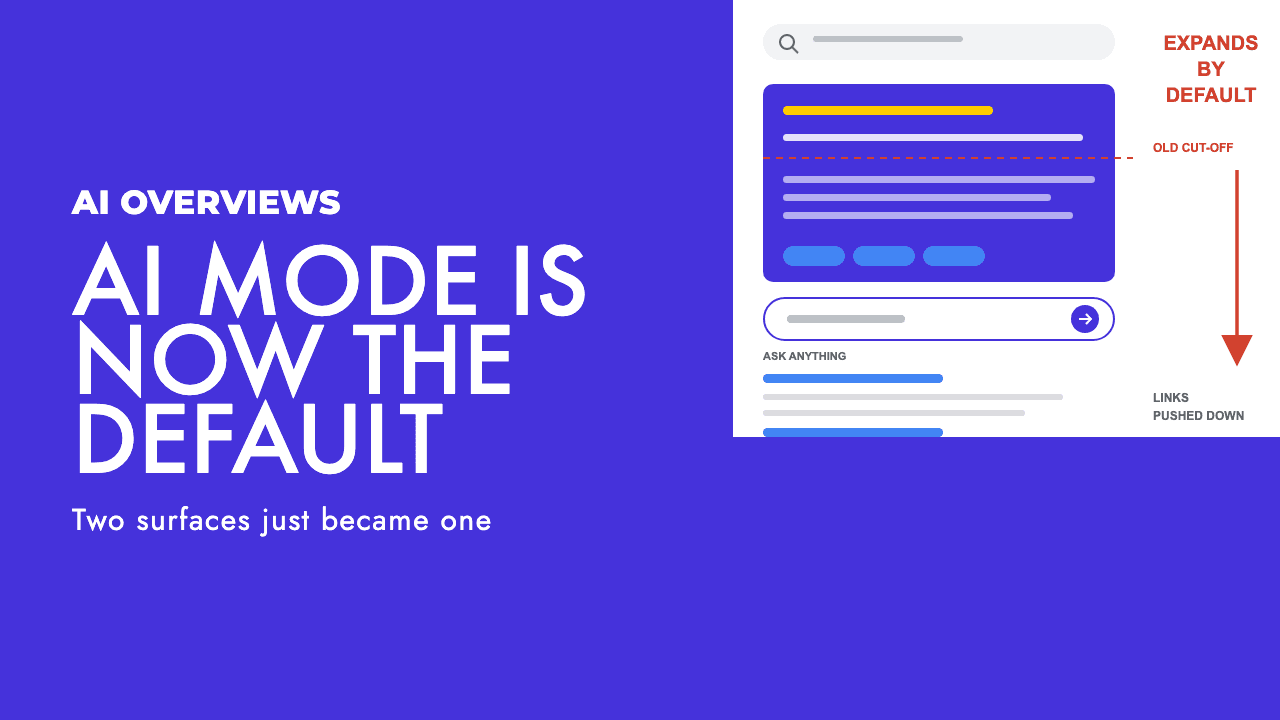
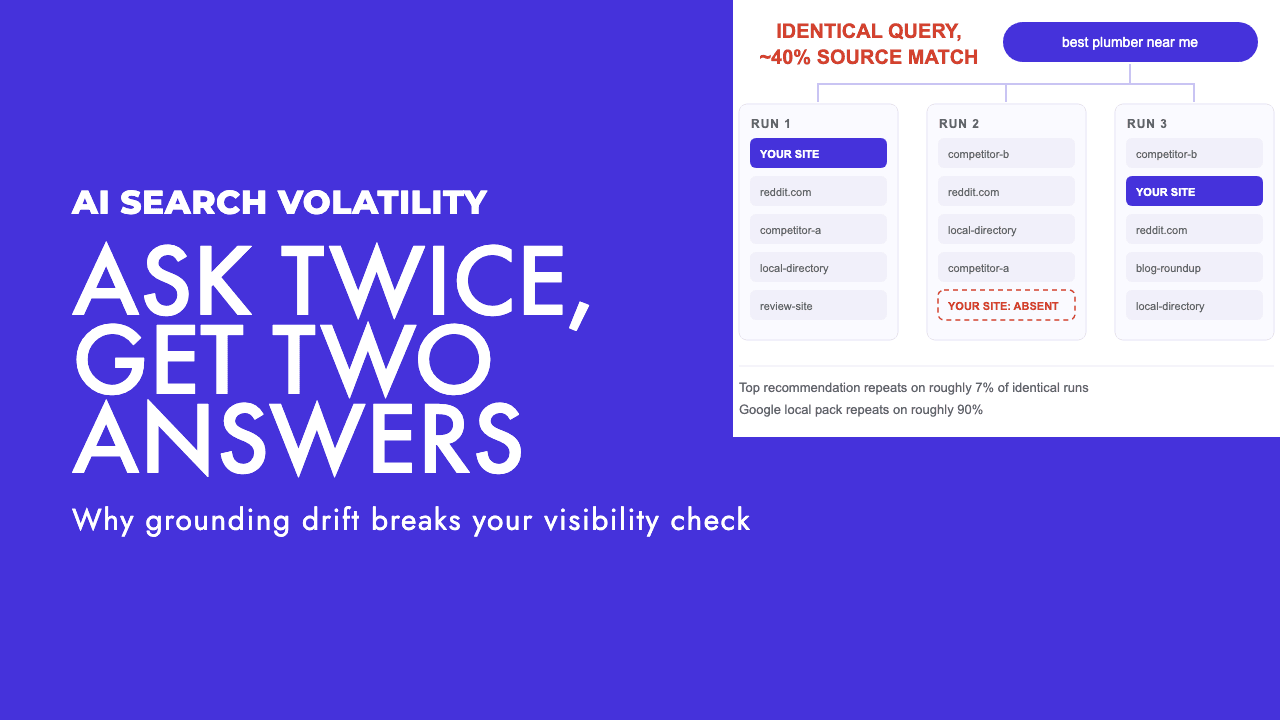
On 28 August Google confirmed that for some queries an AI Overview now expands automatically into a full AI Mode response, without the user clicking "show more", where its systems decide that is most useful (Search Engine Roundtable). Planning questions are the obvious candidates for that treatment, so the reasoning-shaped content described above is now being pulled into the default results page, not just into a separate mode. We wrote up the wider change in AI Overviews expanding into AI Mode. If you want to check whether you are being cited for these questions, run each prompt several times, because the sources change between runs.
Sources: Google, How AI Mode is changing and expanding the way people search (19 May 2026); TechCrunch on Similarweb's AI search data (27 July 2026); Google Search Central, General Structured Data Guidelines.