
Most SME owners asking whether SEO is worth it have already been quoted something. Usually a retainer, usually with a six-month wait attached, usually by someone who benefits if the answer is yes.
We sell SEO, so read this with that in mind. Our honest position is that SEO pays for roughly half the small businesses who ask us, and we tell the other half to put the money into ads, referrals or a better website first.
The short answer
SEO is worth it for a small business when three things are true at once. People search for what you sell. Those searches happen on a surface where a small site can realistically show up. And you can afford to wait for the result.
Fail any one of those and it is the wrong first spend. Here is how that plays out across the businesses we see most often.
| Business type | Does SEO usually pay? | Why |
|---|---|---|
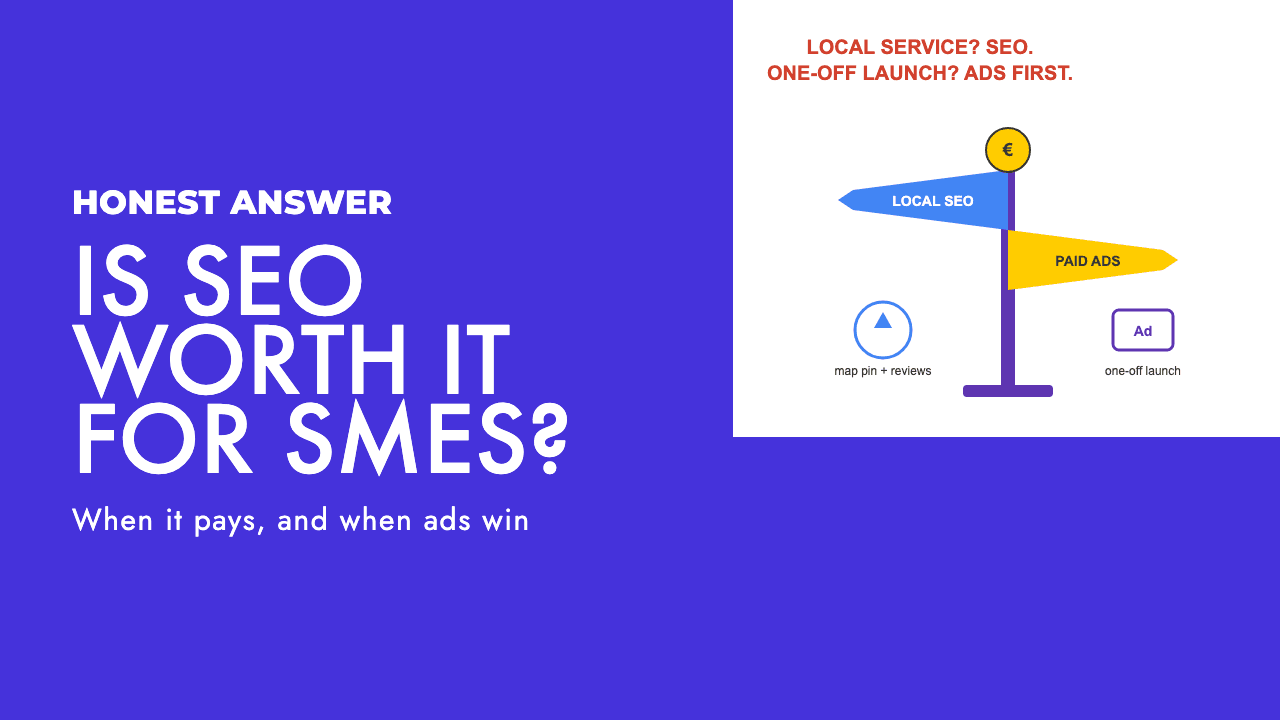
| Local service business (dentist, plumber, accountant, clinic, salon) | Yes, mainly through local search | The map pack rewards proximity, reviews and a complete profile, not domain size |
| Niche B2B service | Yes, slowly | Low search volume but high deal value and few competitors doing it properly |
| One-off product launch, event or seasonal push | No | Rankings tend to arrive after the window has closed |
| Business whose questions AI Overviews now answer directly | Partly | The informational clicks are largely gone, the commercial ones remain |
| Ecommerce competing with Amazon and marketplaces on head terms | Only with a genuine niche | The generic terms are owned by sites you will not outrank |
If you are in the first two rows, keep reading. If you are in row three, skip to the ads section.
What changed since 2024: fewer clicks per ranking
The reason we no longer give a blanket yes is that a ranking buys less than it did. Analysis of Similarweb clickstream data reported by Search Engine Land found 68.01% of US Google searches ended without a click in the first four months of 2026, up from 60.45% in 2024. AI Overviews appear on more than 20% of searches, and when they do, click-through drops by nearly 60%.
That is US data, but Europe is not far behind on the product side. Google rolled AI Mode out in the UK on 28 July 2025, then pushed it to more than 40 new countries and 35 new languages on 7 October 2025, including Greek, which went live in Greece the following day. If you sell in Cyprus or the UK, your customers have had AI answers in both their languages for a year.
We wrote about the mechanics of impressions rising while clicks stay flat in the great decoupling. The practical version for an SME is simple. "How to" content as a lead engine is a worse bet than it was. Searches with buying or local intent still click, still show a map pack, and still send the phone calls that pay the retainer.
What SEO actually costs, from public data
Anyone quoting you a number should be able to place it against the market. The widest public benchmark is Ahrefs' survey of 439 SEO providers, now a couple of years old but still the best sample published.
| Measure | Figure from the Ahrefs pricing survey |
|---|---|
| Average monthly retainer, all providers | $2,917 |
| Average agency retainer | $3,209 |
| Average freelancer retainer | $1,348 |
| Most common retainer band | $500 to $1,000 |
| Average local SEO retainer | $1,557 |
| Most common hourly rate | $75 to $100 |
| Share of providers billing by monthly retainer | 78.2% |
On timelines, Search Engine Land's guide puts measurable results at 3 to 6 months, stretching to 6 to 12 in competitive niches, and notes that Google's own long-standing guidance is 4 months to a year. The same guide cites a Semrush study in which 41% of domains reached the top 10 within six months but only 27% were still there at month 13. Getting there is one job. Staying there is a second one.
Put those together and a realistic SME programme is something in the lower half of that retainer range, for at least six months, with local businesses seeing movement sooner because Google Business Profile edits take effect fast. If a quote is far below the floor of that table, you are buying a directory listing and a monthly PDF, not SEO.
The cheapest wins, in order
Before you pay anyone a retainer, there is a short list of things that move the needle for most SMEs and cost almost nothing but time. We start every small programme, including our UK SEO work, from the same list.
Finish your Google Business Profile. Google says local ranking comes down to relevance, distance and prominence, and that businesses with complete and accurate information are more likely to show up (Google Business Profile Help). Categories, services, hours, photos, a real description. Most profiles we audit are half done.
Ask for reviews, then answer them. The same Google page says more reviews and positive ratings can help local ranking, and that responding to them helps a business stand out. A steady trickle of honest reviews beats a burst of ten in one week. We covered what the map pack rewards in 2026, including the near-me and AI-answer angle, in local SEO in the age of AI search.
One proper page per service. Not a homepage that lists twelve things. A page for each offer, written for the person about to buy it, with the price model, the area covered, what happens after they call, and a photo of the actual people. This is the single highest-return page on most SME sites and it is usually missing.
Fix the basics. Titles that say what the page is and where you are. Pages that load on a phone. Nothing important blocked from indexing. A technical audit matters for larger sites, but for a ten-page SME site the free checks in our SEO tools cover most of it.
Do those four and you have done most of what a cheap local retainer would do. Our local SEO service starts where that list ends: citations, review systems and the content that makes a profile rank outside its own postcode.
Cyprus and the UK are different problems
In the UK the difficulty is density. Government estimates put 5.7 million private sector businesses in the country, 99.85% of them SMEs (Department for Business and Trade). Every category in every city has a handful of firms already doing SEO reasonably well, AI Mode has been live for over a year, and Google confirmed it would extend ads inside AI Overviews to English-speaking markets beyond the US by the end of 2025 (Search Engine Land). SEO pays here, but it pays for the firm that picks a tight service-plus-area target rather than the one that wants "accountant London".
In Cyprus the difficulty is the opposite. SMEs make up 99.8% of enterprises and 81.8% of employment according to the European Commission's 2025 country fact sheet, which means most of your competitors are as small as you are and many have never had a proper website. The map packs are thin, the Greek-language results are thinner, and a well-built site in both languages can rank in months rather than a year. Google has said it has not disclosed any plans to bring ads into AI Mode in the EU (Search Engine Roundtable), so the organic answer is still the whole answer on that surface for now. That is the market we work in every day from our Cyprus base.
The trap in Cyprus is the size of the prize. Some categories simply do not have enough searches to justify a retainer, however easy the ranking would be. Which brings us to ads.
When to spend on Google Ads or Meta Ads instead
We run PPC alongside SEO, and there are situations where we tell an SME to do ads first or ads only.
| Situation | Better first spend | Why |
|---|---|---|
| You need leads this month | Google Ads | Search ads turn on today, SEO turns on in months |
| Launch, event or seasonal window | Google Ads | The window closes before organic arrives |
| Nobody searches for what you sell yet | Meta Ads | SEO needs existing demand; Meta can create it |
| You are not sure which offer converts | Google Ads | Cheapest way to test messages before writing the pages |
| Category so small SEO cannot pay for itself | Ads or referrals | Volume does not exist to return the retainer |
| Same service, same area, next year and the year after | SEO | Cost per lead falls over time instead of resetting each month |
The pattern that works for most SMEs is a small ads budget first, then SEO on the terms that proved they convert. The ad data tells you which service pages to build.
How to decide in one afternoon
Open a private browser window and search for your main service plus your town. Then run four checks.
- Is there a map pack? If yes, local SEO is on the table and the Business Profile work above is your first job.
- Is there an AI Overview or an AI Mode prompt, and does it answer the question outright? If the searcher would leave satisfied without clicking, that query is not going to feed you leads no matter where you rank.
- Count the competitors on page one with a real service page for that exact query. Fewer than three and you have a fast lane. Ten polished ones and you are in a year-long fight.
- Ask whether you can fund six months without seeing a lead from it. If not, buy ads and come back.
A yes on the first and third, a no on the second, and a yes on the fourth is the profile of an SME where SEO pays.
Where SEO is the right call, the work is not mysterious: profile, reviews, one page per service, the basics fixed, then content and links aimed at the searches that actually convert. That is what our UK SEO and local SEO programmes are built around, and a free SEO review will tell you which of the two halves you are in before you spend anything.
Frequently asked questions
How much does SEO cost for a small business?
Ahrefs' survey of 439 SEO providers puts the average monthly retainer at 2,917 dollars, with freelancers averaging 1,348 dollars and local SEO work averaging 1,557 dollars a month. The most common band was 500 to 1,000 dollars. In the UK and Cyprus, expect the lower half of that range for a local service business, and treat anything quoted well below it as a listing-only service rather than SEO.
How long does SEO take to work for a small business?
Search Engine Land's guide gives 3 to 6 months for measurable results and 6 to 12 in competitive niches, and Google's own guidance has long been 4 months to a year. Local businesses usually see map-pack movement sooner than that because Google Business Profile changes take effect quickly. If you cannot fund at least six months, buy ads instead and revisit SEO later.
Is SEO or Google Ads better for a small business?
They answer different questions. Google Ads is better when you need leads this month, are launching something with a fixed window, or want to test which offer converts. SEO is better when you will still be selling the same service in a year and want the cost per lead to fall over time. Most SMEs that do well run a small ads budget first and let SEO take over the terms that prove they convert.
Do AI Overviews make SEO pointless for small businesses?
No, but they change which searches are worth chasing. Clickstream data reported by Search Engine Land shows around 68% of US Google searches ending without a click in early 2026, and click-through dropping by nearly 60% when an AI Overview appears. That mostly hits informational queries. Searches with local or buying intent, which are the ones that pay an SME, still send clicks and still show a map pack.