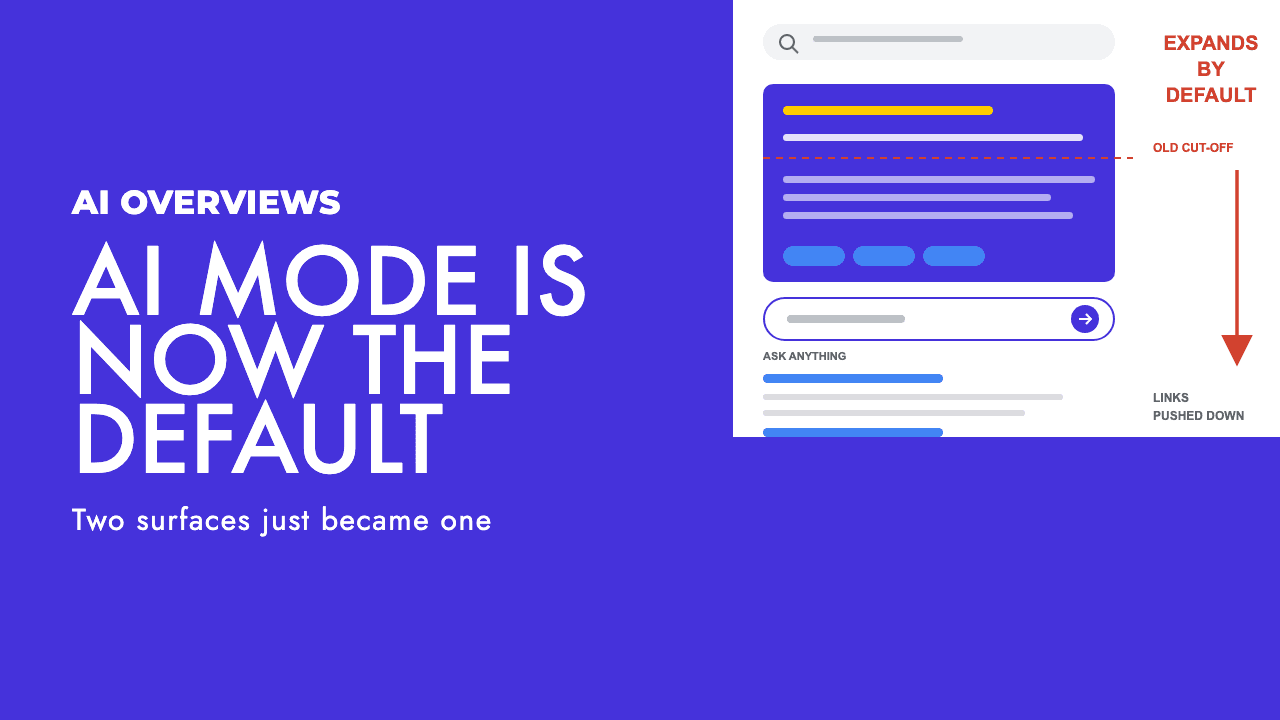

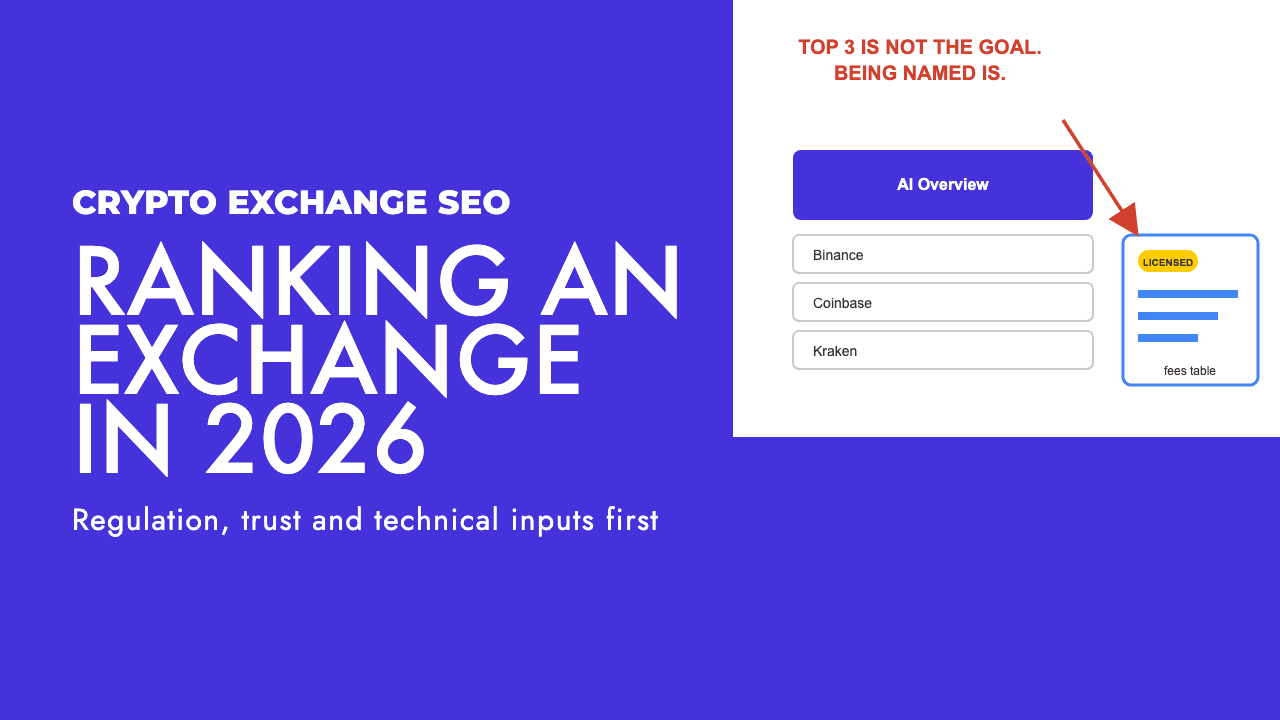
Search "best crypto exchange" from anywhere in Europe and the page has three layers: an AI Overview, a stack of comparison publishers, and then Binance, Coinbase and Kraken. An exchange that launched in the last two years is not in that picture, and no amount of on-page work by itself puts it there.
That is the honest starting point for crypto exchange SEO. What follows is what we tell exchanges who ask how to get in anyway.
The SERP you are actually competing in
Head terms in this vertical are a three-way fight between Google's own AI answer, publishers whose whole business is ranking "best X" lists, and exchanges with a decade of links and brand searches. A mid-size exchange does not win that fight by publishing more articles. The winnable inventory is asset-level, task-level and market-specific.
| Query type | Who wins today | Realistic target for a mid-size exchange |
|---|---|---|
| "best crypto exchange", "crypto exchange" | AI Overview, comparison publishers, top 3 exchanges | Get named inside the AI answer and the publisher lists, not the ranking itself |
| "[exchange] fees", "[exchange] vs [exchange]" | The exchange itself | Own every branded and comparison query about you |
| "buy [asset]", "[asset] price", "how to buy [asset]" | Coinbase, Binance, Kraken, data sites | Page-one on mid-cap and newly listed assets, especially in non-English markets |
| "crypto exchange [country]" | Locally licensed exchanges, local publishers | Page-one in markets where you hold a licence and the big three have a thin or blocked presence |
| Proof of reserves, security, licence queries | Kraken, Coinbase | A crawlable, specific trust page that gets cited |
The rest of this post works through what each of those needs, starting with the input most SEO guides skip.
Regulation is a ranking input, not a compliance footnote
Three things make regulation an SEO variable for an exchange. Google's own guidance says its systems give "even more weight" to strong E-E-A-T for topics that affect people's financial stability (Google Search Central). AI engines lean on regulatory standing when they recommend an exchange. And your licences decide which country pages you can build without lying.
The EU: MiCA is fully in force and the grace period is over
MiCA became fully applicable on 30 December 2024. Firms already operating under national rules were allowed to keep going under a grandfathering clause until 1 July 2026 at the latest, or until their MiCA application was decided (ESMA).
That transitional period has now ended. ESMA's statement of 17 April 2026 made clear there would be no extension, and that unauthorised providers had to wind down by the deadline (ESMA statement, PDF).
For SEO this changes the question. Before July, an EU landing page for an unauthorised exchange was a grey area. Now it is a page inviting users to do something the exchange cannot legally offer them, and ESMA is telling consumers to check the register and move their assets if their provider is not on it.
In Cyprus, CySEC is the competent authority under MiCA. Its announcement of 10 July 2026 repeats the point: from 1 July 2026, crypto-asset services may only be provided in accordance with MiCA (CySEC). The upside for an authorised Cyprus CASP is that one authorisation passports across the EU, which makes a proper set of EU country pages legitimate rather than aspirational.
Put the authorisation on the page: licence, granting authority and a register link in the footer, on every country page and in your Organization schema. A visitor checks it, and so does whatever is compiling the next "safest exchanges" answer.
The UK: every landing page is a financial promotion
Since 8 October 2023, marketing cryptoassets to UK consumers has sat inside the FCA's financial promotions regime, and the FCA applies it to firms based overseas. There are four lawful routes to communicate a promotion, and the rules require specific risk warnings and positive frictions, including a 24-hour cooling-off period for first-time investors (FCA).
The SEO consequence is that a UK landing page, a "how to buy Bitcoin in the UK" guide and a meta description promising yield are all promotions. Copy that would be fine on a .com aimed at nobody in particular can be unlawful when it is targeting en-GB.
The next step is already scheduled. The FCA's authorisation gateway for the new cryptoasset regime opens on 30 September 2026 and closes on 28 February 2027, with the full regime applying from 25 October 2027. Firms that miss the window and are not authorised by then will be unable to take on new UK customers (FCA gateway page). A UK content programme for an exchange that will not be in that gateway is a programme with an expiry date.
The US: state by state, and California just joined
There is still no single federal licence for a spot exchange. New York requires a BitLicense or a limited purpose trust charter for virtual currency business activity involving New York residents (NYDFS). California's Digital Financial Assets Law took effect on 1 July 2026, requiring a DFPI licence or a pending application to keep serving California residents (Jones Day).
For a US-facing exchange, the "available in these states" page is not a legal appendix. It is one of the most cited pages you own, because it answers the first question a user and an AI engine both ask.
What E-E-A-T actually looks like on an exchange
Google says trust is the most important part of E-E-A-T and that the other three contribute to it (Google Search Central). On an exchange, trust is not a badge row. It is a set of pages that say something checkable.
Kraken's proof-of-reserves page is the reference example: a dated snapshot (30 June 2026 at the time of writing), a Merkle-tree method a client can verify against their own balance, and a named scope of assets (Kraken). That page ranks for security queries and gets cited in AI answers because it is specific.
The checklist we use with exchange clients:
| Trust element | What it needs to say | Where it should appear |
|---|---|---|
| Licences | Authority, licence number, register link, date | Footer, about, every country page, Organization schema |
| Leadership | Named executives with verifiable histories | About page, author bylines on research |
| Custody and reserves | Method, cadence, scope, last snapshot date | Dedicated page, linked from the homepage |
| Incident history | What happened, what changed | Security page, not buried in a blog |
| Fees | Maker/taker tiers, withdrawal fees per asset, last updated | Standalone fees page, tables, no PDF |
An exchange with anonymous founders, a Telegram link as its contact page and a fees PDF from 2024 is not going to rank for money queries, whatever it publishes.
Country and language targeting without building doorway pages
Google's spam policies list "multiple domain names or pages targeted at specific regions or cities that funnel users to one page" as doorway abuse (Google spam policies). A folder of /crypto-exchange-germany, /crypto-exchange-france and /crypto-exchange-italy pages with the country name swapped is exactly that.
A country page that is not a doorway answers what is different in that market: licence status there, fiat currencies and payment rails (SEPA, Faster Payments, local bank transfer), supported assets if the list differs, local tax reporting notes, support hours and language. If nothing is different, do not build the page.
For the plumbing, Google's requirements are simple and frequently broken. Language codes are ISO 639-1, region codes are optional and must be ISO 3166-1 alpha-2, you cannot specify a region without a language, and "UK" is not a valid region code (it is GB). Every version must reference itself and all the others, or the annotations may be ignored (Google Search Central). We wrote up the cross-domain and geo-blocking cases in our hreflang guide for casino sites; the patterns are the same for an exchange, and the market planning is what our international SEO work is for.
Two exchange-specific notes. Do not IP-redirect users between language versions; Google advises against it, and Googlebot crawls mostly from the US so it will get redirected too. And if you geo-block a market for licensing reasons, Google's guidance is to treat Googlebot like any other user from that country, which means the US-based crawler will see your US block page unless your marketing pages are handled differently from your app (Google Search Central).
The content that actually ranks for an exchange
Most exchange blogs are a graveyard of "what is blockchain" articles that Coinbase Learn and Binance Academy already own. The pages that earn traffic are product pages that happen to answer a search.
| Page type | Query it wins | What it needs to rank |
|---|---|---|
| Fees page | "[exchange] fees", "crypto exchange fees comparison" | Full tier table, withdrawal fees per asset, spread disclosure, last-updated date |
| Asset pages | "[asset] price", "buy [asset]", "[asset] to EUR" | Live price and market data in the server-rendered HTML, an asset description that is not the CoinMarketCap boilerplate, link to the how-to-buy guide |
| How-to-buy guides | "how to buy [asset]", "how to buy [asset] in [country]" | Steps with the actual screens, payment methods for that market, a country variant only where the offer differs |
| Security and reserves | "[exchange] safe", "[exchange] proof of reserves" | Dated, specific, verifiable |
| Own comparison pages | "[exchange] vs Coinbase" | Honest, with the cases where the other exchange is the better pick |
New listings are the one area where a smaller exchange can beat the giants on timing. If your asset page and listing note are live and crawlable before the token is on Coinbase, you own that query for a window. That only works if the pages are server-rendered and in the sitemap the same hour.
Links in a vertical drowning in paid placements
Crypto is where every "guest post package" seller ends up. Google ran spam updates in June and August 2026, and the August one was a normal global spam update against its existing policies rather than a link-specific one (Search Engine Roundtable). An exchange with a link profile made of sponsored crypto-news posts is carrying risk it does not need.
What earns links for an exchange without buying them: order-book and on-chain data that journalists cannot get elsewhere, fee and spread research across the market, a compliance team willing to comment on MiCA and FCA developments, integrations with wallets and tax tools that carry partner pages, and local press in the countries where you hold a licence. The mechanics overlap heavily with what we described for casino link acquisition, and it is the core of our link building work in this vertical.
Technical faults that are specific to exchanges
Exchange front ends are trading apps with a marketing site bolted on, and the app's defaults leak into the marketing pages. These are the ones we find most often.
Client-side rendering with nothing in the raw HTML. If your asset pages ship an empty shell and hydrate the price and description afterwards, every one of them is waiting on Google's render queue, and in our experience that is where new listings lose their timing advantage. We push exchanges to server-render anything that has a search query attached to it. Our JavaScript SEO troubleshooting post covers how to diagnose this.
Bot protection throttling Googlebot. Google's crawling infrastructure reduces your crawl rate when it sees a significant number of 429, 500 or 503 responses, and Google warns against returning them for more than a day or two (Google Search Central). Exchange WAFs are tuned for scrapers and credential stuffing, and they routinely rate-limit Googlebot without anyone noticing. Verify Googlebot by IP range and give it a separate rule.
Soft 404s and URL variants on trading pages. A single-page app that shows "asset not found" with a 200 status creates soft 404s for every delisted token, and /trade?pair=BTC-EUR next to /trade/BTC-EUR doubles every pair. Return real 404s, pick one URL pattern, and keep the trading interface itself out of the index if it has no crawlable content.
Geo-blocks at the HTTP level. As above, Googlebot in the US sees what a US user sees. If your entire domain returns a block page to US IPs, the marketing site is invisible to the crawler that matters most.
This is the bulk of a technical SEO engagement for an exchange, and it usually moves indexing before any content change does.
AI search: where an exchange gets named
An Ahrefs analysis of 75,000 brands found branded web mentions correlated with AI Overview visibility at 0.664, against 0.218 for backlink count (Ahrefs). For an exchange, the mentions that matter are the ones in the comparison articles and regulator registers the AI engines read.
A Q1 2026 index from the PR firm 5WPR, run across ChatGPT, Claude, Perplexity, Gemini and AI Overviews with 65-plus consumer prompts, found Coinbase and Kraken together taking an estimated 22% of crypto-category citations, with Binance cited for scale but hedged on because of past regulatory settlements. The factors it credits are regulatory standing, proof-of-reserves disclosures and clear state availability (5WPR). Treat the exact numbers as one firm's sample, but the pattern matches what we see: the engines recommend the exchange whose licence status is easiest to verify.
The practical point is consistency. Fees, licences and supported countries should read the same on your site, on the data aggregators and in press coverage, because inconsistency is how an engine decides to hedge. Check that your WAF is not blocking OAI-SearchBot and PerplexityBot while you are at it. We cover the broader approach in our AI search optimisation work.
What a realistic plan looks like
Year one for a licensed mid-size exchange is technical clean-up, a fees page and asset pages that are actually indexed, country pages only for licensed markets, and a trust section a journalist could quote. Year two is where listing timing, comparison pages and data-led PR compound into mentions.
"Top 3 for crypto exchange" is not on that plan, and any agency that puts it there is selling you a number. Being named in the answer for that query, in the markets where you are licensed, is achievable and worth more than the position.
If you want a second opinion on where your exchange stands against that list, our crypto SEO team does this for exchanges, and a free SEO review is the easiest way to start.
Frequently asked questions
Can a new crypto exchange rank for "best crypto exchange"?
Realistically, no, not in the first couple of years. That result is an AI Overview, a stack of comparison publishers and the three or four largest exchanges. The winnable queries for a newer exchange are fees pages, asset pages, how-to-buy guides and market-specific pages in countries where it holds a licence.
Does regulation affect crypto exchange SEO?
Yes, directly. Google gives more weight to E-E-A-T on financial topics, and AI engines lean on regulatory standing when they recommend an exchange. Since MiCA's transitional period ended on 1 July 2026, an unauthorised exchange cannot legitimately serve EU customers, which removes the case for EU country pages altogether.
Why is Googlebot not indexing our exchange pages?
The usual causes are client-side rendering with nothing in the raw HTML, bot protection that returns 429 or 403 to Googlebot, and geo-blocks that hit Googlebot because it crawls from US IP addresses. Check the raw response with a Googlebot user agent from a US location before touching content.