
There used to be a comfortable assumption behind every AI search strategy: get a page onto page one, and Google's AI Overview will pull from it. Ranking was the entry ticket to being cited.
That ticket is no longer valid. Through 2026 the link between where you rank and whether AI quotes you has come apart, and the numbers are not subtle.
An Ahrefs study of 1.9 million citations in July 2025 found that 76% of pages cited in AI Overviews also ranked in the top 10 for that query, and the first page cited typically sat around position two. Rank well, get cited. That held.
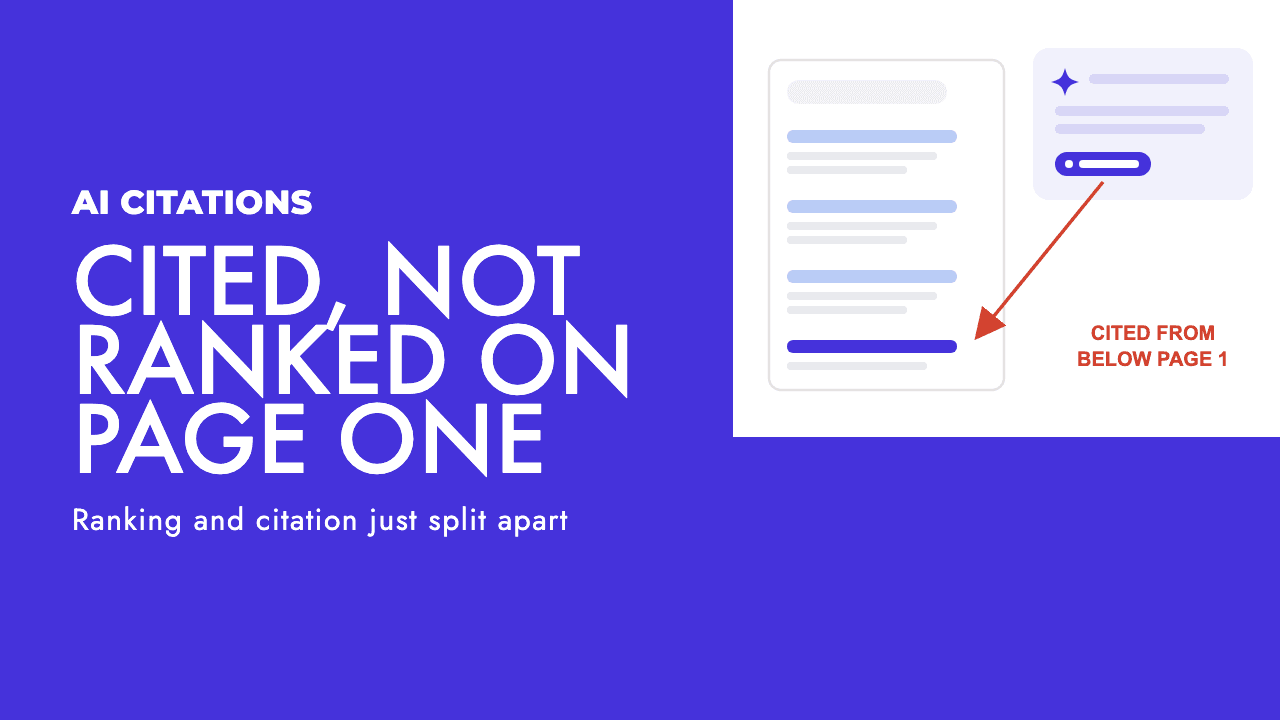
By March 2026 it did not. Ahrefs reran the study across 863,000 SERPs and found the top-10 share had fallen to 38%, with the rest split almost evenly between pages ranking 11 to 100 and pages outside the top 100 entirely (Search Engine Journal). Ahrefs is upfront that better citation parsing explains part of the gap, so treat the two numbers as a direction rather than a clean before and after. A separate 5W Public Relations report, using Brandlight data on AI systems more broadly, put the overlap between top Google results and AI-cited sources at under 20%, down from around 70% (PR Newswire). Whichever number you take, the direction is the same and it is steep.
The practical translation: roughly two out of three pages that Google's AI now cites are pages a normal searcher would never see on page one for that exact query. Ranking and citation have stopped being the same thing.
Why this is happening
The short answer is query fan-out. The longer answer is worth understanding, because it changes what you optimise for.
When you type one question into AI Mode or trigger an AI Overview, Google does not run a single search. It quietly breaks your question into a spread of related sub-queries, runs all of them, and assembles an answer from what comes back. We walked through the mechanics of this in our piece on query fan-out, and it is the single most important shift to internalise here.
A page can win a citation not because it ranks for your original query, but because it is the best available answer to one of the hidden sub-queries Google generated along the way. Your page one competitors were selected to answer the head term. The AI is answering a dozen narrower questions at once, and different pages win each one.
So the page ranking third for "best CRM for small business" might never get cited, while a page ranking fortieth for that head term, but which happens to be the clearest answer to "does this CRM integrate with QuickBooks," gets pulled into the Overview. The retrieval system is not reading the SERP. It is reading passages against sub-questions.
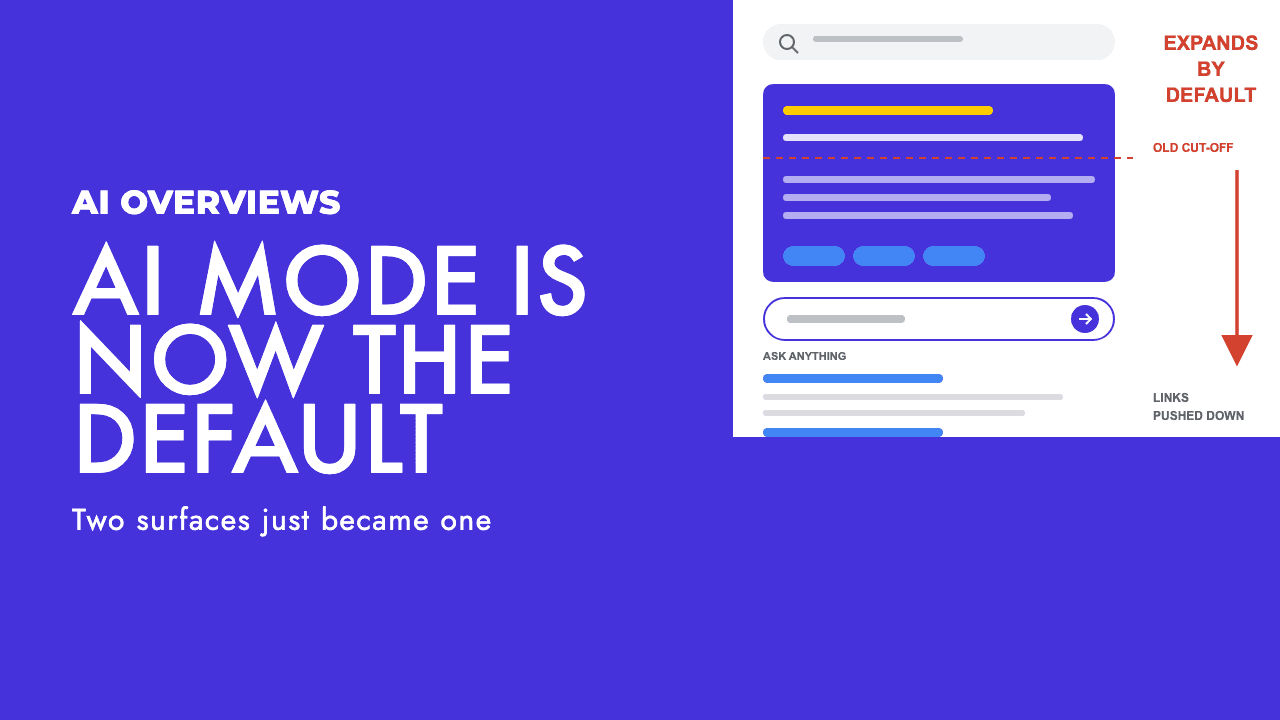
That layer got bigger at the end of August, when Google started expanding some AI Overviews into full AI Mode answers with the follow-up box already open. We covered what that does to the page in AI Overviews and AI Mode becoming the same thing.
This also fits what Google itself keeps saying. AI systems judge whether a page answers a specific need and whether the site is trustworthy enough to quote, not whether it won a ranking contest for a broad term (Google Search Central).
The trap this creates
Here is where a lot of businesses are about to waste money.
The old playbook says: we are not being cited, so we need to rank higher. Build more links to the money page, chase the head term, climb from position eight to position three. Under the new reality, that effort can lift your ranking and still leave you invisible in the AI answer, because the AI was never sorting by that ranking in the first place.
It runs the other way too. Plenty of businesses now rank in the top three and quietly assume they are safe, then wonder why their branded search and referral traffic is drifting while a competitor they have never heard of keeps appearing inside the Overview. Ranking one no longer guarantees the citation, and a chunk of top-ranked pages are simply absent from the AI answers on their own terms.
We see this pattern constantly with client sites. The instinct is always to fix citation by fixing rank. Sometimes those are the same job. Increasingly they are not.
What actually earns citations now
Stop treating "rank higher" as the answer to "get cited more." They are related, not identical, and the gap between them is widening.
First, optimise for the sub-questions, not just the head term. If query fan-out is turning one search into ten, your job is to be the cleanest answer to as many of those ten as you can. That means covering the specific, boring, adjacent questions around your topic properly, in their own sections, rather than one keyword-stuffed page aimed at the trophy term. We go deep on the passage-level mechanics of this in how to structure content so LLMs cite you.
Second, give the AI something only you have. Google's own guidance and every credible study point the same way: original data, first-hand experience, a genuine expert view, a number nobody else is publishing. A page that merely restates the consensus has nothing distinctive for the model to pull, no matter how well it ranks. A page with a proprietary angle can get cited from deep in the results.
Third, keep working on site-level trust, because it is the gate. AI Overviews decide whether your site is worth quoting at all before any single page gets a look in. Technical soundness, a real track record in your niche, consistent quality across the site. This is the unglamorous technical SEO foundation, and it is doing more work than any formatting trick. It is also why we keep arguing that AEO and GEO are still, fundamentally, SEO.
None of this means rankings stopped mattering. They still drive the clicks you do get, and a page that ranks nowhere and answers nothing will not get cited either. The point is narrower and more useful: ranking is now necessary-ish but nowhere near sufficient, and pouring everything into head-term position while ignoring sub-query coverage is optimising for the wrong scoreboard.
What this means if you are a smaller business
This is quietly good news for businesses that were never going to out-muscle the big domains on the head term.
If citation required ranking one, a small Cyprus firm or a niche US operator was locked out by definition, sitting behind the aggregators and the household names. Now that citation flows from being the best answer to a specific sub-question, the door is genuinely open. You do not need to beat Forbes for "best accounting software." You need to be the clearest, most concrete answer to the narrow question your actual customers ask, on a site Google trusts. That is a fight a focused business can win.
For our Cyprus clients in particular, this maps well onto local SEO work and specific intent. The head terms are crowded and international. The sub-questions, the ones tied to a real service, a real location, a real edge case, are where a smaller, sharper site can get pulled into the answer. We wrote more about the local angle in what Cyprus businesses should do about AI Mode.
The honest take
Ranking and citation used to be a single game with one scoreboard. They have split into two overlapping games, and the overlap is shrinking every quarter the studies get rerun.
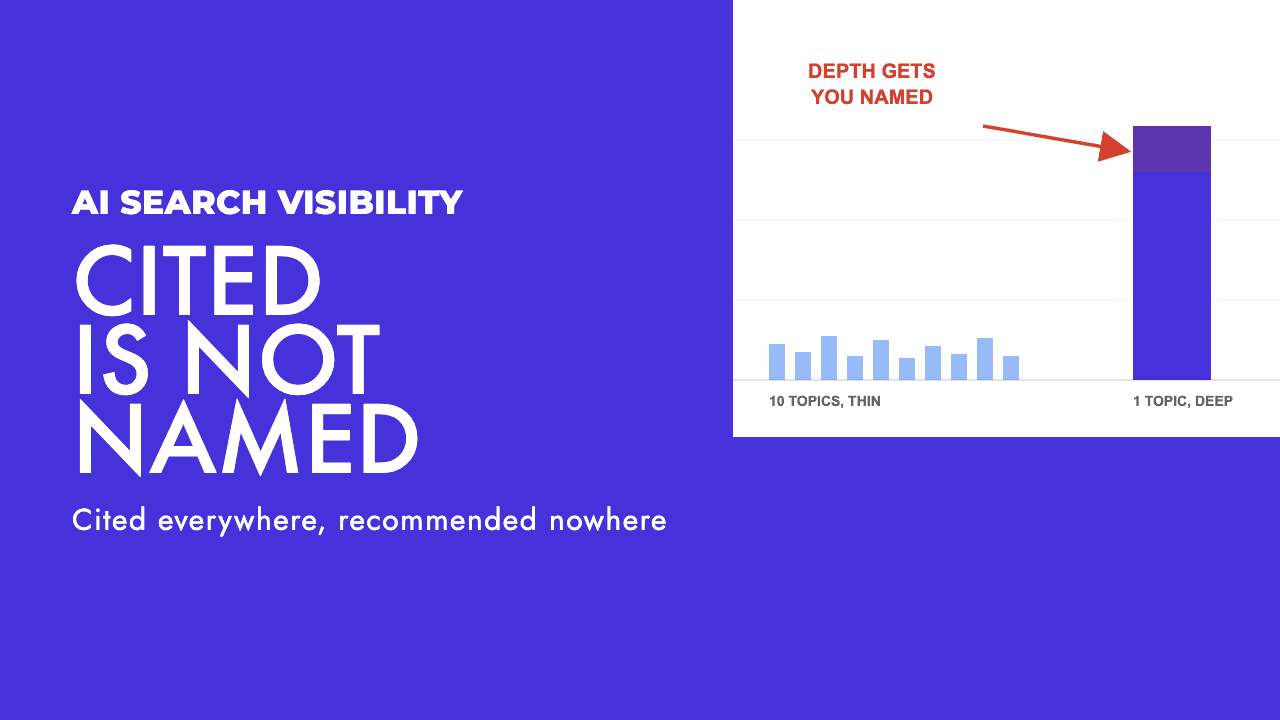
If you are still measuring AI visibility purely by "did our page-one page get cited," you are watching the wrong number. Track which questions you show up for inside the AI answers (including the cases where you are cited without being named), cover the sub-questions properly, publish something only you can, and keep the site trustworthy underneath it all. Do that and you can get cited from positions you would never have bothered fighting for on the old scoreboard.
If you want a straight read on where your site actually stands across AI Overviews and traditional search, that is exactly what we look at in a free SEO review, and it is the work behind our AI search optimization service.