
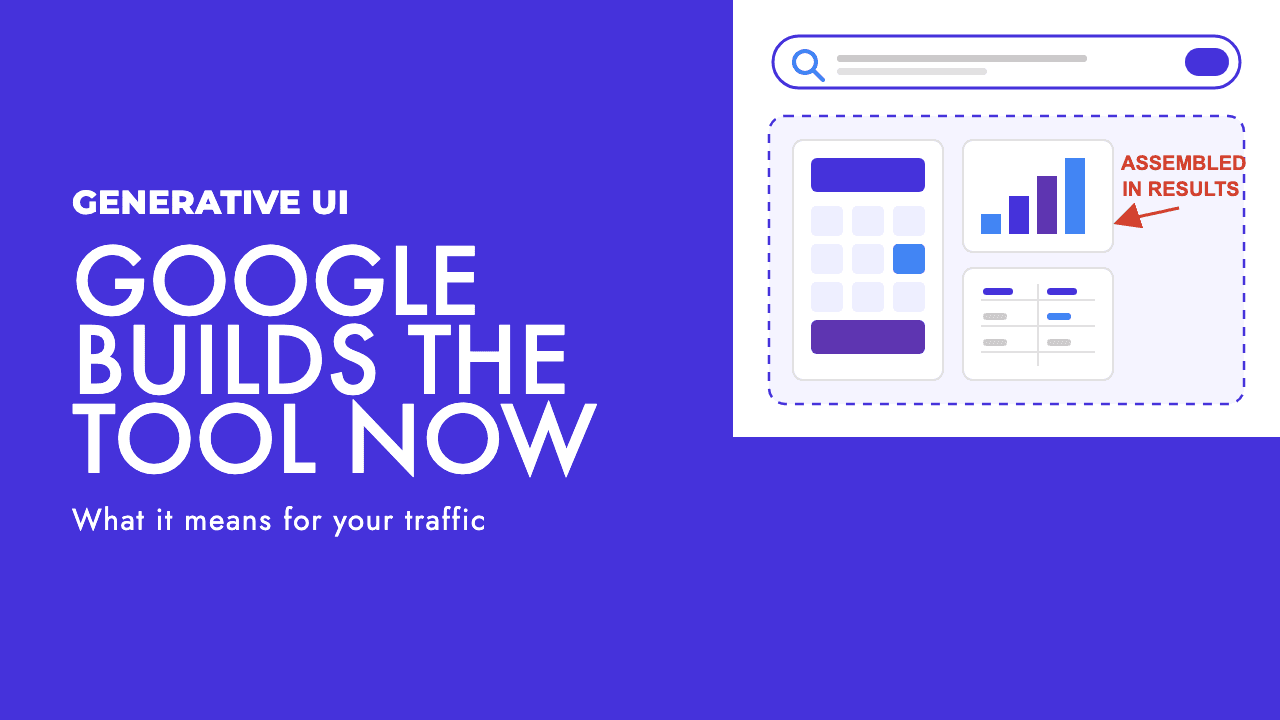
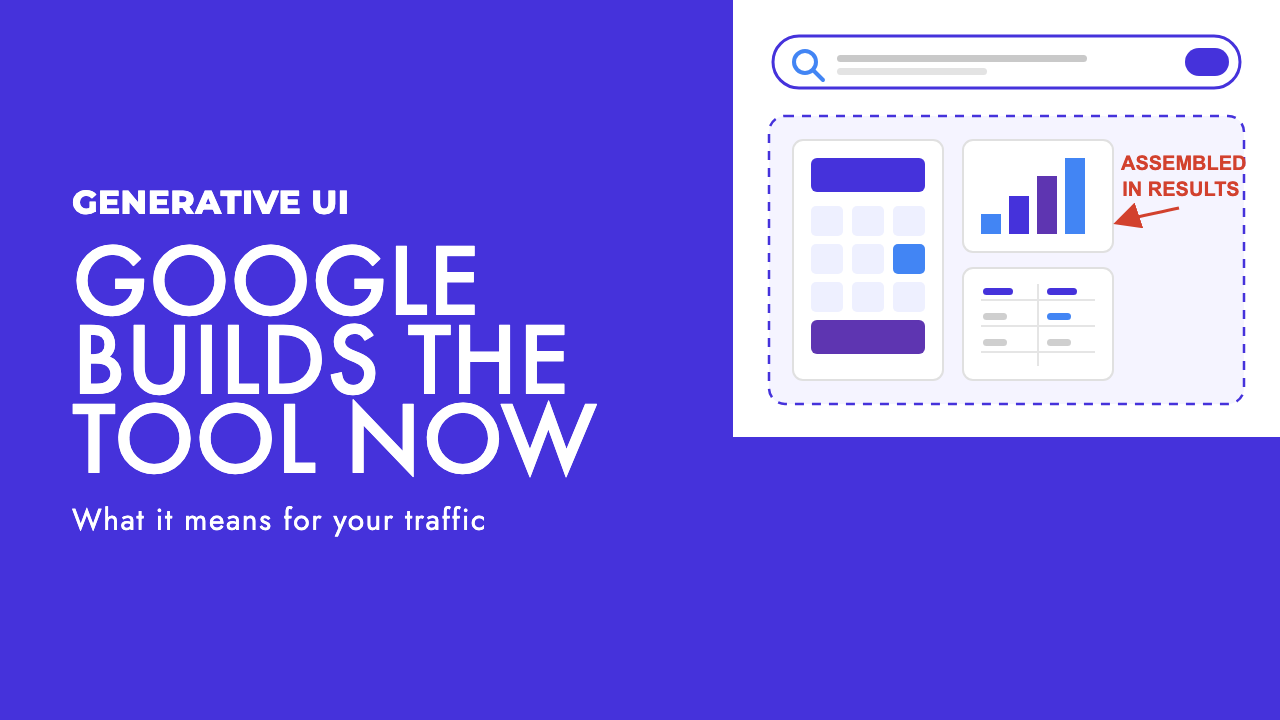
Google is about to build the mortgage calculator for you. And the comparison table. And the unit converter. Right there in the results, so nobody has to click the site that spent six months building the one they used to land on.
That is the plain meaning of Generative UI, the feature Google showed at I/O 2026 and said would be "available for everyone in Search this summer, free of charge". In Google's own words, Search can now assemble components "like interactive visuals, tables, graphs or simulations" in real time (Google). A related feature builds custom dashboards and trackers you keep coming back to, though that one starts with AI Pro and Ultra subscribers in the US.
Read that twice if any part of your traffic comes from a tool, a calculator, or a genuinely useful interactive page. Google is moving into that layer of the web.
What Generative UI actually is
For most of Search's history, the answer to a question was a list of links. Even AI Overviews, for all the disruption they caused, still sat on top of ten blue links and pointed at sources.
Generative UI is different in kind. Instead of writing a paragraph or ranking pages, the model builds an interface on the spot. Ask how a mortgage overpayment changes your term and it can render a working calculator. Ask to compare three cities for a move and it can put a filterable table in front of you. Google's research team frames it as an AI model that "generates not only content but an entire user experience" for the prompt (Google Research).
The persistent version is the part people are underrating. Google says Search can build you a dashboard or tracker you return to and make progress on, a fitness log for instance. That is not a search result. That is a small app living inside Google, seeded by a single query.
The on-the-spot tools are launching free to everyone, not locked behind a Pro tier. The dashboards and trackers are the exception for now, rolling out to AI Pro and Ultra subscribers in the US first. Broad reach for the core feature is what makes it a strategy question rather than a curiosity.
Why this matters for your traffic
The tool page has been one of the most reliable plays in SEO for a decade. Build a good free calculator, ranking checker, or comparison tool, earn links and rankings for the "utility" query, and convert some of that traffic into leads. Whole content strategies are built on it.
Generative UI attacks that play directly. When someone searches for the exact utility your page provides, Google can now generate a working version in the results. No click required. This is the zero-click pattern we have watched spread from featured snippets to AI Overviews, now reaching interactive content that everyone assumed was click-proof.
We see this fear constantly with client sites that lean on a flagship free tool. The honest read: for pure "give me the utility" intent, Google absorbing the interface is a matter of when, not if. Pretending otherwise helps nobody.
But the panic version of this story is wrong, and the nuance is where the opportunity sits.
Our take: stop trying to out-tool Google
You are not going to win a build-off against Google's Search team on generic utilities. A mortgage calculator, a percentage calculator, a basic unit converter. Those are commodities, and commodities are exactly what a general model assembles well on demand.
What Google cannot generate is your judgement, your proprietary data, and your relationship with the user.
A generated calculator does the arithmetic. It does not know that in Cyprus the transfer fees and the specifics of a housing loan change the real number, or that a US buyer in one state faces closing costs another does not. It does not carry your firm's actual pricing, your inventory, or the eligibility rules only you know. And it does not remember the user or save their work in a way that pulls them back to you rather than back to Google.
So the move is to become the trusted source the generated interface has to draw from, and to push your own tools toward value a general model cannot fake, rather than to build a shinier tool. This is the same logic behind structuring content so LLMs cite you: if the machine is going to do the assembling, you want to be the raw material it assembles from and credits.
What to actually do
Make your facts explicit and machine-readable. Vague marketing copy is invisible to a system trying to build a comparison. State prices, fees, eligibility, timelines, and specifics as plain, structured facts. Back them with schema, which our structured data generator will write for you as valid JSON-LD. If Google is assembling a table for your category, you want your numbers clean enough to be pulled into it and attributed.
Move your tools behind a real relationship. A calculator that saves a scenario, a dashboard tied to a user's account, a tracker that remembers history and notifies them. Google's version is stateless and anonymous by design. Yours does not have to be. That is the moat.
Own the interpretation, not just the calculation. The number is becoming a commodity. What it means for a specific business or buyer is not. Guides that explain the "so what" behind the output are harder to generate and are exactly what earns citations in AI answers. That is a content strategy decision more than a product one. This is the difference between GEO and old-school SEO in practice.
Watch this closely if you are in the EU. Generative UI leans on Google assembling from data it holds. It arrives at the same time the EU is forcing Google to share search data with rivals under the Digital Markets Act. Cyprus and the rest of Europe sit at the front of both changes, which makes being a clean, citable source across multiple engines more valuable, not less.
Track your presence, not just your rankings. A ranking report will not tell you whether Google generated an interface that replaced your click. You need to be watching how you show up inside AI features, the same way we described for the redesigned AI search box.
Update, September 2026
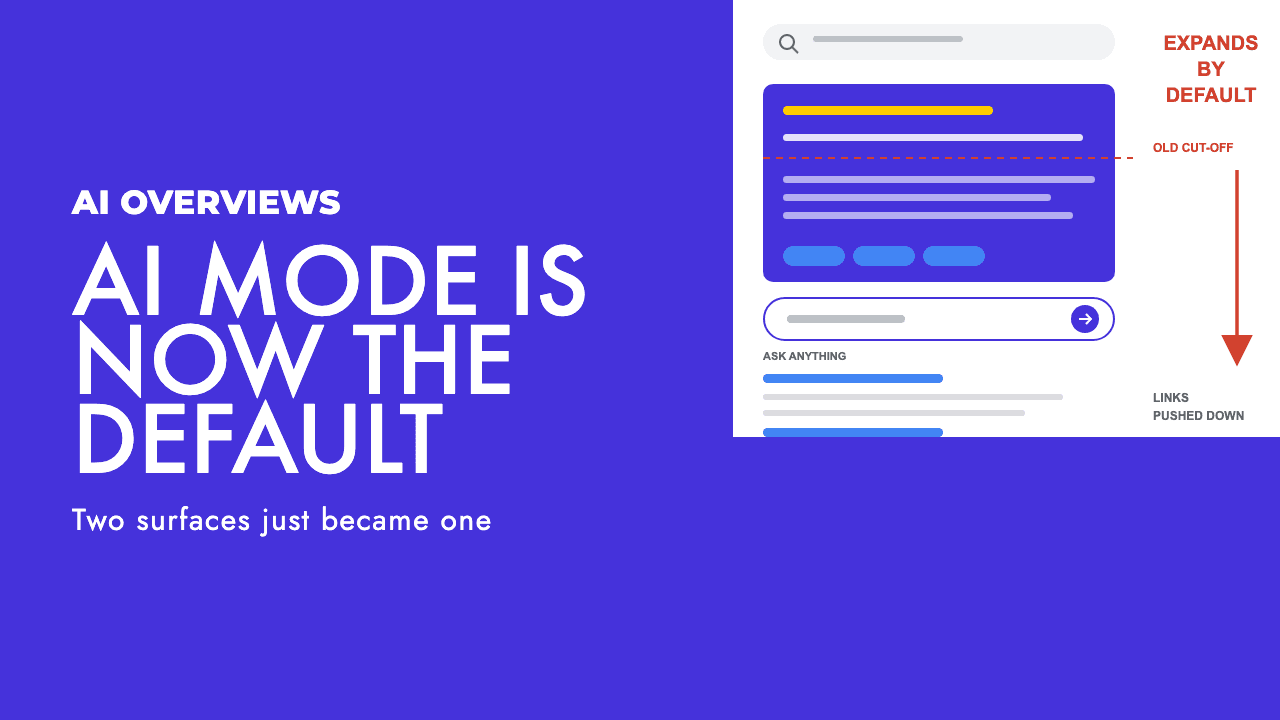
The summer rollout happened, and then it went further. On 19 August Google began pushing Generative UI beyond AI Mode into AI Overviews, so the on-demand calculator or pH scale can now appear in the summary block at the top of an ordinary results page, not only inside the conversational tab; it is live globally in English in AI Mode and reaching AI Overviews over the following weeks, free for everyone (Search Engine Journal). Nine days later Google started auto-expanding AI Overviews into full AI Mode answers for some queries (Search Engine Roundtable), which we unpacked in AI Overviews expanding into AI Mode. Put the two together and a generated tool can now sit on the default results page for a utility query, with your link somewhere underneath it. The advice above stands; the exposure is broader than it was in July.
The bottom line
Generative UI is Google climbing one more rung up the value ladder, from answering the question to building the tool that answers it. For thin utility pages, that is a real threat, and the sites relying on them should plan accordingly.
For businesses with genuine expertise, proprietary data, and a reason for someone to come back, it is a prompt to compete on what a general model cannot manufacture. Be the source it cites. Own the interpretation. Give people a reason to leave Google's generated version and use yours.
If you want a straight read on how exposed your site is to this shift, that is exactly the kind of thing our AI search optimization work looks at. Or start with a free SEO review and we will tell you where you stand.