

For 25 years the Google search box did one job. You showed up with a question already formed in your head, you typed it, and autocomplete sped up the typing. The box captured demand. It never tried to change it.
That just ended. At Google I/O 2026 the company called its new search box the "biggest upgrade to our Search box in over 25 years, now completely reimagined with AI" (Google). It expands as you type to fit longer questions, it accepts images, files, videos and even your open Chrome tabs as input, and most importantly it suggests how to ask, with AI-powered prompts that, in Head of Search Liz Reid's words, go "beyond autocomplete" (Search Engine Land).
Read that last part again, because it is the part that matters for anyone trying to get found.

The short version
The old box recorded the question you already had. The new box helps you write a better one. That sounds like a small interface tweak. It is not. It moves the decisive moment of search upstream, out of the results page and into the box itself, before a single blue link or AI Overview has loaded.
For businesses that means three things, and we will take each in turn:
- The query a person actually submits is now partly Google's suggestion, not purely their own words.
- Short head terms matter less. The longer, fuller, more conversational question is what gets answered.
- More people will slide straight into AI Mode from the box, which changes the shape of the traffic you get, not just the amount.
What actually changed
Three concrete things changed, and they stack. First, the box now expands as you type, giving people room to describe what they want in full sentences instead of clipped three-word phrases. Second, it is multimodal at the point of entry, so a photo, a file or a Chrome tab can be the query. Third, and the one to focus on, it offers AI-powered suggestions designed to anticipate your intent and help you formulate the question you are actually trying to ask.
Google's own framing is the tell. CEO Sundar Pichai described the direction as search moving "from individual queries to ongoing conversations and now to agentic workflows" (Search Engine Land). The reimagined box is the front door to that shift. It is where Google starts steering a casual question into a richer one, and where many people will now flow straight into AI Mode rather than scanning a page of links.
This is the same engine we wrote about in our guide to query fan-out, pushed one step earlier in the journey. Fan-out happens after you hit enter, when one question silently becomes a dozen sub-searches. The new box reaches back before you hit enter and helps decide what that question is in the first place.
Why a smarter box is a bigger deal than it looks
Autocomplete and AI suggestions are not the same animal, and the difference is the whole story. Autocomplete predicted the end of your sentence based on what other people had typed before. It was a faster way to submit a query you already owned. The new system does not just predict your words, it proposes a better question and reframes the intent behind it.
That turns the box from a capture layer into a shaping layer. Demand is no longer simply recorded as people type it. It is partly authored by Google in the moment, nudged toward longer, more specific, more answerable phrasing. The query that lands in the results is now a collaboration between the user and the model, and the model is leading.
If you have spent years targeting the exact head term people type, this should make you sit up. The exact term is becoming less stable, because the box is actively rewriting it on the way in.
Our take: the box is a query-shaping layer now, not a capture layer
Here is our honest read, framed clearly as opinion. This is the most underrated announcement of the I/O 2026 cycle, and most of the coverage missed why. Everyone fixated on the 24/7 information agents and the generative mini-apps, which are flashier. The quiet redesign of the box will touch far more searches, far sooner, because every single search starts there.
When Google shapes the question, it also shapes the answer surface. A short, ambiguous query used to return ten links and let the human sort it out. A longer, model-refined question returns a confident AI answer, because now the machine has enough to work with. So the box upgrade is a lever that pulls more searches into the AI-answer experience, which is exactly what Search Engine Land flagged when it warned the change "might impact the type of search traffic Google has been sending you" and could mean "more people jumping to AI Mode sooner."
The opportunity sits right next to the risk. If Google is going to help people ask fuller questions, the businesses that have already answered those fuller questions, cleanly and in plain language, are the ones the model reaches for.
What this means for your keywords
Stop building strategy around the bare head term and start building it around the question. The two-word keyword still has volume, but the box is steering more people past it into a complete, natural-language ask. In iGaming and casino search, "casino licensing cyprus" becomes "what do I need to get a gambling licence in cyprus and how long does it take." You want to own the second version.
In practice that means two shifts. Cover the intent in full, the way a person speaks it, including the qualifiers, the constraints and the follow-up they would naturally add. And build genuine entity clarity, so that when the box anticipates intent, your brand, your products and your service area are the recognisable thing it can attach the answer to. Consistent naming of who you are and what you do, across your site, is what lets a model resolve a vague query onto you with confidence.
This is the heart of answer engine optimisation, and it is why the work that wins here is the same work that wins across ChatGPT and Perplexity. You are writing for a system that reformulates the question and then lifts a passage to answer it. Give it a clean passage to lift.
Fewer clicks, but the click that lands is warmer
Expect the shape of your traffic to change before the volume does. When the box pushes people into a conversation and an AI answer, more queries resolve without a click at all. That continues the pattern we have called the great decoupling, where impressions hold up or climb while clicks stay flat.
The flip side is that the click you do get arrives later and warmer. Someone who refined their question with the box, read an AI answer, and still chose to visit your page has self-qualified in a way a casual head-term clicker never did. The job now is to be the cited source inside the answer, and to be the obvious next step for the person who wants more than the answer gave them. We unpack the citation side of that in our guide to structuring content so LLMs cite you.
What to actually do about it
You do not need to rebuild your site. You need to point the work you are already doing at the question, not the keyword. Here is the practical list:
- Write for the full question. For every important head term, map the longer, spoken version a person would now type, and answer it directly in the first two sentences of the relevant section. A free keyword research tool is a reasonable starting point for building that list.
- Lock down your entities. Name your business, products and service areas the same way everywhere, so the model can attach a reframed query to you without guessing. This is groundwork for the whole Google AI Mode playbook.
- Cover the conversation, not the single query. If the box turns one question into a back and forth, plan content for the natural follow-ups, not just the opener.
- Make passages extractable. Short paragraphs, clear definitions, lists and tables that a machine can lift cleanly. Formatting does not earn the citation, but it makes the citation possible.
- Watch the new reports. Google launched its generative AI performance reports in Search Console in June 2026, and they reached every site worldwide on 31 August. Use them to see where you appear in AI surfaces, and judge the change by visibility, not clicks alone.
Update, September 2026
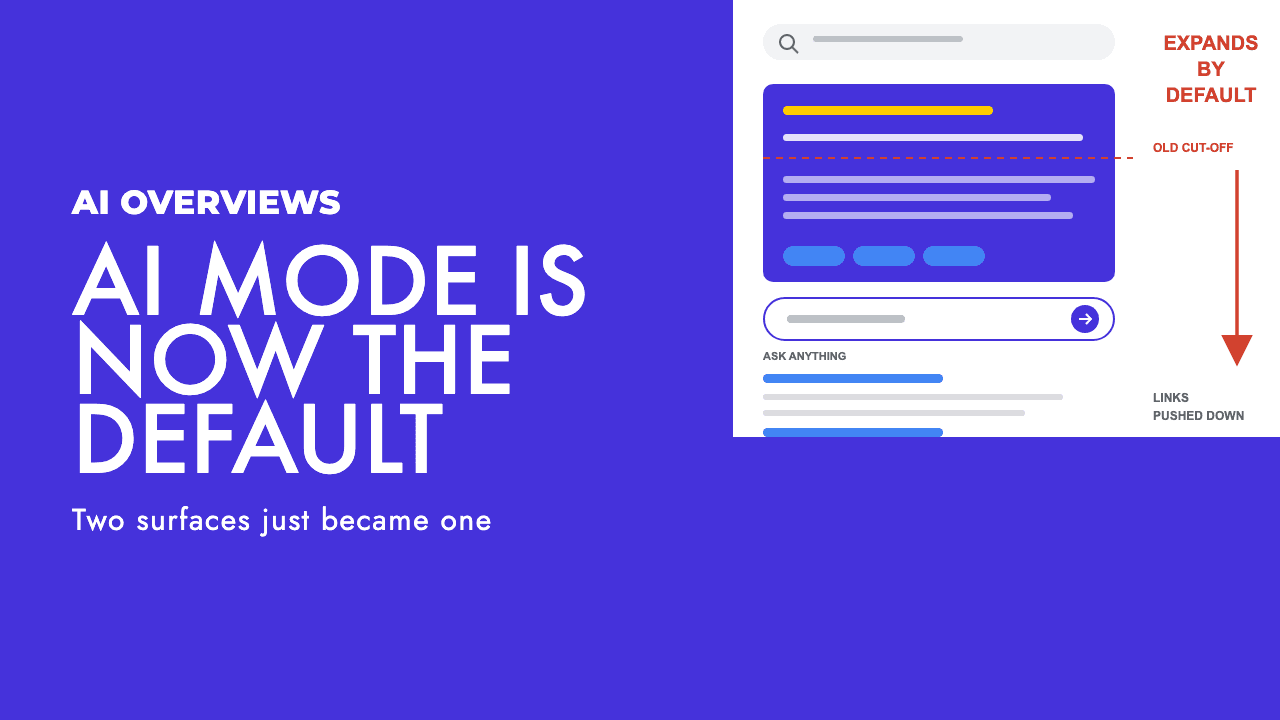
The prediction that the box would push more people into AI Mode sooner has aged quickly. On 28 August Google started auto-expanding AI Overviews into full AI Mode responses for some queries, with the "Ask anything" follow-up box already open and no "Show more" click required; Google's line is that it does this "for topics where our systems determine it's most useful for people" (Search Engine Roundtable). The organic results get pushed correspondingly further down. We wrote up what that does to your reporting in AI Overviews expanding into AI Mode. The advice above does not change; the time you have to act on it got shorter.
The bottom line
Google reimagined the search box because the search box was the last piece of the old model still standing. For 25 years it recorded the question. Now it helps write it, and in doing so it pulls the decisive moment of search off your page and into the box.
The businesses that win this are the ones who have already answered the real, fuller question a person is trying to ask, clearly enough that a model can lift it, rather than the ones chasing the perfect head term. That is a content and authority problem, not a markup trick, and it is squarely fixable.
If you want an honest read on whether your pages answer the questions people now actually ask, a free SEO review is the place to start. We work with businesses across Cyprus, where we are based, and the US on AI search optimisation that gets you into the answer, not just onto the page.