
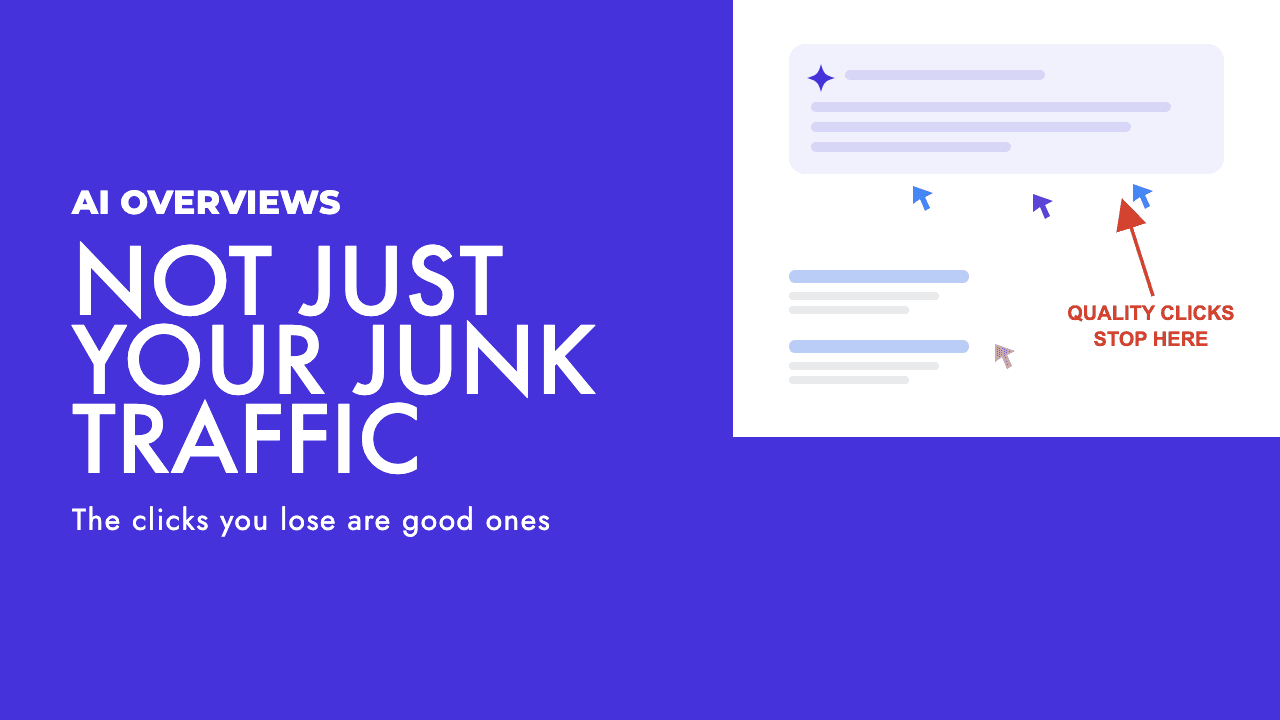
There's a story a lot of businesses have been telling themselves for the past year: AI Overviews only take the traffic you never really wanted. The tyre-kickers, the accidental clicks, the people who bounce in two seconds. New research says that story is not true, and if you've been leaning on it, you've been misreading your own numbers.
The comfort blanket came partly from Google itself. When AI Overviews rolled out, Google Search VP Liz Reid framed the click drop as the summaries filtering out low-engagement "bounce clicks," the implication being that anyone who still wanted your page would click through anyway. That framing gave a lot of marketers permission to shrug off falling traffic as no big deal.
What the study actually found
A randomised field experiment by Saharsh Agarwal and Ananya Sen put that claim to the test. Participants were randomly assigned to see or not see AI Overviews on their real Google searches. That randomisation matters. It's the difference between correlation ("sites with AI Overviews get fewer clicks") and cause ("the Overview is what took the click"), which is the first time we've had a clean causal read on this (SSRN).
The headline number: when an AI Overview appeared, organic clicks fell by 39.8%, and zero-click searches rose. No surprise there. Everyone with a Search Console login has felt that shape.
The part that breaks the comfort story is the engagement data. The researchers measured three things about the clicks that did happen: how often people hit the back button to the results, how many bounced inside ten seconds, and how long they stayed on the page. Across all three, the sessions with an AI Overview and the sessions without one were statistically indistinguishable (Search Engine Journal).
In plain terms: the clicks AI Overviews took were just as engaged as the clicks they left behind. There is no evidence that the summaries are skimming off junk. They're taking a representative slice of your traffic, good visitors included.
Our take: retire the "it was only junk anyway" excuse
We hear a version of this in nearly every client conversation. Traffic is down, and someone in the room reaches for the reassurance that it was low-intent traffic that wouldn't have converted. It's a very human thing to say when a chart points the wrong way. It's also, based on this data, wishful thinking.
Here's why it matters beyond feeling good or bad. If you believe the lost clicks were worthless, you do nothing. You keep publishing the same content, keep reporting the same way, and keep treating the decline as background noise. If you accept the lost clicks were real visitors who would have behaved like your other real visitors, you have to actually respond.
This is the same pattern we wrote about in The Great Decoupling, where impressions climb while clicks flatten. The decoupling study told you the relationship between visibility and traffic had snapped. This one tells you the traffic you're losing on the other side of that break is worth having.
Where the loss actually lands
The one genuinely reassuring finding is about distribution, not quality. The click loss concentrates on informational queries, the "how does X work" and "what is Y" searches where a paragraph answer is often all the person wanted. Overviews triggered on 53% of informational queries in the study, against 15% of navigational and 6% of transactional ones, so the queries closer to a purchase took far less of a hit.
So the honest read is not "the traffic didn't matter." It's "the traffic that left was mostly top-of-funnel, and that funnel now leaks at the top by design." Those informational visitors were real, they engaged, and some share of them would have gone on to become customers. You're not losing bots. You're losing the first touch.
That reframes the job. If the top of the funnel is structurally leakier, you have two levers: earn your way into the answer itself, and get sharper about the queries where a click still happens.
What to actually do about it
Compete to be cited, not just to rank. When an AI Overview answers the question, the game shifts from "be the blue link they click" to "be the source the summary is built from." That means content structured to be quoted: clear direct answers near the top, specific data and named examples, genuine expertise a model can lean on. That is a content strategy job before it is a formatting one. We break the mechanics down in how to show up in Google AI Overviews, and it's the core of our AI search optimization work.
Defend the queries that still click. The study is a clear signal to weight your effort toward commercial and comparison intent, where a paragraph rarely closes the loop and people still want to see the actual page, the pricing, the options. On those pages the snippet is doing real work, so writing a stronger meta title and description is cheap effort that still pays. We went deeper on that split in the research versus buy divide. Pure informational content still has a role, but stop expecting it to carry your traffic.
Fix your measurement before you fix your strategy. If your reporting still treats "sessions from organic" as the headline, you'll keep drawing the wrong conclusions. Start tracking whether you're being cited in AI answers, whether branded search is holding up, and whether the clicks you do get convert. Fewer, better-qualified visits can be a healthier business than a big pile of top-funnel sessions, but only if you're measuring the right thing.
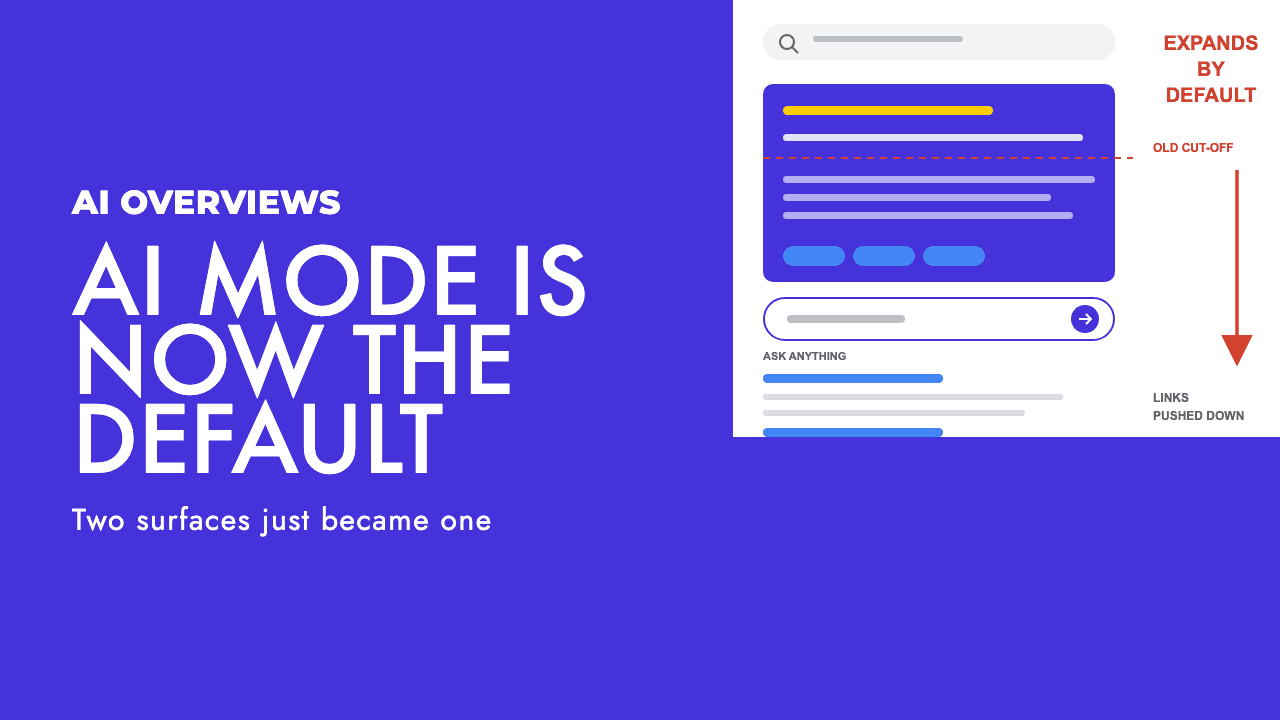
Don't rush to opt out. Blocking AI features to protect your click count is the panic move, and it usually costs more than it saves. We laid out the trade-offs in should you opt out of AI Overviews. Short version: hiding from a surface Google says more than 2.5 billion people use every month is not a plan, and that surface has since started expanding into full AI Mode answers on its own.
The bigger point
None of this is a reason to give up on search. It's a reason to be honest about it. Google's own guidance now says the quiet part out loud, that optimizing for its generative features "is optimizing for the search experience, and thus still SEO," rooted in the same ranking and quality systems as everything else (Google Search Central). The fundamentals didn't change. What changed is the excuse.
The traffic AI Overviews are taking is not junk. Once you accept that, you stop waiting for it to come back and start doing the work that gets you cited, keeps your commercial queries clicking, and measures what actually moves the business.
If you want a straight read on where AI Overviews are eating your visibility and which queries are still worth fighting for, our free SEO review is a good place to start.