
Run almost any "how", "what", or "best" search on Google today and the first thing you see is not a blue link. It is a paragraph of generated text, a few citations tucked along the side, and a fold you have to scroll past to reach the actual results. That box is the AI Overview, and over the last year it has gone from a nervous experiment to the default answer on most informational queries.
People are not just being shown AI Overviews. They are searching for what they are and what to do about them, and the pile of advice on offer has grown faster than the evidence behind it.
So here is our contribution to that pile. We went through the public click studies, looked hard at how Google actually decides who gets cited, and then separated the moves that genuinely help from the ones being sold by people who need you scared. If you have read our piece on the great decoupling, treat this as the sequel. That one was the diagnosis. This is what you do about it.
What AI Overviews actually are in 2026
An AI Overview is the generated summary Google places at the top of the results for a query it thinks it can answer directly. It pulls passages from a handful of pages, stitches them into a short answer, and links the sources it leaned on. It is the same engine that powers Google AI Mode, just dropped into the classic results page rather than a separate chat surface.
The mechanism underneath is worth understanding, because it changes what "winning" means. Google does not match your page against the query once. It breaks the question into sub-questions, runs a spread of searches at the same time, and assembles the answer from whichever page best satisfies each thread. We wrote a whole piece on this, called query fan-out, and it is the single most useful concept for making sense of AI Overviews. You are no longer trying to rank one page for one keyword. You are trying to be the best available source for a cluster of related questions, any one of which can pull you into the box.
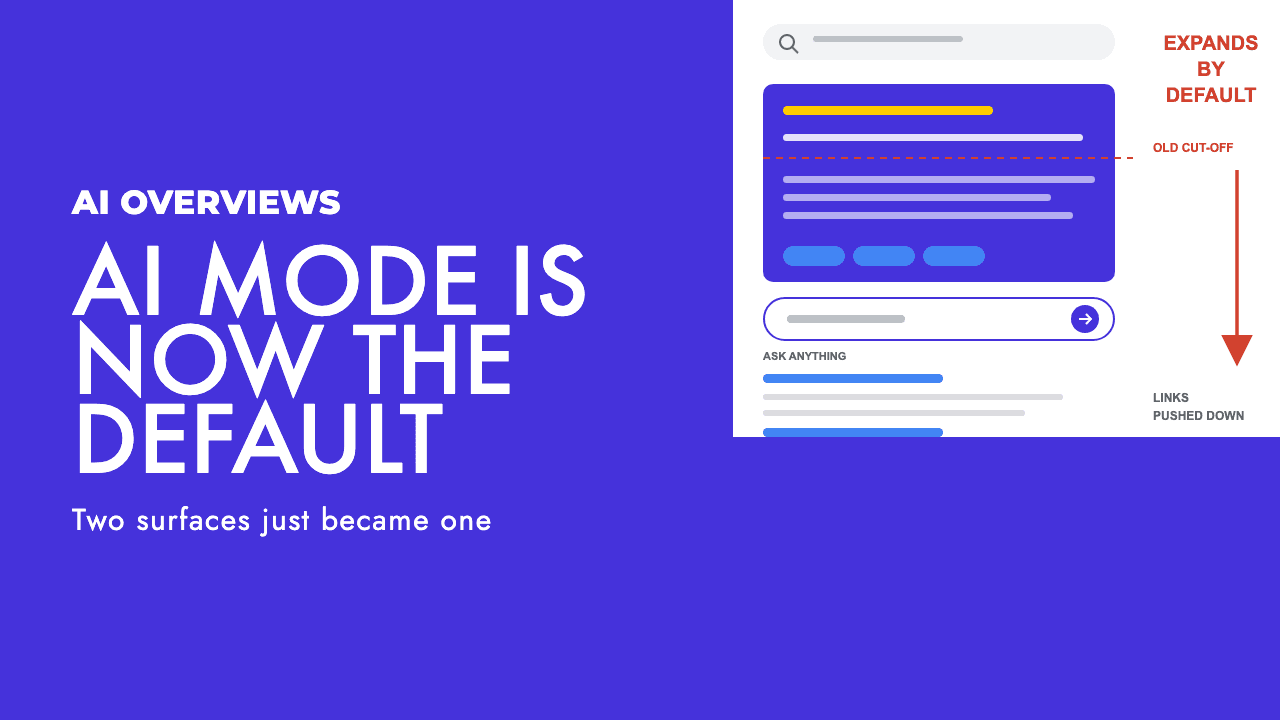
The box itself has since grown. From late August 2026, Google began expanding some AI Overviews into full AI Mode answers automatically, with the follow-up prompt already open, and Search Console now reports both surfaces as a single impressions number. We covered what that means in AI Overviews and AI Mode becoming the same thing.
The reach is the part that makes this unavoidable. Pew Research found that 58 percent of US users ran at least one search in March 2025 that returned an AI summary, in a study laid out on the Pew Research Center site. That was over a year ago. On informational queries the coverage now feels closer to total.
The click math is genuinely bad, and you should know the real numbers
This is where most articles either panic or wave it away. The honest version sits in the data, so here it is.
The same Pew study found that when an AI summary appeared, users clicked a traditional result 8 percent of the time, against 15 percent when there was no summary. Roughly half the clicks, gone. And the link inside the AI summary itself? Users clicked it just 1 percent of the time. The box answers the question and the session ends.
Ahrefs put a sharper number on it from the publisher side. In an updated analysis of 300,000 keywords, they found AI Overviews cut the organic click-through rate for the number one result by 58 percent, up from the 34.5 percent they measured back in April 2025. The effect nearly doubled in under a year. Search Engine Land has been tracking the same direction of travel across multiple studies.
A randomised experiment published in the summer closed the last escape hatch: the clicks an Overview takes are just as engaged as the ones it leaves, so the "it was only junk traffic" line does not hold either.
Put plainly: ranking first is worth a lot less than it used to be on any query that triggers an Overview. That is not opinion, it is measured. What you do with that fact is where the opinion starts.
What this looks like inside a real Search Console account
We run our own site through the same wringer we put clients through, and the shape is the same on almost every account we open. Impressions climb, sometimes sharply, over a few months. Clicks stay flat. The chart looks like a pair of scissors opening, and that is the decoupling from our earlier piece showing up on a single graph.
Look at where those impressions land and the picture sharpens. A large share of them sit on pages ranking well beyond the first page, picking up visibility across a broad cluster of informational and AI-adjacent queries and converting none of it, because at position 40 or 60 you are nowhere near the Overview's source list and nowhere near the clicks either.
The honest caveat, and longtime readers know we always include one: most of that is not AI Overviews stealing clicks. It is a site ranking on page four and beyond for queries it has not earned yet. Position 50 does not get clicks with or without an Overview. Blaming AI for a depth-of-ranking problem is the most common mistake we see, and it is worth checking your own account for it before you buy an AI strategy. The AI Overview tax measured by Pew and Ahrefs is real, but it lands hardest once you are already near the top. The rest is just SEO that is not finished.
How Google actually decides who it cites
This is the part worth your attention, because it is the only part you can act on. From Google's own guidance and from watching which pages get pulled, a few things hold up consistently.
There is no special markup and no separate track. Google's documentation on AI features in Search is blunt about this. There is no "AI Overview schema", no setting, no tag. The pages it cites are pages it already crawls, indexes, and ranks. Visibility in the Overview is downstream of normal ranking, not a parallel game. This is the same point Google has made about GEO and AEO being, at root, still SEO.
It pulls extractable passages, not whole pages. The model lifts the specific sentence or short block that answers a sub-question. Pages that bury the answer in a wandering intro give it nothing clean to lift. Pages that state the answer plainly, right under a heading that matches the question, hand it a passage on a plate.
It rewards demonstrated experience. First-hand data, original testing, named methods, and a clear author do better than recycled summaries. This is E-E-A-T doing exactly what it was always meant to do, now with teeth, because the model is choosing between sources and needs a reason to trust one over another.
It needs you to define things explicitly. Spell out the entities. Name the product, the company, the framework, the place. The model resolves which source to cite for which claim partly by how clearly you have told it what you are talking about.
None of that is new advice. It is the answer engine optimization playbook, which is the topic cluster playbook, which is the helpful content playbook before it. The mechanism keeps changing names. The behaviour it rewards has barely moved in a decade.
The actual playbook, minus the theatre
Here is what we do, in order of how much it actually moves the needle.
Answer the question in the first two sentences under the heading. Lead with the direct answer in about 40 words, then expand. This is the single highest-leverage change, because it is exactly the shape the model wants to extract. Stop warming up. Say the thing.
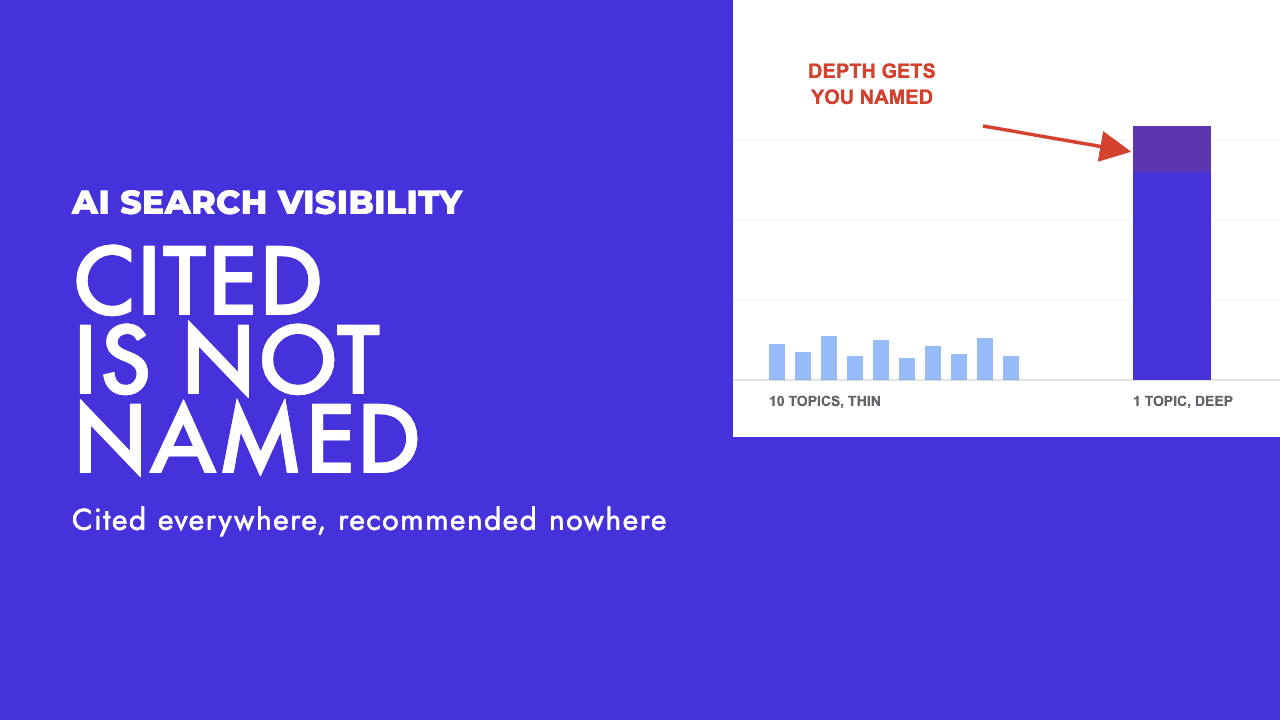
Build the cluster, not the keyword. Because of fan-out, one thorough page that genuinely covers a subject and its neighbours beats ten thin pages chasing variations. A keyword research report is still the quickest way to map those neighbours before you write. We have watched a single deep page on our site pull impressions for dozens of phrasings we never wrote for. Depth is the strategy. We lean on this hard in our content strategy work.
Show your own evidence. Original data, screenshots, a number nobody else has. The model has infinite access to the generic answer. What it does not have is your first-hand result, and that is increasingly what gets a source picked.
Fix the boring technical layer. If Googlebot and the AI crawlers cannot fetch and render your content cleanly, none of the above matters. Crawlability, fast pages, clean structure. This is unglamorous and it is non-negotiable, which is why technical SEO is still the floor everything else stands on.
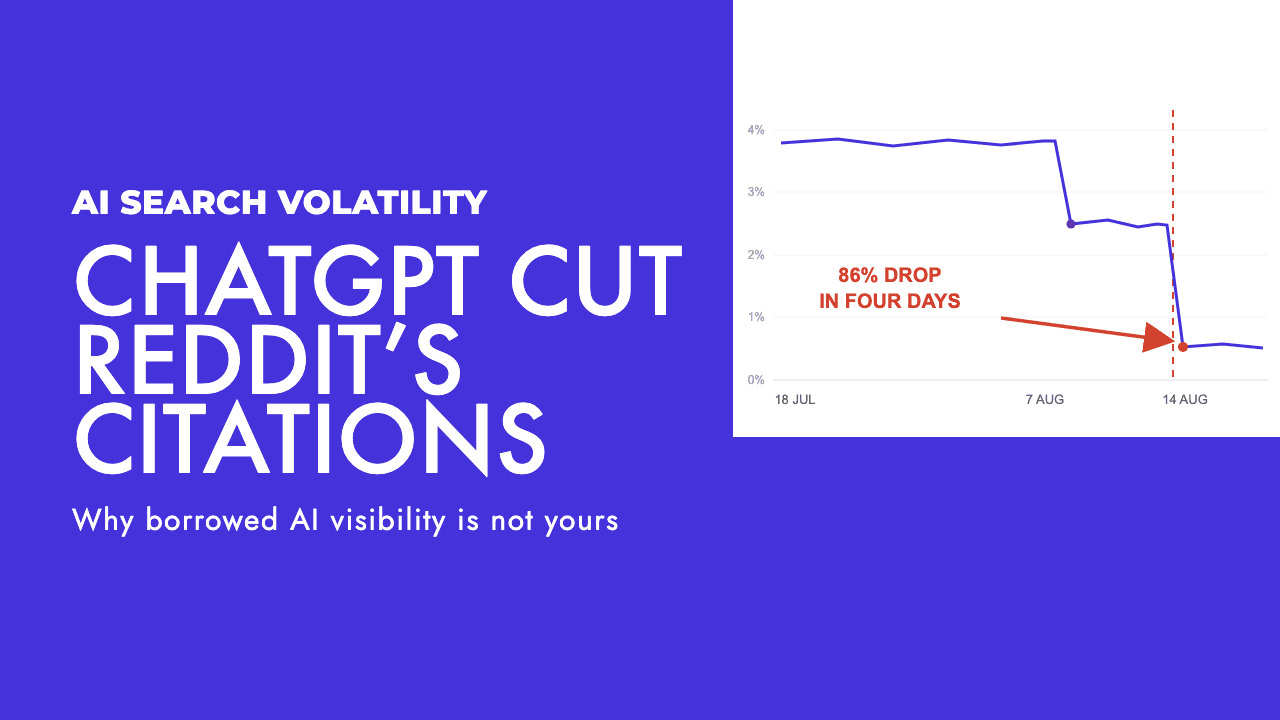
Earn the authority. Citations in Overviews skew toward sources with real off-site reputation. Links and mentions from places that matter still do the heavy lifting here. Nothing about AI changed that. Reddit threads have become one of those places that matter, which is why we wrote a full guide to Reddit SEO.
What is not on this list: llms.txt files, "AI Overview optimization" tools that promise a dashboard, and paying for a separate GEO audit that is your existing SEO audit with the find-and-replace run on it. We said our piece on the first one in llms.txt: useful standard or SEO theater, and the take has not aged a day.
Cyprus and the US get different answers
This matters and almost nobody splits it out, so we will.
In the US, AI Overviews are everywhere and the informational publishers are taking the full hit. If your traffic depends on ranking for "how to" and "what is" queries, the click math above is your daily reality and the citation game is genuinely worth playing, because being in the box is sometimes the only visibility left.
Cyprus is a quieter, later story, and that is an opportunity. AI Mode and Overviews rolled out across the US first and have been expanding through Europe since, so Cypriot searchers are seeing more of them every month. But the queries that pay a local business, the commercial ones like "seo agency cyprus" or "accountant limassol", still trigger Overviews far less often than informational searches do. Google is cautious about putting a generated answer on a query where someone is trying to hire or buy.
So the read differs by who you are. A Cyprus service business should not panic about Overviews eating its money queries, because they mostly are not. It should own the informational layer of its funnel, the questions clients ask before they hire, and make sure its commercial and local SEO foundations are genuinely strong, because that is where the clicks still flow. That is the split we apply to our own Cyprus SEO work too: the informational layer is a citation job, the commercial layer is a ranking job, not an AI problem.
A US informational site has the opposite priority. For it, the box is the battle.
Our honest opinion: is it worth chasing?
Yes, but not as a separate project. That is the whole answer.
The mistake we keep seeing is treating "AI Overview optimization" as a new discipline with its own budget line. It is not. Everything that gets you cited, plain answers, real depth, first-hand evidence, clean technical foundations, genuine authority, is the same work that has always built strong organic performance. You do not need a new strategy. You need the existing one done properly, with the answer moved to the top of the page.
The thing actually worth changing is what you measure. Clicks alone now understate your reach badly. Impressions, citations, and brand visibility inside the answer are part of the scoreboard now, and Google's generative AI performance report in Search Console (live for every site since 31 August 2026) at least shows you the impressions side, as we explained in our guide to the AI Overviews report. A click is no longer the only outcome that counts, and if you are still judging SEO purely on sessions, you are measuring 2026 search with a 2018 ruler.
We help businesses in Cyprus and the US do exactly this work through our AI search optimization service, and the foundation under all of it is still ordinary, well-executed SEO. The label on the box changed. The work to get inside it did not.
If you want to go deeper on where AI search is actually heading, our breakdown of the AI search engine market share is the place to start. And if you would rather have someone just handle it, that is what we are here for.