
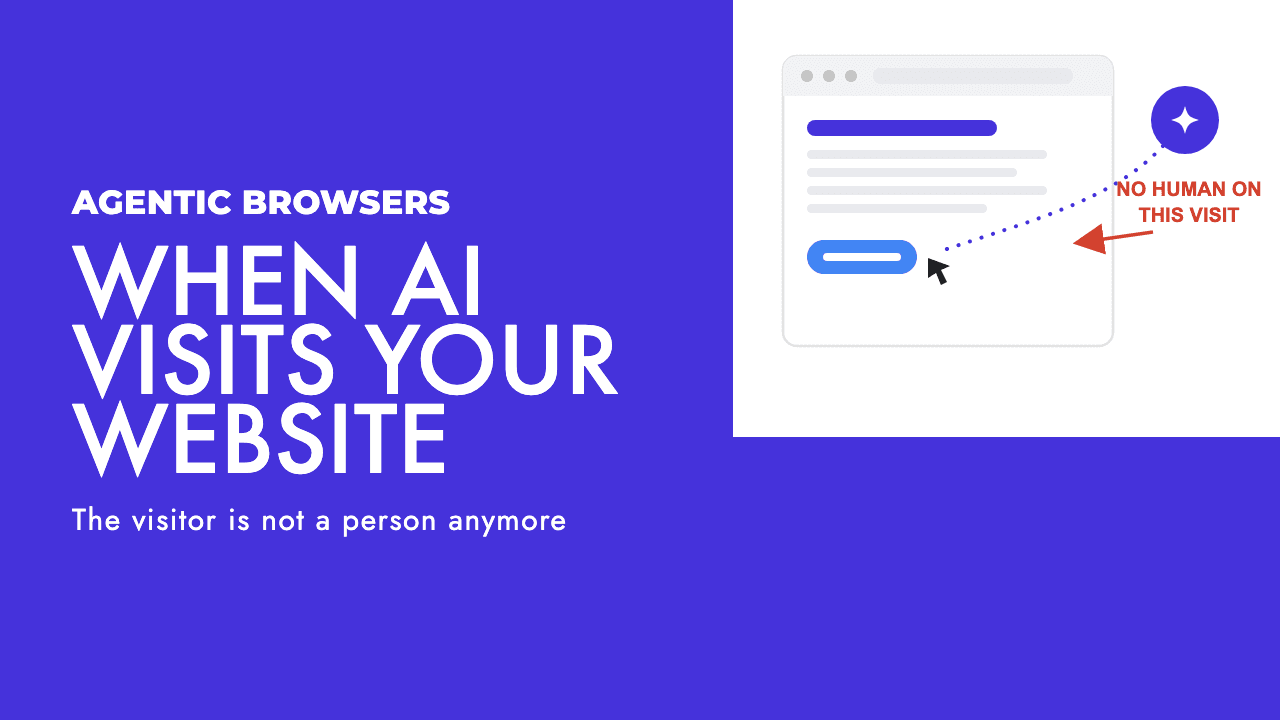
There is a new visitor on your website, and it does not read the way a person does. It lands on a page, scans the structure, clicks the button it needs, fills the form, and leaves. It does not see your hero image or your carefully written headline. It is an AI agent, browsing on behalf of a human who never opened your site.
This is the shift agentic browsers bring. OpenAI's ChatGPT Atlas and Perplexity's Comet are not search boxes bolted onto a browser. (Update, September 2026: OpenAI retired Atlas on 9 August and moved its agent mode into the ChatGPT desktop app and a Chrome extension. The behaviour described here has not gone away, it has changed address. Details at the end.) They can take an instruction like "find me a plumber in Limassol with good reviews and book the earliest slot" and go do it, moving across sites, reading pages, and acting on them without the user watching each step (Practical Ecommerce).
For most of the last two years the AI conversation in SEO has been about the answer layer: AI Overviews and ChatGPT summarising your content so the user never clicks. That is real, and we have written about it. The agent layer is different, and most businesses have not thought about it at all yet.
The three ways an AI can now come between you and a customer
It helps to separate what is actually happening, because "AI is changing search" gets used to mean three very different things.
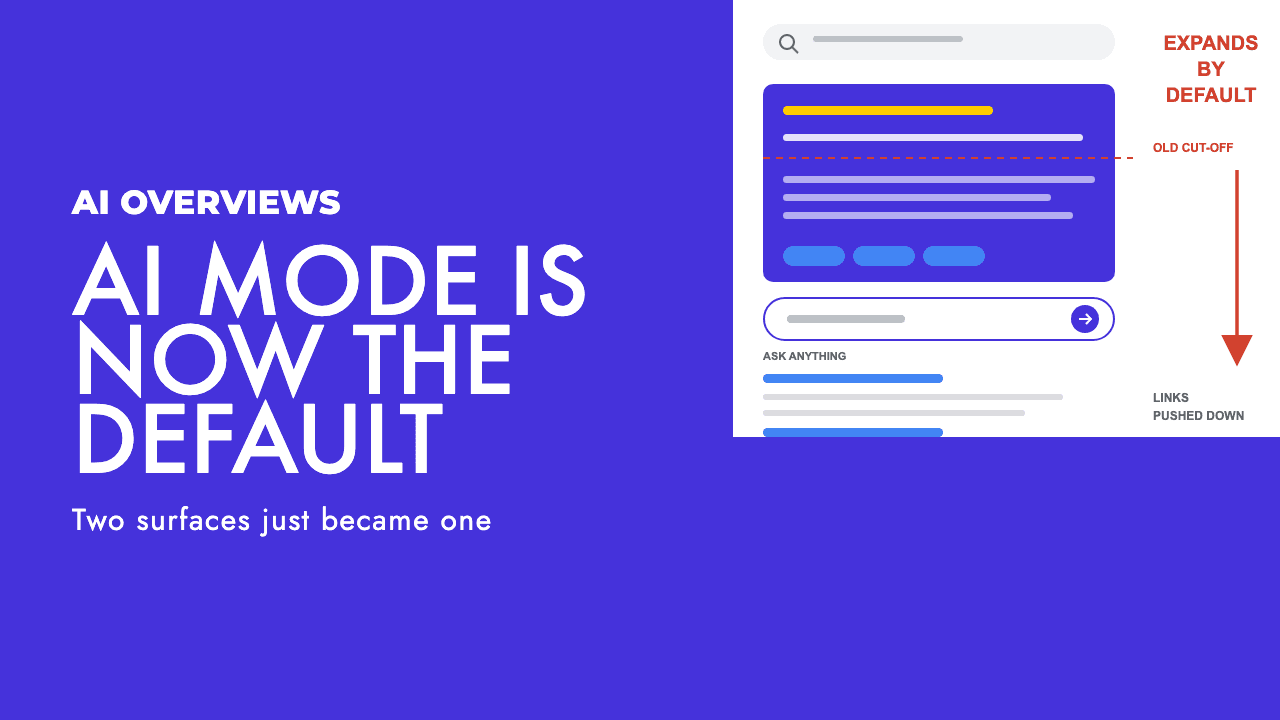
The answer layer. The AI reads your content and answers the question itself. The user gets what they need without visiting. This is AI Overviews and the classic zero-click problem.
The agent layer. The AI does not just read. It clicks, scrolls, fills out forms, and completes tasks on your site as if it were a user. The person gave one instruction and the agent handled the rest. Google has since taken the same idea off the web entirely, with an AI that phones local businesses for quotes.
The app layer. The AI skips your website entirely and pulls what it needs through a direct integration or feed. This is what OpenAI built with its shopping partners, where a catalog gets read as structured data rather than a browsed page. We covered that side in our piece on how ChatGPT product discovery actually works, and Google's version is AI Mode acting inside partner apps.
Each layer changes a different thing. The answer layer changes whether you get the click. The agent layer changes what your website needs to be good at once the click arrives. The app layer changes whether your website is even in the loop.
Today the honest picture is that agentic browsing is small. One publishing executive interviewed by Digiday called it "a 3 percent problem," too minor yet to rank among their top worries (Digiday). We think that framing is right for now and dangerous as a conclusion. Three percent is the number you plan around before it becomes thirty.
Why this is not just "another crawler"
Here is the part that trips people up. An agentic browser is not a bot you can spot in your logs and block.
ChatGPT Atlas was built on Chromium and ran inside a normal browser session, and the ChatGPT desktop app that replaced it does the same. When the agent acts on your site, it looks like an ordinary Chrome user, because underneath it essentially is one. Search Engine Land reported that Atlas could even click paid ads in a way ad networks read as a genuine visit, warning that "every AI click on sponsored posts can trigger ad spend just like a real visitor" (Search Engine Land).
The vendors say as much in their own documentation. OpenAI lists ChatGPT-User as the user agent for fetches a person triggers inside ChatGPT, and notes that robots.txt rules may not apply to it because the request came from a user (OpenAI). Perplexity documents Perplexity-User the same way and says it generally ignores robots.txt (Perplexity). The full list of what obeys robots.txt and what does not is in our AI crawlers and robots.txt guide.
Sit with what that means for two things you rely on.
Your analytics get noisier. Some slice of your sessions, conversions, and even ad clicks may now be an agent completing a task, not a person forming an opinion of your brand. The industry does not yet have a clean signal to separate the two.
Your funnel assumptions bend. If an agent can fill your quote form or start a booking, then the polished persuasion on the page matters less for that visit, and whether the form actually works for a non-human matters more.
This is why we treat agentic browsing as a technical and structural question, not a content one. It sits much closer to technical SEO than to copywriting.
Our take: stop optimising only for the eye, start optimising for the parser
Here is our actual opinion, stated plainly.
The winners in an agent-browsed web will be the sites a machine can understand and operate without guessing. Not the prettiest sites. The most legible ones.
For fifteen years we optimised pages for two audiences: the human eye and the search crawler. The agent is a third audience, and it reads more like the crawler than the human. It wants clear structure, honest labels, and a path through a task that does not depend on noticing a subtle visual cue.
We see the gap constantly in audits. A booking button that is a styled div with no real button semantics. A price that only exists as an image. A multi-step form where the "next" control is obvious to a person and invisible to a parser. A human muddles through all of that. An agent stalls, and the task quietly fails on your site instead of a competitor's.
None of this is exotic. It is the accessibility and structured-data work good teams were already meant to do. The agent just raised the stakes on doing it properly.
What to actually do about it
You do not need an "agentic strategy." You need to make your site legible and operable, and most of the list below pays off for human users and traditional SEO too.
Make key actions real, not decorative. Buttons should be buttons, links should be links, and form fields should be labelled. If an agent cannot tell what a control does from its markup, treat that as a bug.
Expose the facts as data, not just pixels. Prices, availability, opening hours, locations, and service details belong in structured data and readable text, not locked inside images or scripts that only render after interaction. Our Local Business and Product schema generator will write that markup as valid JSON-LD. This is the same discipline that helps you get cited by AI answers in the first place.
Test your critical path headless. Can your booking, quote, or contact flow be completed without a mouse and without visual cues? If your dev team cannot walk a task through cleanly in a stripped-back session, an agent will not either.
Keep your feeds and listings clean. For product and local businesses, the structured feed is increasingly the thing being read. Stale or thin data is how you get skipped at the app layer entirely. The lightweight version of the same idea is an llms.txt file pointing at your key pages, kept current rather than shipped once and forgotten.
Do not try to fake human traffic detection yet. Blocking is a blunt instrument right now. The IAB Tech Lab's Anthony Katsur has told publishers he would not let Atlas or Comet at his content, suspecting the browsers are a way to crawl a site through the user's session (Digiday), and that is a fair worry, but it is a decision to make with data, not on instinct. Watch your logs, understand who is arriving, and make blocking decisions deliberately rather than in a panic. When you do decide something should be blocked, write the rule explicitly with a robots.txt rule generator instead of pasting a user agent list you have not read.
Update, September 2026
OpenAI announced on 9 July that it was retiring Atlas, and the browser stopped working on 9 August, less than a year after its October 2025 launch (TechCrunch, The Register). OpenAI's own line was that the browser is a feature rather than the destination, and the agent mode moved into the ChatGPT desktop app, which now has a built-in browser and a cloud-hosted browser for agents, plus a ChatGPT extension for Chrome.
Perplexity went the other way and kept building the browser: Comet is Chromium-based, free, and on Windows, macOS, Android and iOS, with the iPhone version arriving in March 2026 (Wikipedia).
For your site the practical picture is unchanged. The agent still arrives inside a real Chromium session, still looks like a person in your analytics, and still needs the same legible markup and working flows described above.
The strategy underneath has not changed
If this feels like a lot of new rules, here is the reassuring part. Google's own consolidated guidance this year landed on a blunt message: there is no separate AI search strategy, and the fundamentals still hold (Google Search Central). The same guide points sites that care about agents to a short agent-friendly website best practices guide on web.dev, which is worth the ten minutes.
We agree, with one addition. The fundamentals now include being readable by things that are not human. Clean structure, honest data, working flows, and clear semantics were always good practice. Agentic browsers just turned them from a nice-to-have into the difference between a task that completes on your site and one that does not.
For businesses in Cyprus and the US, the practical move is unglamorous and worth doing now while it is still a 3 percent problem. Audit your most important flows the way a machine would experience them. If you want a second pair of eyes on where your site would trip an agent, that is exactly the kind of thing our website audits and AI search optimisation work is built to catch, and you can start with a free SEO review.
The visitor changed. Your job is to make sure that when it arrives, it can actually do what it came to do.