
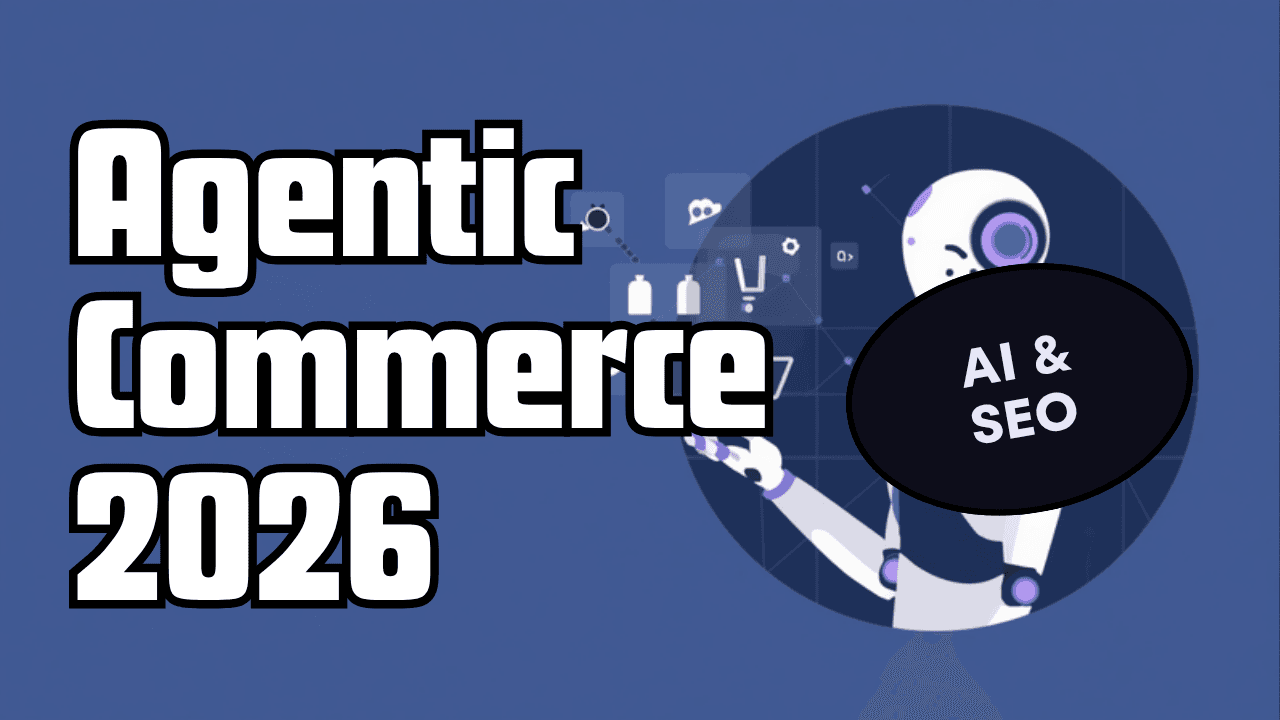
For two decades the person you optimised for was a human with a mouse. They typed a query, scanned a page of links, clicked, and decided. In 2026 a second kind of visitor is showing up, and it does not scan anything. It reads. An AI agent lands on your product, parses the structured data, checks the price and stock, compares you against four competitors in parallel, and either adds you to a basket or moves on. No scrolling, no hero image, no clever headline. Just data, weighed in milliseconds.
This is agentic commerce, and the noise around it is hard to ignore. Every major platform has shipped something with "agentic" on the label in the past year, the card networks have written rules for it, and the phrase has started turning up in client briefs. The interest is real. The question, as always, is how much of it is shipping and how much is a conference slide.
We have spent the last few months testing how these agents actually behave on client stores, in both the US and here in Cyprus. Here is the honest read.
What agentic commerce actually means
Agentic commerce is the practice of an AI agent completing part or all of a purchase on a person's behalf. Instead of you searching "best wireless earbuds under 100 euro," reading reviews and buying, you tell an assistant what you want and it does the legwork. It finds candidates, compares specs and prices, and in the more advanced cases, checks out.
This is not a thought experiment any more. Over the past year the major platforms have built the rails. ChatGPT launched Instant Checkout with Etsy and Shopify merchants in September 2025, on an open Agentic Commerce Protocol it co-developed with Stripe, then in March 2026 moved in-chat checkout into merchant apps while keeping the protocol and the product feeds. Google started rolling out agentic checkout in Search and AI Mode for US merchants in November 2025, the surface we cover in our AI SEO work and our Google AI Mode playbook, where the search itself can carry a buy action. Perplexity picked PayPal to power checkout inside its answers. The payment networks moved too: Visa Intelligent Commerce and Mastercard Agent Pay both launched in April 2025 to let agents pay with tokenised credentials. When the card schemes start writing rules for bots paying for things, the trend has left the slideware stage.
So the plumbing exists. What is still early is adoption. Most people are not yet handing their wallet to an agent for anything past a low-risk reorder. Our own view is that 2026 is the year of agent-assisted research and the first cautious purchases, not full autonomy. The buyer still wants the final say on anything that matters. That gap is exactly where the opportunity sits, because the agent is already shaping the shortlist long before the human approves it.
How an agent actually picks a product
This is the part that changes the work. A human forgives a messy page. They will squint past a missing spec, infer the size, trust a brand they recognise. An agent does none of that. If the data is not explicit, machine-readable and consistent, you are invisible to it, no matter how good your photography is.
From what we have seen, agents lean on a handful of signals when they assemble a shortlist:
- Structured product data. Clean, complete product structured data is the single biggest lever. Price, availability, GTIN, ratings, shipping, returns. Google's own documentation has spelled this markup out for years, and the agents read exactly these fields. Half-filled schema is the new broken page. If you are starting from nothing, our schema markup generator will get the basic Product fields in place.
- Feeds that match reality. The agent often pulls from a merchant feed, not your live HTML. If your feed says in stock and the page says sold out, you do not get a polite warning, you get dropped. Feed hygiene has gone from a paid-ads chore to a core ranking input.
- Corroboration it can find elsewhere. Agents cross-check. A product that is reviewed on third-party sites, discussed in forums and cited in roundups reads as real and safe. One that exists only on your own domain reads as a risk. This is the same off-site authority logic that already drives AI search visibility, pointed at a checkout.
- A page a bot can reach. If your specs load through JavaScript the agent does not execute, or your key content sits behind an interaction, it never sees them. We still find stores blocking the very crawlers they want to win, which is why we keep banging on about AI crawlers and robots.txt. Our robots.txt tester shows you whether GPTBot, ClaudeBot and the rest are allowed in.
Notice what is not on that list. Brand storytelling. Above-the-fold persuasion. The carousel. None of it reaches the agent. It is not being rude, it simply cannot use any of it.
Where we think the hype is running ahead of reality
We are not in the camp that says everything changed overnight. A few things are worth saying plainly, because the agentic commerce pitch is getting loud and some of it does not survive contact with a real store.
First, most purchases are still human. When OpenAI pulled checkout out of the chat, Forrester's analysts pointed out that completing a purchase inside an answer engine is the least-adopted thing regular users do with one. Curiosity is high but habit has not formed. People are experimenting, not delegating.
Second, agents are conservative by design. They favour what they can verify. In practice that means established products with deep review histories and clean data win the agent's pick, and new or thinly documented products struggle. If you are a smaller brand, the agent is not your shortcut to fairness, it is another gate. The way through it is the unglamorous work of content depth and entity-building, not a magic schema tag.
Third, "agentic SEO" as a productised service is mostly a rename. The label is new and the work underneath it is not, which is usually the shape of a term looking for a market. Optimising for agents is, underneath, the same job we made the case for with answer engine optimization: be genuinely useful, be technically clean, be trusted off your own site. New buyer, old fundamentals.
What this means if you sell things online
If you run an ecommerce site, the practical takeaways are less dramatic than the headlines and more demanding than they sound.
Get your structured data complete, not just present. Audit your product feed against your live inventory until the two never disagree. Make sure every spec a buyer might filter on exists as text a machine can lift, not baked into an image. Earn reviews and mentions on places the agent already trusts, because corroboration is what turns a candidate into a pick. And check, properly, that the new wave of AI crawlers can actually fetch your pages. This is the bones of technical SEO and ecommerce SEO, done with a bot reader in mind rather than only a human one.
The shift is not confined to the US either. Google has switched AI Overviews on across European markets, and we have written up what the AI Mode rollout means for Cyprus businesses. We read it the way we have argued before: people are not searching less, they are searching differently, and smaller markets get the change a beat after the US rather than escaping it. Planning as if your local market is immune is the most expensive mistake on this list.
Our take
Agentic commerce is real, it is early, and it rewards the same discipline good SEO always has, just with less room for fudge. The agent is a literal reader. It will not be charmed, it will not infer, and it will not give you the benefit of the doubt. That sounds threatening, but we think it is mostly clarifying. The stores that win the agent are the ones that already had their data, their feeds and their off-site reputation in order. The ones that lose were getting away with gaps a human reader was kind enough to overlook.
So we are not telling clients to chase a new acronym or buy an "agentic" tool. We are telling them to make their store legible to a machine that buys, because that machine is going to do more of the choosing every quarter from here. If you want a clear-eyed look at where your product data and AI visibility actually stand, that is the kind of thing we dig into in a free SEO review, no agent required.
Update, September 2026
The two biggest platforms have gone in opposite directions since spring. OpenAI retired Instant Checkout in March, about six months after launch, and now routes purchases through merchant apps inside ChatGPT with the Agentic Commerce Protocol left in place as the plumbing. Its developer docs still ask merchants for a daily refreshed product feed with identifiers, pricing, inventory and fulfilment fields, which is the part that decides whether you show up at all. We cover that side in our guide to ChatGPT product discovery and feed optimisation.
Google kept building. It published the Universal Commerce Protocol in January with Shopify, Etsy, Wayfair, Target and Walmart, announced Universal Cart at I/O in May (one basket across Search, Gemini, YouTube and Gmail, US first, with the brand staying merchant of record), and on 27 August extended UCP checkout to hotel bookings inside AI Mode with ten partners. All of it is US-only for now. Our Universal Cart post has the detail. The advice above has not moved: whichever agent wins, the feed and the structured data are what it reads.