
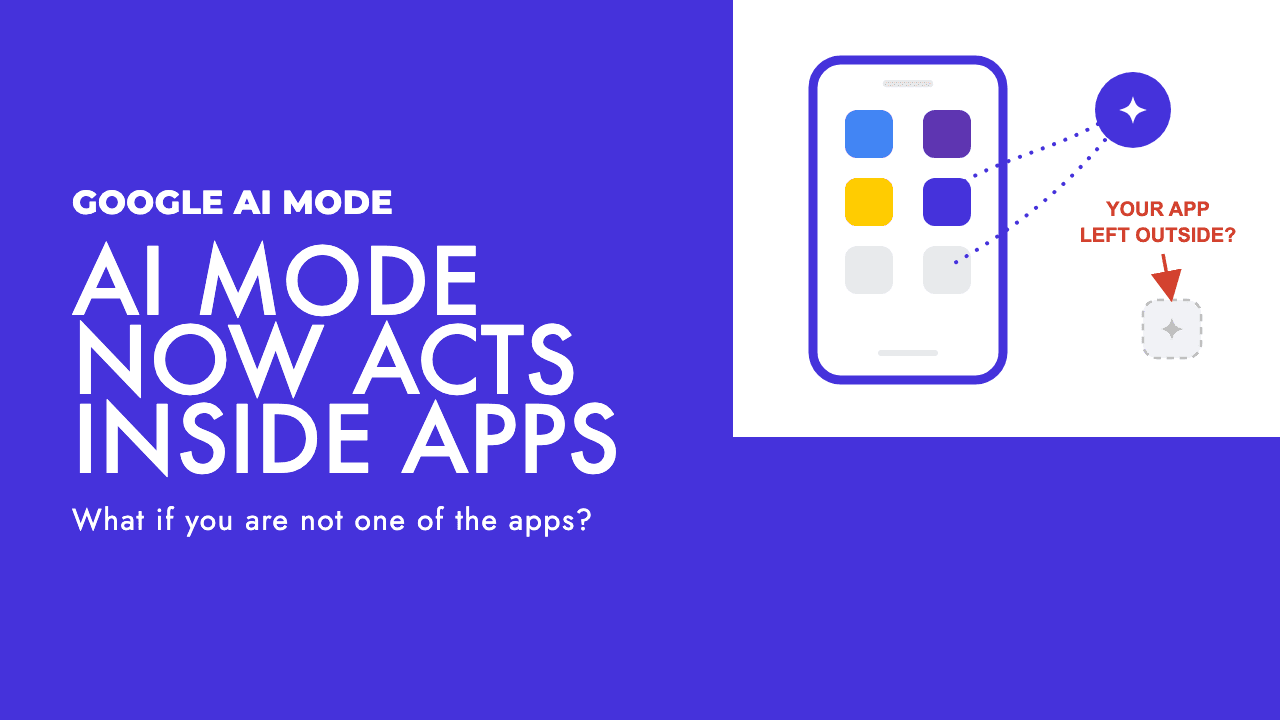
On July 16 Google gave AI Mode a new power. It can now reach into a small set of apps and finish a task for you, not just tell you how to do it. You can ask it to turn a recipe into an Instacart basket and check out, pull up a Canva template for a project, or build a playlist and save it to YouTube Music, all without leaving the search box (TechCrunch).
Three apps at launch. Instacart, Canva, YouTube. US only for now. It is easy to file this under "neat feature" and move on. We think that would be a mistake, because of what it signals about where search is heading and, more importantly, who gets to be in the room when it gets there.
What actually changed here
For its entire history, search has been a directory. You asked, it pointed, you left to go do the thing somewhere else. The whole discipline of SEO grew up around winning that hand-off, the click that sends someone from Google to you.
App actions break that pattern. The task now completes inside Google's surface. The user never lands on a website at all, because the doing happens in a connected app that Google talks to directly through an integration.
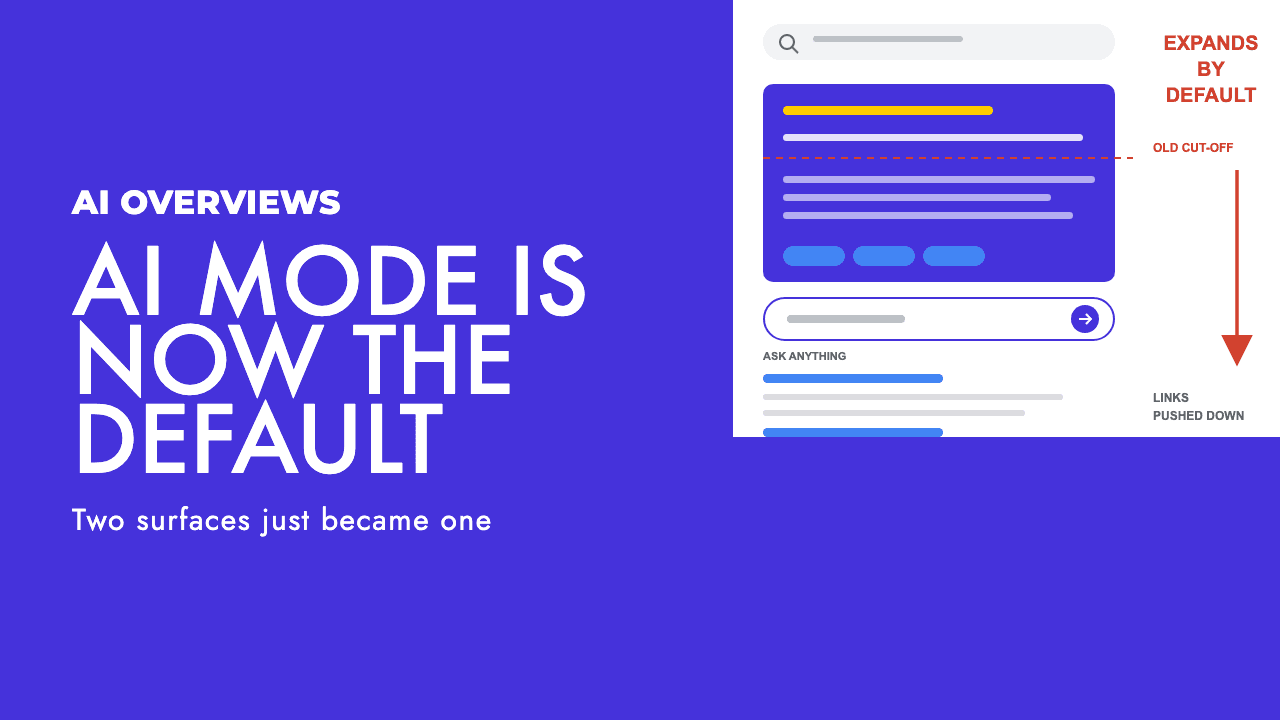
This is a different beast from the shifts we have already written about. The answer layer, where AI Overviews reads your content and replies so nobody clicks, is one thing. An agentic browser like ChatGPT Atlas or Perplexity Comet driving a normal browser across your actual pages, which we covered in what happens when an AI agent visits your website, is another. This is a third: Google building a private set of pipes into chosen partners, so search can perform the action itself.
Google framed the broader direction at I/O 2026, positioning AI Mode as an agentic surface that gets things done rather than a list of links (Google). App actions are the first consumer-visible piece of that agenda.
The part nobody is saying out loud: the partner list is the product
Here is our actual take, stated plainly.
The feature is not the story. The list is the story. Instacart, Canva and YouTube did not earn their slots through good SEO. They earned them through a business relationship and a technical integration that Google chose to build, with a partner Google chose to work with.
That is a real departure. Organic search, for all its flaws, was a meritocracy of a kind. Publish the best answer, structure it well, earn the links, and you could rank next to a giant. The action layer does not work like that. You cannot optimise your way onto a partner list you were never invited to. Google has said it is "working with a range of partners" and will add more apps, but that is an invitation Google extends, not a ranking you climb (TechCrunch).
So if you run a business in Cyprus or the US and you are watching this, the honest first question is not "how do I get in." For almost everyone, the answer to that is "you do not, not this year." The useful question is "what does this change about the ground I already stand on."
What it changes for a business that is not a partner
Three things, in rough order of how soon they matter.
Category by category, the do-it-here surface expands. Groceries, design, music today. Restaurant bookings already work this way through a different pipe, with AI Mode reserving tables via partner platforms in the US and, since April, eight booking platforms in the UK. It does not take much imagination to see local services, ticketing and appointments follow. If your category becomes an action inside AI Mode, the click you used to compete for gets absorbed. Worth knowing which of your money queries are most exposed to that, so it is not a surprise.
Your data becomes your entry ticket, long before any partnership. Every one of these integrations runs on clean, structured, machine-readable data. Google is not scraping Instacart's homepage. It is reading a feed. The businesses that eventually get pulled into action surfaces will be the ones whose product, price, availability and location data is already impeccable and accessible. That work is not speculative. It is the same technical SEO foundation that already decides whether AI systems can trust and use your information. Google's own guidance on AI features asks for nothing exotic, just pages that are indexable and crawlable, with structured data that matches the visible text (Google Search Central).
The website stops being the only front door, so it has to be the best one. When some tasks complete elsewhere, the visits you do get become more valuable and more intentional. Those are people who chose you over the frictionless option. That raises the bar on what your site does once they arrive, and it makes the difference between being merely listed and being genuinely chosen.
What we would actually do about it
We are not telling anyone to panic over a three-app feature in one country. We are telling you to read it correctly and prepare for the version of it that reaches your category.
Get your structured data honest and complete. Not decorative schema for a rich result, but a genuine machine-readable description of what you sell, where, at what price, and whether it is available right now. This is the single move with the biggest payoff, because it is the prerequisite for every action surface, agent and answer engine at once. It is the core of how we approach AI search optimisation.
Know which of your queries are "do" queries, not "learn" queries. Informational content is fairly safe. The exposed ones are transactional, the searches where a user wants to complete something. Those are the ones an action layer eats first, and a keyword research tool that flags intent makes that split quick to do.
Build for the visit you still get. If fewer clicks arrive but they are warmer, your conversion path, your proof, and your reasons to choose you matter more than ever. We wrote about this same pressure from a different angle in our piece on Google's search agents, and the conclusion holds here: the businesses that win are the legible, trustworthy, well-structured ones, not the loudest.
And keep it in proportion. This connects to the broader agentic shift we have been tracking, including what AI shopping agents mean for commerce and Google generating tools directly inside Search. None of it is a reason to abandon the fundamentals. All of it is a reason to make the fundamentals genuinely good, because every new layer Google adds reads the same clean data underneath.
Update, September 2026
The next category arrived faster than we expected, and it was travel. On 27 August Google started rolling out hotel booking inside AI Mode in the US, with Booking.com, Expedia, Hilton, Marriott, IHG, Choice, Wyndham, Priceline, Hotels.com and Trip.com as launch partners; you pick a hotel, tap "Continue on Google" and pay with Google Pay without leaving the answer (Google). The partner stays the merchant of record and handles customer service (PPC Land), which is exactly the shape described above: the seat at the table goes to whoever has the integration, and independent hotels are not on the list. At the time of writing we have not seen Google announce further connected apps beyond the launch three. If you run a hotel, our hotel SEO page covers where the organic ground still is.
The honest bottom line
Google AI Mode doing your grocery shop is a small feature with a large message. Search is quietly becoming a place where things get done, not just found, and the first seats at that table went to partners, not to the best-optimised pages.
You probably cannot buy or earn a seat this year. What you can do is make sure that when the action layer reaches your category, your business is the obvious, well-structured, trustworthy candidate to plug in, and that the customers who still visit you directly find a reason to stay.
If you want a clear read on which of your queries are most exposed and whether your data is ready for what is coming, that is exactly what a free SEO review is for.