
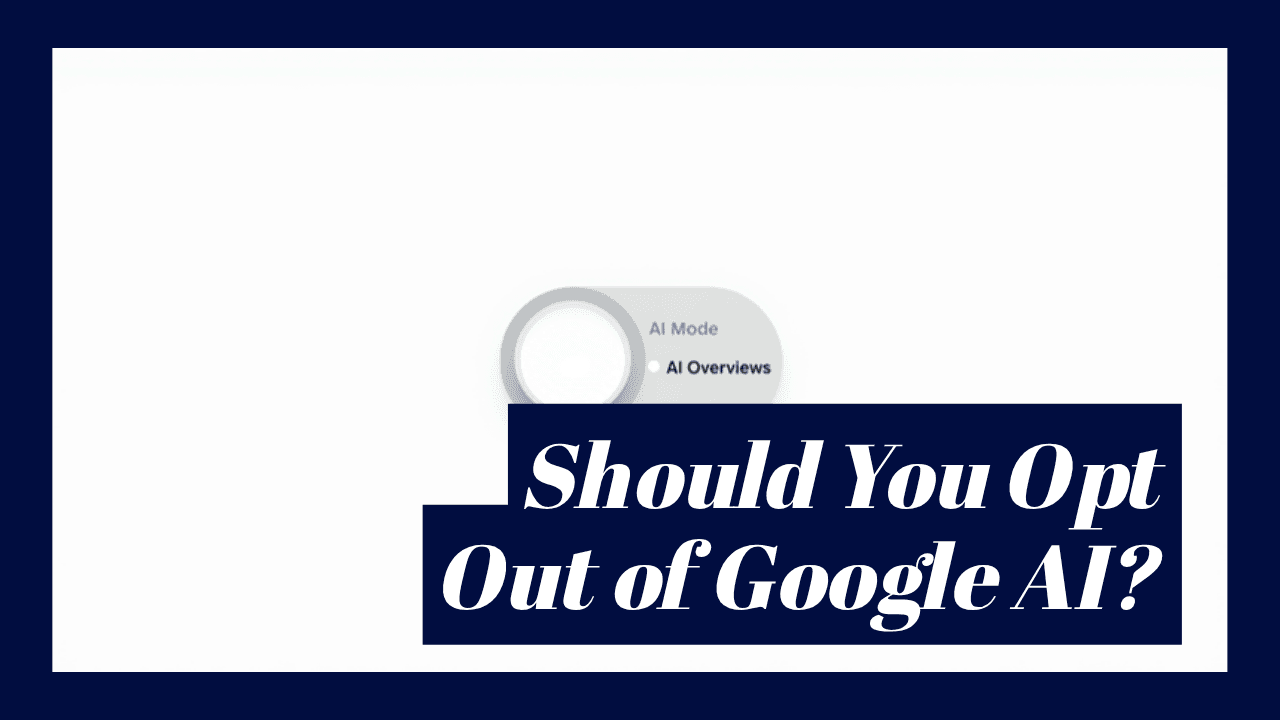
You can now switch your website off in AI search. Google built the button, it is sitting inside Search Console, and for a lot of business owners it looks like the answer to a problem they have been losing sleep over.
Resist it.
On June 3, 2026, Google began rolling out a toggle that lets website owners opt out of appearing in AI Overviews, AI Mode, and AI Overviews in Discover. The headline reassurance is the one everyone latched onto: flipping it does not touch your normal search rankings. You stay indexed, you keep ranking in the blue links, you just vanish from the AI answer (Google Search blog).
Here is our read on what this switch actually is, who it was built for, and why we would tell almost every business in Cyprus or the US to leave it alone.
This is a regulation story, not an SEO feature
The first thing to understand is why this button exists at all. Google did not wake up feeling generous toward publishers.
The UK's Competition and Markets Authority designated Google with Strategic Market Status in September 2025, and on June 3 it imposed a Publisher Conduct Requirement under the Digital Markets, Competition and Consumers Act. The opt-out toggle is Google's first move to comply. It launched UK-first, to a subset of UK website owners, with the wider legal obligations becoming binding in December (ppc.land). The UK test phase is now over: as of 31 August 2026, Google says the control has rolled out to all websites worldwide, so this is a decision every site owner can now make, not just British publishers.
That context changes how you should read the feature. It is not a growth tool Google designed to help you win. It is a concession extracted by a regulator on behalf of news publishers who argued, with some justification, that AI Overviews were summarising their journalism into zero-click answers. The button was built for them. Whether it fits your business is a separate question, and for most it does not.
What the switch actually does, and does not do
Before anyone flips anything, look at how blunt this control is.
It is domain-level only. You cannot opt out a single thin page or a section you would rather keep out of AI answers while leaving the rest in. It is all or nothing across your whole site. Page-level controls were promised, but Google's accepted timeline does not bring those in until March 2027 (ppc.land).
It is also leaky. The toggle covers AI Overviews, AI Mode, and AI Overviews in Discover. It does not cover the standalone Gemini assistant, which the CMA order treats as a separate obligation. And it does nothing at all outside Google. ChatGPT, Perplexity, Copilot, and every other answer engine carry on exactly as before. You have switched off one room in one house while the rest of the street stays lit.
So the mental model of "I'll remove my content from AI search" is wrong. What you can actually do is remove your content from three Google surfaces, domain-wide, with no granularity, while staying fully visible in every other AI tool people use. That is a much narrower and stranger thing than it first sounds.
Why opting out is self-harm for most businesses
Here is our opinion, stated plainly: for the overwhelming majority of businesses, flipping this switch is choosing to be invisible where attention is moving.
AI Overviews now reach more than 2.5 billion users a month, and AI Mode has passed a billion of its own (Google Search blog). When someone asks a question about your category, that answer is increasingly the first and sometimes only thing they see. Being cited inside it is the modern version of ranking on page one. Opting out does not protect that position. It forfeits it.
Think about who actually uses AI Mode for your kind of business. A traveller asking which beach restaurants in Limassol take walk-ins. A US founder asking which agency handles international SEO. A homeowner asking what a roof repair should cost. These are commercial questions, and the AI answer is where they get decided now. Pull yourself out and a competitor fills the slot you vacated. The user never knows you existed, because you told Google not to mention you.
The publisher logic does not transfer. A news site lives on the click, and an AI summary that answers the question kills that click. A restaurant, a law firm, a SaaS company, a B2B supplier, those businesses want to be the recommendation. For them a citation inside the answer is the goal, not the threat. We see this constantly: the businesses winning right now are the ones a model trusts enough to name, and you cannot be named if you have opted out.
The narrow cases where it might make sense
We are not saying the button is useless. There is a real list of sites it was built for, it is just short.
If you are a subscription news or research publisher whose whole model depends on people landing on the article, and you can show AI summaries are cannibalising those visits, the trade-off is at least worth modelling. If you hold genuinely proprietary content, original data, paid reports, members-only analysis, that you do not want lifted into a free answer, the switch gives you a lever you did not have before. If you operate under a contractual or legal obligation to keep certain content out of third-party AI, this is now a documented way to do it.
Even then, weigh it carefully. The toggle is domain-wide, so opting out your premium reporting also opts out your homepage, your about page, and every commercial query you would happily be cited for. Until page-level controls land in 2027, that is a heavy price.
What we would do instead
The instinct behind opting out is usually fear: AI is taking my clicks, so I will take my content back. We understand it. We think it solves the wrong problem.
The clicks are not coming back by hiding. They are won by being the source the model reaches for, which means the work has not changed as much as the panic suggests. Tight topic clusters. Direct answers near the top of the page. Named authors and real proof. Clean, structured product and service information a machine can lift a sentence from and trust. That is what earns the citation, and it is the opposite of disappearing. Our take on structuring content so LLMs cite you and our practical guide to showing up in AI Overviews both come back to the same point.
While you are in Search Console looking at the toggle, look at the report next to it instead. Google now shows you how often your pages appear inside AI features, which is the number that actually tells you whether you are winning here. We broke that down in how to read Google's new AI Overviews report. Spend your energy moving that number up, not switching yourself off.
The bottom line
Google handing you an off switch for AI search is not the same as that switch being good for you.
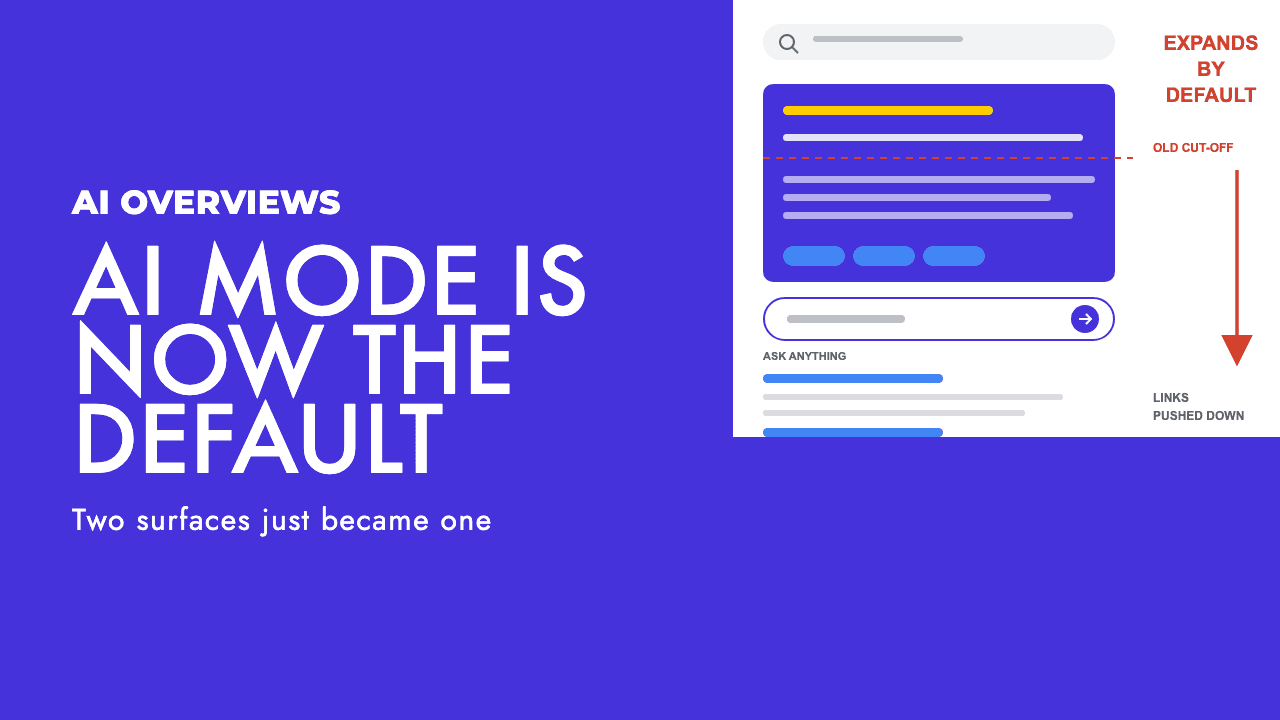
It is a regulatory concession, built domain-wide and Google-only, that suits a small group of subscription publishers and almost no one else. For a business in Cyprus or the US trying to be found, flipping it trades visibility in the fastest-growing part of search for protection against a problem you probably do not have. And since Google started expanding AI Overviews into full AI Mode answers on its own in late August, the surface you would be walking away from has only got bigger.
If you are genuinely unsure which side of that line your business sits on, that is a real strategy question and worth getting right before you touch anything. Our AI search optimization work starts exactly there, and a free SEO review will show you whether you are being cited inside AI answers today, which is the only honest place to start the decision from.