
Most of the panic about AI Overviews treats search as one undifferentiated thing that is quietly being eaten. It isn't. The interesting story in the data right now is not "AI Overviews are taking your clicks." It's which clicks they take, and which ones they leave completely alone.
Here is the divide, and it should change how you spend your effort. AI Overviews have made themselves at home on top of research queries. They have almost entirely stayed out of the way of buying queries. If you treat those two as the same problem, you will pour work into the wrong pages.
What the intent split actually looks like
Seer Interactive tracked 5.47 million queries and 2.43 billion organic impressions from January 2025 through February 2026. Their AI Overview CTR analysis found AI Overviews appearing on about 36% of informational queries, roughly 8% of commercial queries, and just under 5% of transactional ones. That is a 7x gap between the top and bottom of the funnel.
The breakdown inside the informational bucket tells the same story from a different angle. Seer found comparison queries showing an Overview 95.4% of the time and question-format queries 85.9%, while single-word informational searches sat at 27.3%. The AI answer wants to help you decide. It rarely wants to stand between you and the checkout.
So the honest summary is this: AI Overviews own the top of the funnel and leave the bottom mostly intact. The research phase, where someone is comparing, learning, and shortlisting, is where the answer box now lives. The transactional query, where someone already knows what they want, still sends a clean click to a real page.
Why this happens, and why it will hold
This is not an accident of rollout timing. It is what the model is good at.
Research queries are exactly the kind of thing a generative summary handles well. "What is the best CRM for a small law firm" has a defensible synthesized answer. Pulling three options together and explaining the tradeoffs is genuinely useful, and Google can do it without much risk of being embarrassingly wrong.
A transactional query is different. When someone searches to buy a specific product or book a specific service, they do not want a summary. They want the page. Inserting an AI answer there adds friction and, for commercial queries, real liability if it gets a price or a spec wrong. Google has a strong commercial reason to keep those SERPs clean too, because that is where the ads and the Shopping units earn their keep.
Our take: this divide is structural, not temporary. Expect the research layer to keep getting more AI-heavy and the transactional layer to stay comparatively click-rich. Plan around that shape rather than around a single headline CTR number.
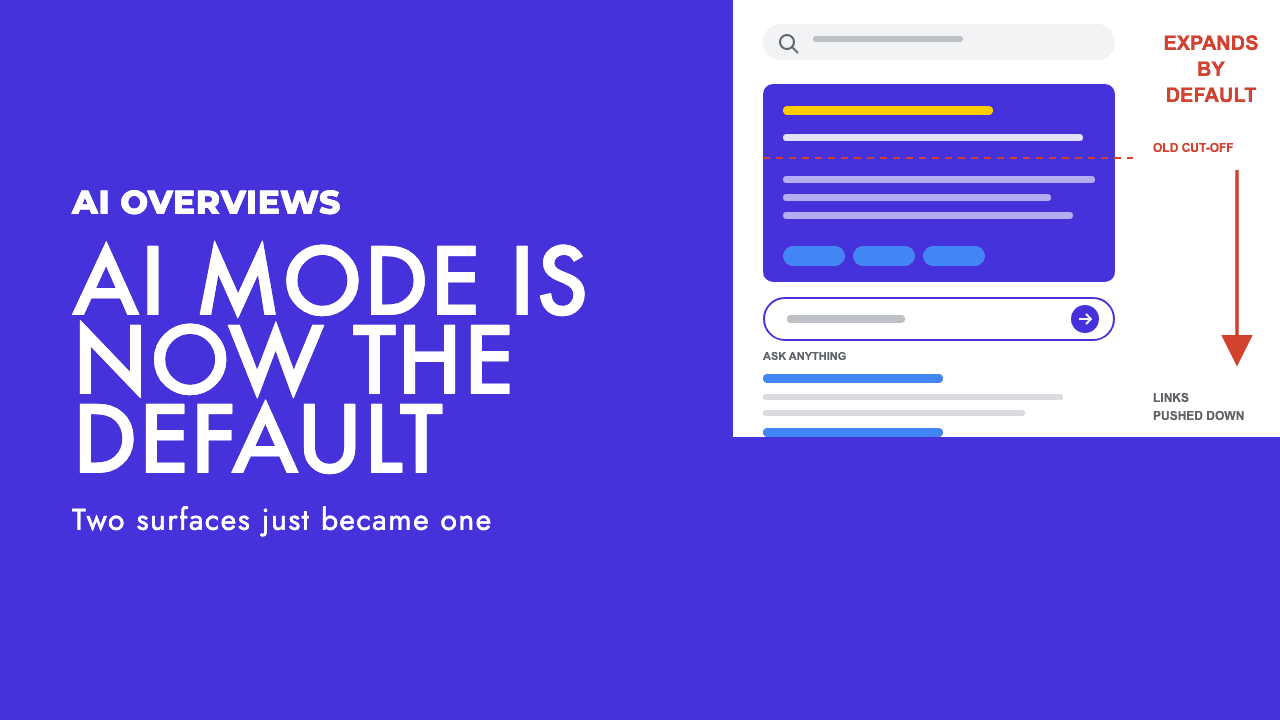
Two later data points back that up. A randomised experiment published in the summer found the click loss from AI Overviews concentrated on informational queries, and that the lost clicks were just as engaged as the ones that stayed. And when Google started auto-expanding AI Overviews into full AI Mode answers at the end of August, the early examples were definitional and informational searches, not local or transactional ones (our read on the expansion).
What this means for your pages
Stop trying to force your product and service pages into AI Overviews. For most transactional queries there is no Overview to be cited in, and chasing one is effort spent on a surface that mostly does not exist for those searches.
Instead, split your thinking by intent, because Google already has.
On research queries, the game is citation, not the click. When an Overview answers "how do I choose an SEO agency in Cyprus," the win is being one of the named, linked sources inside that answer, and being the brand a reader remembers when they later search for you directly. This is where genuine expertise, comparison content, and clear structure pay off. It is the layer we walk clients through in our AI search optimization work, and the mechanics are the same ones covered in our guide on showing up in AI Overviews.
On transactional queries, the game is still the click, so protect it. Your money pages need to load fast, answer the buying question directly, carry clean product or service markup, and remove friction. The traffic that reaches them is more intact than the headlines suggest, which makes conversion the thing worth obsessing over there, not AI visibility.
Build the bridge between the two. The research query is increasingly answered without a visit. That makes brand memory the real prize. If you are the source cited during the research phase, you are the name typed into the search box during the buying phase. That handoff is the whole ballgame now, and it is closely related to the pattern we described in the great decoupling, where impressions climb while clicks flatten.
Google's own guidance backs the boring answer
It is tempting to treat all of this as a reason to buy some exotic new tactic. Google is telling you not to.
In its AI optimization guide, most recently updated in July 2026, Google is blunt: "optimizing for generative AI search is optimizing for the search experience, and thus still SEO." It explicitly says you do not need special markup files, artificially chunked content, or manufactured mentions. The generative features run on the same core ranking and quality systems as everything else.
That lines up with what we see in client work. The sites that get cited in research-query Overviews are the ones that would rank well anyway: real expertise, a clear technical structure, content that says something a summary cannot fully replace. There is no separate AI funnel to optimise. There is your existing content, sorted by intent, with the research layer treated as a visibility problem and the transactional layer treated as a conversion one. If you want the longer version of that argument, we made it in GEO vs SEO.
The practical move for Cyprus and US businesses
For a Cyprus SME or a US small business, the resource question is what matters. You cannot do everything, so do the thing that matches how search now behaves.
Audit your key pages by intent. Our keyword and intent research tool is free to run if you need a list to start from. For the research and comparison queries in your space, invest in content that deserves to be cited and structure that makes it easy to lift. For the transactional queries, stop worrying about AI Overviews that mostly are not there and make the page convert. That is the split, and it is a far better use of a limited budget than reacting to whichever CTR statistic went viral this week.
If you want a second pair of eyes on which of your pages sit on which side of that line, our free SEO review is a straightforward place to start, and we work with businesses through our Cyprus SEO practice, the UK market and the US on exactly this.
The one-line version: AI Overviews took the research, not the sale. Build for both, but stop treating them as the same fight.